


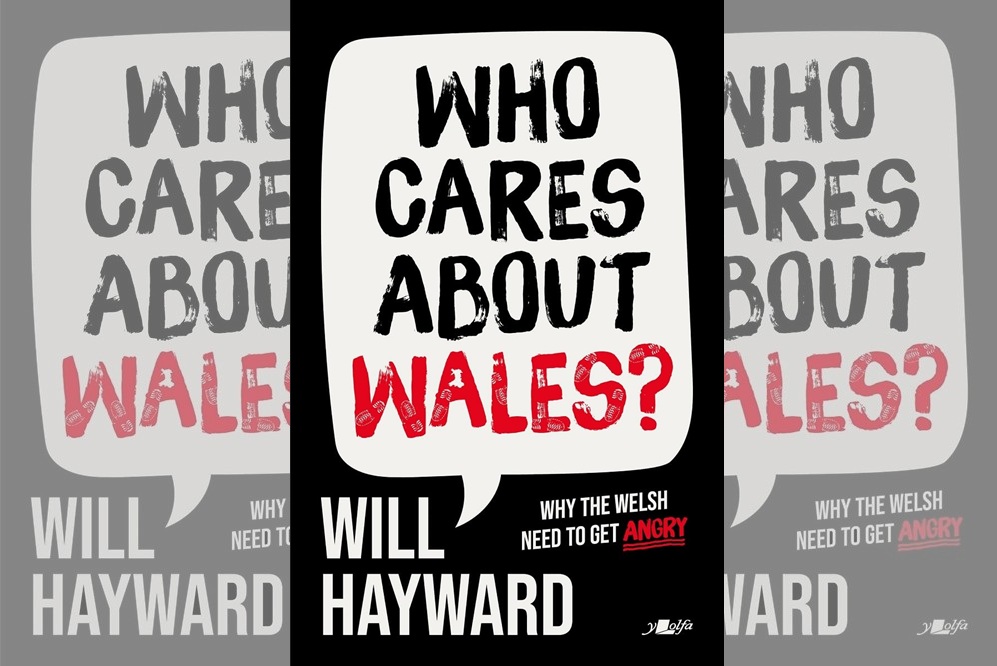
Book review: Who Cares About Wales? Why the Welsh need to get angry by Will Hayward
Desmond Clifford
With the election only weeks away, it’s time to think seriously about the issues. Who’s talking rubbish and who, hopefully, isn’t?
Will Hayward’s “Who Cares About Wales?” fills some of this space and its publication is timely.
He sees the issues through a cloud of indignation and notes no pattern of incremental improvement, only abuse, trickery and scandal.
The most useful chapter explains how the Treasury finances the Welsh Government. The “Barnett Formula” is bizarre and has only flimsy roots in rational policy.
Explanation is not simple, and Hayward properly credits expert help from the Wales Governance Centre.
He acknowledges some improvements negotiated by Welsh Government; as a civil servant, I recall going to the Treasury with Carwyn Jones to meet George Osborne to kick off the process. Can you see Rachel Reeves inviting the Welsh Government in today to discuss Welsh funding?
Will Hayward is critical of Barnett but oddly tentative about its reform, which I don’t understand. The formula is rotten and should be replaced with a needs-based system using current data and revised every three years as part of the Treasury Spending Review.
Conceptually, reform is straightforward enough – but it needs a Treasury willing to do it.
The chapter on the NHS is glum reading. Everyone wants a better health service – don’t they? – but there’s no consensus on what to do. Some issues are resolvable only with more resource, but the NHS already gets a bigger share of Welsh Government spending every single year – that’s one reason why everything else is so cash-starved.
The Welsh Government has positioned itself awkwardly. It both is, and isn’t, in charge of the NHS – a sort of Schrödinger’s Cat arrangement.
The NHS top management sits inside the Welsh Government yet when something operational goes wrong, the Government is keen to create distance. In practice, Ministers can shout at Health Boards but lack an effective menu of sanctions.
Patient experience surveys show many patients are pleased with their care, an aspect of the NHS insufficiently reported.
The cases which go wrong are magnified in media-political coverage, which is fair enough, but can create an unbalanced view of a massive service. Political focus on the big picture and sustainable solutions is elusive. We need attention to delivery now and a vision for the future – both matter – and the answer can’t always be more public money.
For the first decade of devolution, Transport was a backwater with little political profile. Over recent years it has risen steadily up the political ladder.
Oversight
Oddly, “Who Cares About Wales?” doesn’t even mention Transport for Wales, a significant oversight since its work is the biggest single investment in devolution’s history.
It was launched by Carwyn Jones and was arguably his administration’s most important decision. (Not building the M4 relief road was, Covid apart, Mark Drakeford’s most important decision, for good or ill).
Will complains that the Cardiff train to Merthyr takes an hour, as though this is some great policy failure. It takes an hour because it stops (13 times) along the way: it’s a commuter service!
Transport for Wales is slowly making a difference and doing what devolution is supposed to do, building institutions and infrastructure to change Wales for the better.
Hayward is very sound on the Kafka-esque topic of UK railway financing. He describes how railway projects conceived and constructed exclusively in England result in payments to Scotland and Northern Ireland but not to Wales. It’s so stupid and unjust you couldn’t make it up: the Rebecca Riots broke out with less provocation.
The non-devolution of Crown Estate revenues, and policing and justice, are further examples of Wales being treated worse than Scotland and Northern Ireland.
Directionless
I agree with Will Hayward that Culture is a devolution disappointment. The political agenda for culture has been mean, tepid and directionless where it should be expansive and transformational.
The philistine Welsh Government has starved institutions of cash and treats them like charities rather than economic drivers and pillars of national life. The National Museum of Wales, custodian of the nation’s treasures, had to use buckets for its leaky roof while the limp Vaughan Gething shrugged his shoulders.
Our anthem identifies a land of poets and singers, but we have yet to see a Welsh Government match that vision.
Yes, government means tough choices, but comparatively modest investment could transform culture, creating jobs and value in the process. Ireland put culture at the centre of its search for prosperity and profile 35 years ago. The multiplier effect is clear and well-evidenced, and culture is a field of comparative advantage for Wales.
Haywood fairly describes the Welsh Government’s support for Bad Wolf, a tv and film production company, whose outstanding success shows what “win-win” investment can look like. Creative Wales, an arm of the Welsh Government, is doing good work but needs higher priority.
Scandal
Welsh education has, arguably, got worse since devolution, a scandal which receives oddly muted political attention for reasons I’ve never well understood.
Educationalists will say there’s more to it than PISA results, and maybe there is, but results are surely central to any analysis of young people’s life chances. In 2020, every single pupil in a class of 30 at Fitzalan High School in Cardiff achieved A* at Maths GCSE. The teacher is a Welsh national hero in my opinion and his portrait should be painted on city walls.
There are some excellent schools in Wales, and some poor ones. It’s frustrating. Resources are important, for sure, but so are good teachers.
Hayward’s Economy chapter is as gloomy as the others. The capital is reasonably prosperous but much of Wales is sluggish. In the Acknowledgements, Will thanks people who helped inform him, “particularly in the third sector”.
Here’s an interesting subtext. The “third sector” has huge influence on the terms of political debate in Wales. That’s their job and some of them are extremely good it.
The business sector, which generates Wales’ income and wealth, has, with some exceptions, a scrappy and fragmented voice in public affairs. Welsh business should be at the heart of government policy formation. The Welsh Government fawns over trade unions (I wonder why?!) but the business sector should be more demanding of the Welsh Government.
Farming is maybe the only sector which systematically represents its interests with full vigour. Farmers are well-organised, highly networked politically and they work hard to keep issues on the radar. Other sectors could take a leaf from their book.
Money
Part of the mooted answer to every topic raised in Will’s book is more money.
Wales’s budget is fixed and, for reasons Will explains, can’t increase much in any realistic near-term scenario. A sympathetically revised funding formula would inject more money but still nowhere near the expectations outlined here. Our entire political and media culture is built on stimulating expectations which cannot, financially, be met.
Someone somewhere has to pay for things, and that basic realism is often missing from debate.
“To govern is to choose”, is one of the clichés of politics. Trying to keep everyone happy can have the opposite effect. Governments need a strategy with priorities clearly set out and they need to be honest with voters.
As a society we can’t afford everything and governments need to be honest about what, for now at least, they’re willing to live without.
It’s small wonder Wales is static when one party governs continuously. For a quarter century Labour ministers sat pretty with the fair certainty they’d be re-elected. “Why change, the public must like us…?”.
Change now looks likely and let’s hope the dial can be shifted on a few issues.
I agree with much of Will Hayward’s analysis, though occasionally through gritted teeth. His indignation is too ostentatious, and I found myself craving relief from the foghorn.
As an alternative, he might have set out his indignation clearly at the beginning and then let the facts speak. As a result, the book sometimes falls awkwardly between stools, part policy compendium and part polemic.
With tighter editing, it could easily be fifty pages shorter, and he could have included a couple more chapters.
That said, “Who Cares About Wales?” is a bold run over a wide horizon of issues including some which normally struggle for airtime (carers, poverty, housing).
Anyone who reads this will be better informed and better prepared with a bullshit-detector at election time. Will is particularly strong on finance which is a feather in the cap since it’s an arcane and difficult topic.
We need more books, not fewer, on Welsh politics and policies and, as citizens, we have a duty to be informed on issues.
There aren’t lots of people doing what Will Hayward does and I hope this book finds a wide readership.
Who Cares About Wales is published by Y Lolfa and can be purchased here and at all good bookshops.
Support our Nation today
For the price of a cup of coffee a month you can help us create an independent, not-for-profit, national news service for the people of Wales, by the people of Wales.



Will HAYWARD (NOT HayWOOD) hits the spot regularly, while it appears that some elected politicians ignore his work.