
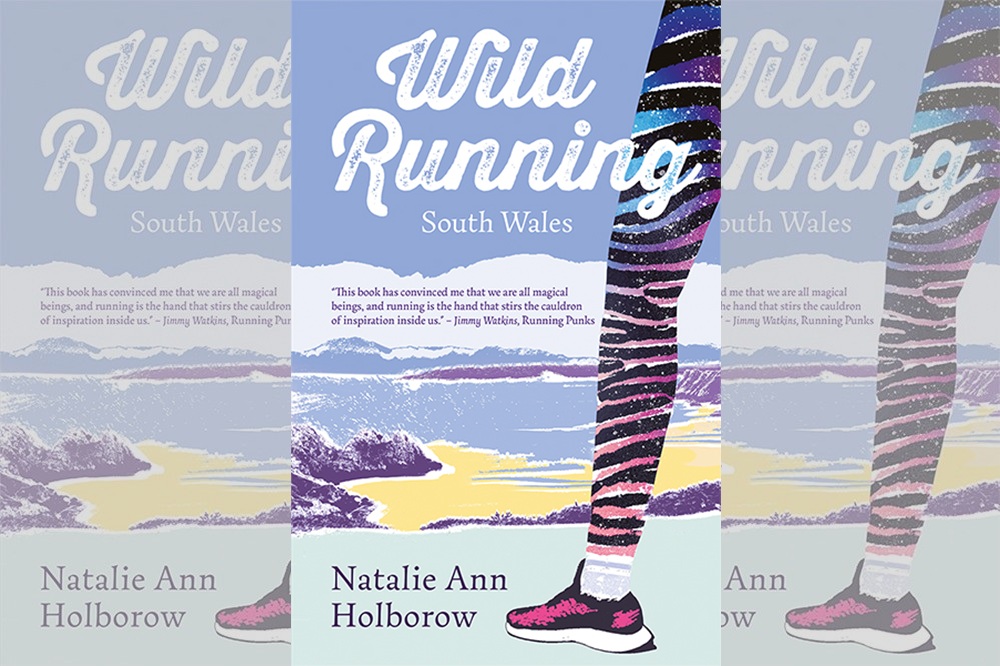
Book review: Wild Running by Natalie Ann Holborrow
Desmond Clifford
Ah, the pain and jealousy – for me – of books about running! I was quite a serious-minded athlete in my twenties. I ran for Aberystwyth Athletics Club, a motley community of die-hards in the mid 1980s.
We used to run out from the university playing field on Llanbadarn Rd through the back yards of farms as far as Capel Bangor and then sprint back into Aber along the A470, a road without lights or footpaths.
We did it in summer light and winter darkness. It was insane and a wonder I didn’t end up as roadkill. Anyway, I can’t even run to the bus stop these days and I miss it so.
I once clocked 10 miles in under 60 minutes. Not quite Guto Nyth Bran, but nifty enough. I thought I might be on the verge of a breakthrough. Alas, it proved a peak rather than a new base level and I gave up competition in favour of running for fun.
I explored cities all around Europe this way and once experienced a Wordsworthian moment of joy when I crested the top of Hergest Ridge, having come up from Knighton and finishing downhill into Hay-on-Wye. I ran round Llyn Tegid, Bala on a crisp autumn day, and along Sarn Helen near Felinfach on a warm summer’s evening. Life rarely feels better.
For such a ubiquitous activity the literature of running is surprisingly small. I don’t mean books of the “from-couch-potato-to-London-marathon” variety; there are plenty of those.
I mean real literature, fiction or non-fiction, stimulated by the properties of running.
Running boom
There’s “Marathon Man” (1974) by William Goldman, better known in its 1976 film form starring Dustin Hoffman and Laurence Olivier. Hoffman played a marathon runner, long before it was fashionable, though running was incidental to the main plot about Nazi gold. However, the film contributed to the New York running boom which eventually crossed the Atlantic and resulted in the British marathon boom.
The literary classic of running is Haruki Murakami’s “What I Talk About When I Talk About Running” (2007) – the title was inspired, of course, by Raymond Carver’s famous collection of short stories.
Murakami’s book is a memoir of his creative life and the relationship, in his world view, between sport and running, “Most of what I know about writing I’ve learned through running every day.”
This comment references Albert Camus’ famous line, “Everything I know most surely about morality and duty, I owe to football” (Camus played in goal for Racing Universitaire d’Alger).
Charles Dickens walked incredible distances most days and would surely be a runner if he lived today.
Running and literature feels like a gap waiting to be filled in and Natalie Ann Holbrow contributes to the field with “Wild Running”.
It’s a hybrid book, with elements of the manual – where to park, nearest coffee shop, how to pace yourself over hilly terrain – combining with history, memoir, contemplation and aspiration.
Favourite running places
She identifies her favourite running places across South Wales (all of them nicer than running in the dark to Aberystwyth; why didn’t we just run along the Prom?).
We go as far west as Oxwich, as far north as Pen-y-Fan, and as far east as glorious Tintern Abbey. Tintern has rich associations with poets: Wordsworth was motivated by romantic beauty, Holborow was pumped with serotonin; Allen Ginsberg was on LSD.
As well as providing pointers for runners, the author takes in some history, flora and fauna, and contemplations.
With the real runner’s authenticity, she engages those favourite and unifying topics among all runners everywhere – the running shoe and injuries. What shoe to wear and in what circumstances; nothing preoccupies the serious runner more.
Do you wear the racing shoe for lightness and speed? Or does pragmatism come first, and should you sacrifice speed for clunky grip through the mud? It’s a human version of the Formula 1 dilemma but running allows no pit stops. Then there’s the practicality of getting into a car to go home with mud-caked shoes. There’s more to think about that you’d imagine.
Holborow is an agreeable companion as she guides us along her favourite trail runs.
Sometimes she runs alone, and contemplation is her companion, and sometimes she has company.
Diabetes
She manages a diabetes condition and talks about this openly. She wondered whether to refer to it at all, but I’m glad she does. It adds to the book’s authenticity and sense of fullness.
In practical terms, it helps runners, actual or prospective, understand that some medical conditions don’t necessarily exclude running so long as they’re planned for, and medical advice is followed carefully. The remarkable British Olympic sprinters, sisters Lina and Liviai Nielsen, both manage their careers with multiple sclerosis diagnoses.
Holborow is a poet and brings this eye to her observations. In the early morning at Merthyr Mawr she notes, “Daffodils flare along the verge like little yellow candles.” Given that she’s a poet, I wondered whether some poetry might have added an extra touch to the book? What lines, if any, come to her when she’s pushing her body with rhythmic breathing? In fairness, her tiring body may be stimulating entirely unpoetic thoughts!
There is a sense of running as a simple metaphor for life or any committed human activity. As she notes, “You just put one foot (or word) in front of the other and hope it leads somewhere.” Samuel Beckett couldn’t put it any better.
As poets should be, she is appreciative of the unexpected. She is surprised to learn from a running companion that 40% of the workforce at Port Talbot steelworks are women. I’m surprised too; it would never have occurred to me.
Barriers
She has things to say about the specifics of a woman’s experience running. The first modern Olympics were held in 1896 but it was 1984 before the first women’s marathon was held (won by the magnificent Joan Benoit) and as late as 1996 before the full slate of distance events mirroring the men’s competition was scheduled.
She talks about the barriers, psychological and otherwise, which can discourage women’s participation – physical security, sadly, among them – but emphasises the sense of achievement, progress and well-being that can come from running.
Natalie Ann Holborow is a good companion for these trail runs across South Wales. The locations are interesting, as is her commentary, and the good news is you don’t even have to be a runner to enjoy it.
You could walk the course and, if you can’t do that, the text stands up anyway. It’s an interesting account of the creative life as well as the runner’s. We hear of the compromises and complications, the energy expended to stay afloat, the worry about the next publication – will it happen, will it work, will anyone like it? Sometimes life really is about putting one foot in front of the other and seeing what happens next.
Support our Nation today
For the price of a cup of coffee a month you can help us create an independent, not-for-profit, national news service for the people of Wales, by the people of Wales.


