

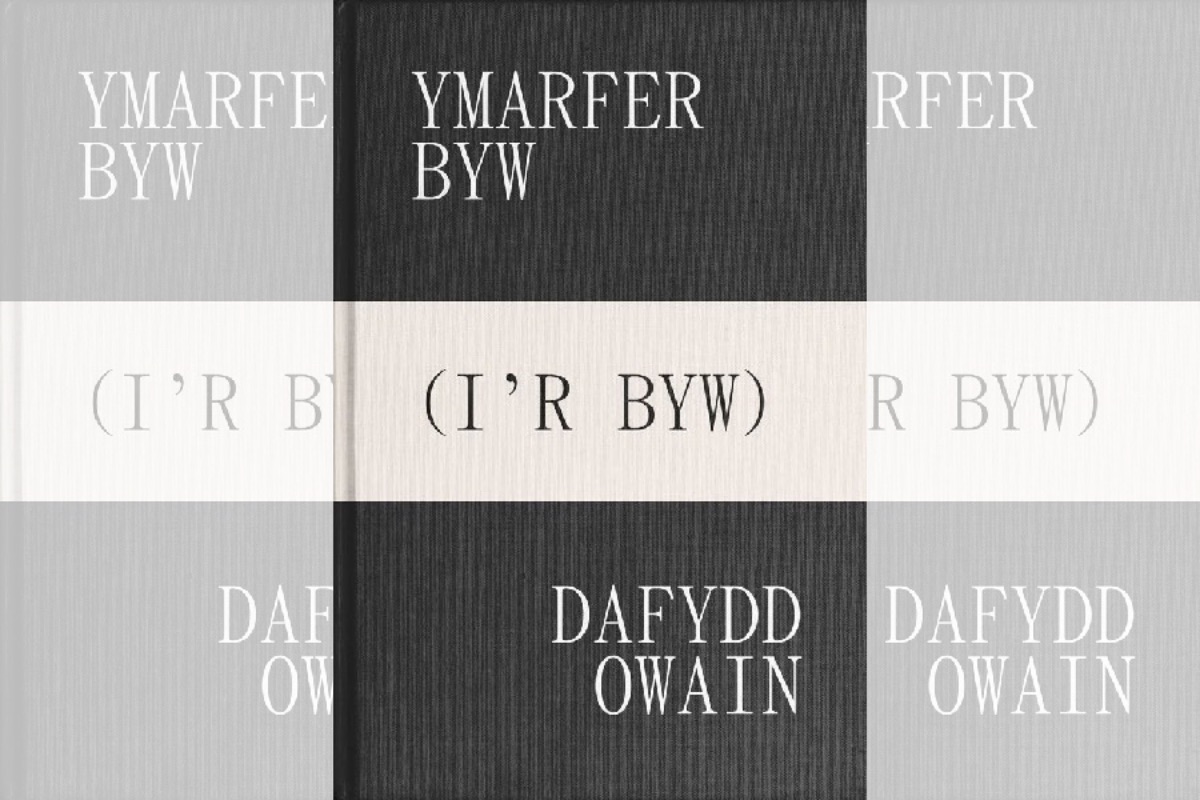
Book review: Ymarfer Byw – I’r Byw by Dafydd Owain
Jon Gower
The arrival of Dafydd Owain’s 2025 second album ‘Ymarfer Byw – I’r Byw’ – a title which suggests that life is not a rehearsal – announced an artist at the very height of his powers. It was little wonder it garnered this year’s Welsh Music Prize. Since then there’s been an arrestingly insightful documentary on S4C, directed by Owain himself, which mixed dynamic live performance with introspective meditation, all shot in moody black and white and grey. Joyfully, the end of the programme switched abruptly to colour, with the singer-songwriter dancing to Geraint Jarman’s ‘Rhywbeth Bach yn Poeni’ which addresses the little things that vex or trouble people all the time, thus striking a hopeful note after the songs and “inteviews” had taken us into the world of Owain’s depression and difficult personal struggles.
Deep honesty
And now, this, a book of song lyrics, prose offcuts and terse, tight “monologues”which gives us the opportunity to delve further into the words, in a beautifully designed volume from Atro, a brand-spanking new publisher based in Aberystwyth. You will recognise the aesthetic from the TV film and from the videos for the songs as well as the hallmark owl – a recurring symbol with its soul-searchingly piercing eyes – but the volume’s greatest strength is the depth of its honesty. As Owain declares in his introduction, the book was born in a time of personal darkness and complexity, when writing – along with drinking, smoking, breaking and repair – were some of its many manifestations.
Dark invitation
The novelist Manon Steffan Ros has entitled her foreword ‘Gwahoddiad I’r Tywyllwch,’ suggesting the tome is an invitation into the darkness. In this she explains how she faltered in writing it, struggling to find the words to describe the greatness or majesty of Ymarfer Byw (I’r Byw.) She also delinates between the experience of hearing the sung lyrics and reading the words on paper. It is the reader who decides which words should be shouted out and which should be whispered as one tests what Ros describes as the thin line, almost invisible, between the comfort of the emotional exposure and the urge to reach for a blanket to hide it. Ros is utterly right and the words here, be they micro-poems or marginal notes in the book of life belong, somehow to an inbetween place. They are song lyrics presented as poetry, yes, but they are somehow more than that. It’s the lacerating heart-searching truthfulness of them that sets them apart. Think Leonard Cohen living somewhere near Caernarfon and you’re part way there.
Owain tells you about a time when death wasn’t a fantasy about stopping the pain but that it wasn’t cold but warm and had nothing to do with hurting anyone. Neither was it about leaving but had more to do with feeling a little less pain:
Do’dd marw ddim yn ffantasi am stopio poen.
Do’dd o’m yn oer.
O’dd o’n gynnas.
D’odd o’m byd i neud efo brifo neb.
Do’dd o’m byd i neud efo mynd.
O’dd o fwy i neud efo teimlo bach llai unig mewn poen…
The words lead into a comparison between that feeling about death and the experience of performing songs, both offering a comparable warmth. And as it says in the song “Dim Byd Cweit Fel Cariad,” where Owain sees himself as a thousand songs, ‘Dw i’n gan mil/o ganeuon.’ They are both expressions of him and a part of him but as the song cautions at the very end, he is still scared of pianos.
Laugh out loud funny
Ros also notes another quality of Dafydd Owain’s writing, namely the humour and I have to admit that some of it is genuinely laugh out loud funny, this in part because of the acerbic take or the skewed eye view. There’s the story of his running on the treadmill in the gym, when the man from his favourite kebab shop in Caernarfon appears on the one next to him, almost causing him to fall off with surprise. When the man greets him, cheerily Owain thinks it’s his fucking kebabs (Ffocin kebabs chdi) he’s trying to run off. It’s a briskly funny story, told in energetic Cofi demotic but then the story’s register changes as he ponders the notion that he, Owain is haunted.
Many things haunt him, while he suggests that maybe has a fear of pianos. He sees them as being akin to fortune tellers, able to tell whether your car is going to break down next week, or that you yourself are going to do the same. It’s appropriate that the image on the facing page shows the musician almost as a spectral apparition at the keyboard, grainily pixillated, fading into grey. Other images are so indistinct they trouble the eye, haunting you, forcing you to search. To accompany Owain in his search.
Emotionally clobbering
I’ll freely admit that never have I been so glad to read a foreword to a book, to have its aid as Manon Stefan Ros discusses the impact of Dafydd Owain’s work: it braced me for it. But it still wasn’t sufficient as this volume floored me, then picked me up again by my bootstraps, had me hooting and then left me emotionally clobbered. There are words that uplift or pierce and others that fiercely illuminate, like training an arc lamp into life’s dark corners.
Manon concludes her appraisal by thanking Dafydd Owain for the invitation to enter the raw, honest darkness, underlining the book’s importance, too. I can only echo the sentiment and share that gratitude. This is an extraordinary volume, a companion piece to the songs but also a gathering of shards and lyrics-as-poems which stand proudly in their own right, shored up by the indubitable integrity of the artist and the sheer, clear-eyed but vulnerable humanity of his work. Diolch.
Ymarfer Byw – I’r Byw is published by Atro and is available from all good bookshops.
Support our Nation today
For the price of a cup of coffee a month you can help us create an independent, not-for-profit, national news service for the people of Wales, by the people of Wales.
Get more trusted Welsh news
Choose Nation.Cymru as a preferred source in Google News to see more of our journalism.



The Album was amazing this will be wonderful … he has the most compelling voices in contemporary Welsh music. Included here are the album’s lyrics in their entirety, as well as poems and monologues published for the first time. His singing is rightfully described as “ raw and immersive ” Won the 2026 Welsh music prize against tough competition too…