


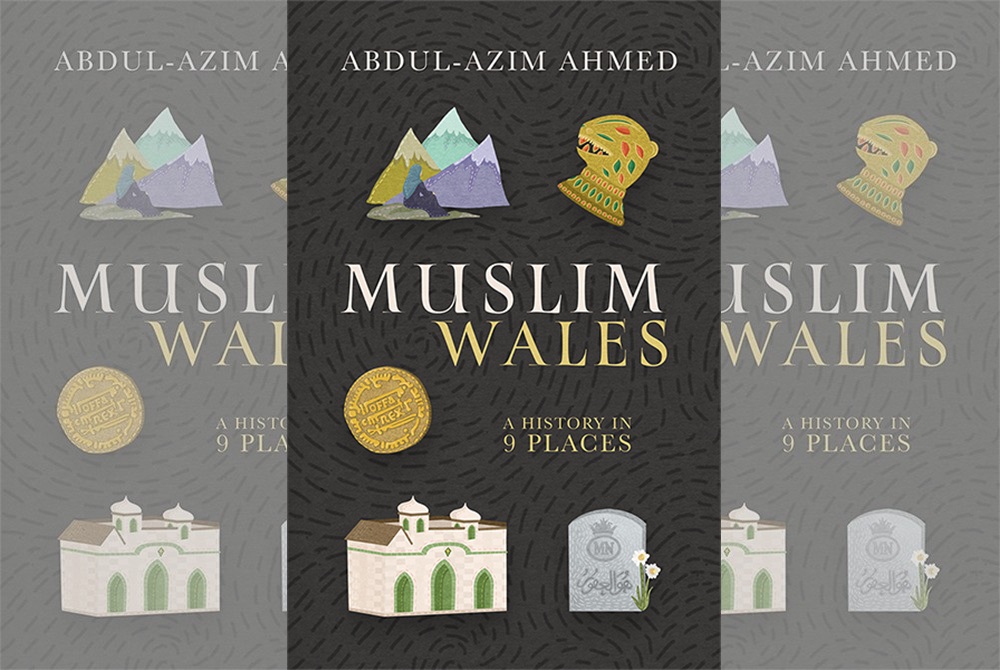
Book review: Muslim Wales: a History in 9 Places by Abdul-Azim Ahmed
Desmond Clifford
Bang off the bat it turns out that I’ve peddling Fake News, or at least, Fake History.
Multiple sources have reported over the years that Britain’s oldest mosque was founded in Cardiff. The story was picked up by the Welsh Government and repeated by them in various commentaries about Wales. “Them” in this context was once “me”.
I was among those who repeated this apocryphal story – and so, mea culpa, as they don’t say in Cardiff’s oldest mosque.
Like a lot of apocryphal stories, it wasn’t true, but it might plausibly have been. As a port city, Cardiff was among the British towns – like London, Bristol, Liverpool – to receive an early Muslim population as part of its diverse mix. There were certainly Muslims living and working in Cardiff long before they achieved visibility in most of Britain.
The Muslim population in Wales is growing but remains small. At the 2021 Census around 70,000 Muslims were recorded, 2.2% of the population.
Maritime and Empire links stretching back into the nineteenth brought communities from Yemen and Somalia and elsewhere. More recent arrivals have come from a wider geography across the Indian sub-continent and the Middle East.
The “oldest mosque in Britain” may have been demolished as myth but is amply compensated by a deep well of Muslim connections to Wales reaching way back into history.
There is a coin – a gold dinar – in the British Museum, discovered in nineteenth century Italy, with King Offa, of dyke fame, on one side and the Islamic declaration of faith on the other. There are competing theories, and no one knows for sure the coin’s origin.
Whatever the truth, it’s reasonable to suggest that Offa and the Muslim world knew of each other and the existence of such a coin suggests either a tax or trade relationship, or both.
It’s easy to imagine that our distant forebears lived in isolation hermetically sealed from each other. They didn’t. Travel was difficult, slow and potentially dangerous but very well established.
The first books on Wales were written by the cleric Gerald of Wales. His “Journey Through Wales” describes his mission, alongside Baldwin, the Archbishop of Canterbury, to recruit for the Third Crusade.
In 1187 Jerusalem fell to the Muslim, Sultan Saladin and ignited crusading passion across Christendom.
We know from Gerald that their mission began in Radnor, down to Brecon and through Llandaff, along the south coast and then up along the west from Neath. I live not far from Llandaff and am astonished that my ancestral neighbours in 1187 would have dropped what they were doing, taken the cross and travelled to Acre and Jerusalem to fight.
They fought against Muslims but also traded with them and camped among them. Welsh soldiers returning from the crusade must, surely, have bought artefacts and trinkets back with them to Wales. If so, none have yet been found.
Renegade
The first record of a Welsh Muslim was in 1671. We don’t know his name or anything much about him except that he was a renegade – a “runagado”. Seemingly he was a sailor who at some stage was captured by North African pirates in the employ of the Ottoman Empire. He converted to Islam – he may have had little option – and plied his trade with Algerian corsairs.
When the Dutch navy captured the Algerian ship, they released the English prisoners but records show executed the Welsh sailor on the grounds of his religion – so the first Welsh Muslim and the first Muslim martyr.
Abdul-Azim casts his history in terms of places that tell the story. Empire is the basis of Wales’ primary relationship with Islam and Powis Castle, near Welshpool, is the most significant private memorial to that period.
As it happens, my local pub is named after Robert Clive, the owner of Powis Castle. A substantial portion of Britian’s conquest and exploitation and trade took place in Muslim lands in Africa and Asia.
Abdul-Azim argues, and I agree with him, that Wales was complicit with Empire rather than a victim of it. I would modify this position only slightly to note that, since Wales had no government of its own, it’s hard to argue there was any agreed and coherent Welsh political position.
But the Welsh tucked into empire just as keenly as others. Clive was at the top of the tree but there was a long tail of traders, teachers, pirates, preachers, governors and civil servants who all joined the aggrandisement of British power and benefited from it.
We learn all manner of unexpected things. The first known named Welsh Muslim was Amelia Davies, born in 1867 in Carmarthen. She relocated as an adult to London where she met and married Sheikh Meeran Buksh, a law student from India.
She died young and was buried at Bethlehem Chapel at Pwll-trap, St Clears, where her burial place can be seen still.
Diplomat
Lord Henry Stanley, nineteenth century owner of a large estate on Anglesey, converted to Islam while serving as a diplomat in Constantinople. In the process he became the first Muslim member of the House of Lords, to the acute embarrassment of his family; one of his brothers became a Roman Catholic bishop, a broad church if ever there was one.
Stanley sponsored a series of stained glass windows depicting Islamic art in Anglesey churches at Niwbwrch, Llanbedrgoch, Bodewyrd and Llanbadrig – quirky and lasting monuments to Wales’ Muslim history.
The historic relationship between Wales and Islam is fascinating and, to me, all the more so because so much of it is unexpected. Abdul-Azim details these histories in an engaging way.
At a larger scale, Muslim communities have grown over the last generations from around 1970s onwards.
The largest communities are unsurprisingly in the major towns although Muslim communities exist all over Wales, including some very surprising connections.
Living in Cardiff, mosques have become a very familiar site, both purpose-built distinctive designs and repurposed chapels. I am neither Muslim nor a chapelgoer, but It’s heartening to see buildings remaining in use for the purpose for which they were intended – worship.
This is a superbly entertaining and enjoyable book. It treats a space in Welsh history which is under-researched and has been treated as marginal; this brings Muslim Wales closer to the mainstream.
The author explains very well how Islam has introduced its culture into Wales and how it has engaged with Welsh culture, in both Welsh and English.
Quran
As Wales has changed over recent decades, so has the profile of people who speak Welsh. Excerpts of the Quran have been translated into Welsh though a full translation has yet to appear.
The book focuses on places in Wales which have a historic connection to Islam. It’s an interesting device. It draws readers in and points up some unexpected connections.
Pedantry is part of the reviewer’s kitbag, so I ought to correct the error that Welsh devolution began 1998; it fact it was 1999. The author points to a positive relationship between Islam and other faiths, and with Welsh politics, through the Faith Council first initiated by Rhodri Morgan (in spite of Rhodri being a humanist).
The book provides a historical perspective. I suspect there is much more to be said about Wales’ contemporary developing and growing Muslim communities and perhaps that will be a future project for the author.
Support our Nation today
For the price of a cup of coffee a month you can help us create an independent, not-for-profit, national news service for the people of Wales, by the people of Wales.
Get more trusted Welsh news
Choose Nation.Cymru as a preferred source in Google News to see more of our journalism.



Enjoyed that. Afraid I will wait untill it’s in our local library rather tha buy though.
Go and ask the library to get it in…. Then you know they have a copy!