


English broadcaster says Welsh national pride is less ‘threatening’ than other parts of UK
Amelia Jones
An English writer and broadcaster has said Welsh national pride feels ‘welcoming and infectious’ in contrast to English identity.
Zakia Sewell, who is a writer, DJ and broadcaster based in London said she finds Welsh national pride less threatening than other parts of the UK.
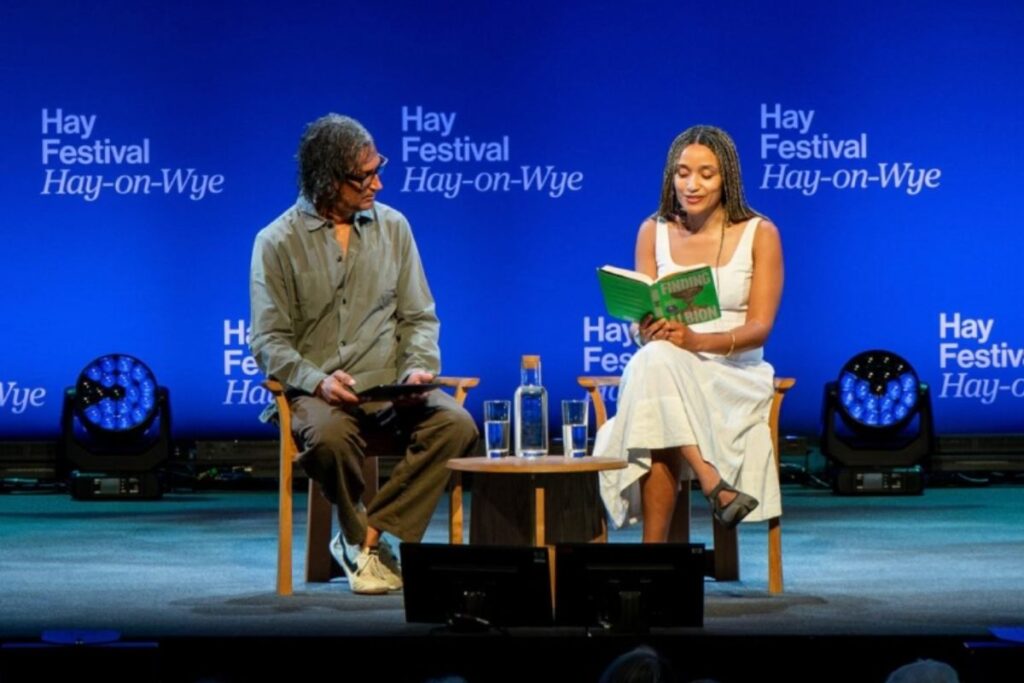
Zakia Sewell made the comments during a discussion at the Hay Festival with historian David Olusoga, where the pair explored national symbols, mythology and how ideas of identity are shaped across the UK.
The event was described as: “A quest for a different Britain.
“Together they [Sewell and Olussoga] consider ancient legends, Celtic rites and the mystic stone circles that punctuate our landscape, and ask whether this alternative history could help unite an increasingly divided country. A thought-provoking session offering a fresh, hopeful perspective on British identity.”
Speaking about her experience of Welsh identity compared with England, Sewell reflected on how her perception of national pride has been shaped by what she has seen and learned across different parts of the UK.
In a clip posted on social media, she said: “It was in Wales I first encountered a sense of national pride that felt welcoming and sort of infectious as opposed to threatening.
“Wherever you are in Wales, you see the red dragon emblazoned everywhere on the back of cars and castle parapets. And for me, although the St George’s Cross is ostensibly my flag, I have a very different reaction to that flag when I see it, and particularly not in football.
“So I sort of, I wondered what that was about, why that is, and, you know, sort of learning a bit more about the Welsh symbols. You know, there are so many, and they seem so kind of rooted in Welsh story in a way that English symbols don’t in the same way. You know, there are sort of a plethora o these kind of magical symbols, you know, the mountain goat, the bard, the druid, the triple harp, the dragon, of course, the leek, you know, the list goes on and on.
“And there’s something about the way in which English symbols feel a little bit more difficult to locate. I was curious about why this was, and I learned that there was this kind of conscious conjuring of Welsh national identity after the union of 1797.
“These symbols, although they’re kind of rooted in a lot of older stories and the kind of myths of the Mabinogion and so on, that they didn’t just sort of arise organically from the earth.
“In fact, there was a kind of concerted effort on the behalf of aristocrats and writers and antiquarians to sort of conjure these symbols and to sort of to use them as a way to distinguish and define Welshness in the face of English dominance. And so, yeah, that was totally, that was a new discovery for me. I sort of felt that they just kind of rose up organically.
“And it made me think, well, could we do something similar in England today? Is there a need for us to collectively reimagine or draw upon a new set of symbols that reflect who we are as the English today?”
Sewell’s reflections form part of a wider exploration of British identity, symbolism and history, themes she also examines in her book Finding Albion.
The book looks at ideas of Englishness and national myth, and how history and storytelling continue to shape modern understandings of identity across the UK.
You can watch the full video here. To find out more about her work, you can purchase her book here.
Support our Nation today
For the price of a cup of coffee a month you can help us create an independent, not-for-profit, national news service for the people of Wales, by the people of Wales.
Get more trusted Welsh news
Choose Nation.Cymru as a preferred source in Google News to see more of our journalism.



I think there’s a noticeable difference in the way that Cymru celebrates its language and culture by focusing on the good things we have rather than other countries close by which focus on people possibly taking something from them. I think this is one of many reasons why England appears to be going backwards.