


Enigmatic works by Stephen Young go on display at Cardiff gallery
Stephen Price
An exhibition of works by the celebrated painter Stephen Young, who died last year, is currently taking place in Cardiff.
Stephen was born in Godalming, Surrey and studied at Guildford School of Art and later Chelsea School of Art.
He graduated with first class honours in painting and, after a year of postgraduate study and a period as artist-in-residence at Sussex University, moved to Cardiff where he worked at Cardiff College of Art, eventually becoming Director of the BA in Fine Art course at University of Wales Institute, Cardiff.
He remained a committed painter throughout, his work ranging from the abstracts in his early years to his later unique theatrical narrative style.
Stephen exhibited widely in public and private galleries in the UK, among them John Moore in Liverpool, and The Hayward Gallery and The Serpentine Gallery in London. He also exhibited regularly in Spain. His work can be found in numerous public collections including the Arts Council of Wales, South Wales Arts, South Glamorgan County Council and in private collections worldwide. He was also twice a National Eisteddfod prize winner.
The new exhibition of pieces by Young includes 35 works – a mixture of oils and mixed media works dating between 1989 and 2017.
Michael Crowther, a contemporary of Young, writes: “Steve arrived in Cardiff in 1969, not long out of Chelsea School of Art. While still a student he had been awarded Junior Prize at the John Moores Exhibition. Teachers as different in their own practice as Malcolm Hughes and Ken Kiff had been particularly helpful and supportive to him.
“I met him in 1970. The works he showed me had clearly emerged from the Constructivist side of the business. The tools of his trade were drawing pens, inks, long arm compass, rulers, templates, and sundry aids to geometry. Most works were on paper, some on board, nothing on canvas, minimal colour and avoidance of that thing we call painterly. A sort of severity prevailed. Beckett, Elliot, and the Duchamp of the Large Glass loomed large in his thinking.
“In 1975 Steve and I had a show of drawings. In his catalogue statement he said he preferred to make “art at a distance”, and that his work evolved “through alternating involvement and alienation”. Another part of his statement, however, eased these austerities; he made “deliberate and eclectic borrowings of images, methods and conventions which are often disparate and antagonistic to each other”. This seemed to relate more specifically to his drawings and with hindsight pointed the way to a future output. In one of his large drawings, “Bunker”, an emphatically illusionistic bunker shape – tiled? – sits on ground inside its own spatial enclave, seemingly pasted on to the flat shapes behind. A whiff of Sienese painting pushes against geometry.
“Steve had shown in one of the early and prestigious exhibitions at the Serpentine Gallery, he was seen as a serious young artist. By the mid-seventies, however, he was increasingly worried by his own brand of seriousness and where it had landed him. He was troubled by the material constraints he’d imposed upon himself, more and more suspicious of the rigidities of his “Theoretical Position”, as thoughts about art are now called. He admired Picasso, Matisse, and Bonnard more than he did Duchamp. He read all sorts of poetry and prose, was an attentive listener to classical music, but also had records by Roxy Music. On occasions, like Mondrian, he liked to dance!
“He told me, probably over a beer, that he intended to make a table, top tipped forward and tilted to one side, a foray into three dimensions. It appeared shortly after – a found bench top had been given four-by-two-inch timber legs. Tipped and brought forward it implied a “modern” picture plane. It could have been wrenched out of a Braque or Picasso, one of his “eclectic borrowings”, yet something like a tipped up table had appeared in the bunker drawing. It looked fresh, and ready to go places. It is hazardous to talk of periods and breakthroughs. Fifty years on, however, I remember this construction as the start of something, the flood of sculptures, reliefs, drawings and paintings that he made in the late seventies and early eighties.
“Here in York we have a drawing from this “Middle Period”. A figure – man or woman – has landed with firm footing on a kind of frame. I say ‘firm’, as the figure appears to have arrived quickly by some acrobatic means? A pointy, coolish red hat, sits above a face with almond-shaped eyes and open mouth. The face is simply drawn, but the look could denote a successful landing – “look what I have done!” – or it could express exhaustion from the effort. Inside the frame, which has six sections and short trestle-like legs, are three piglets. Two of them are trying, unsuccessfully it seems, to escape; the other piglet is resigned to failure, sad.
“The drawing is in pastel and appears to have been made quickly, and altered quickly. A previous position of the figure’s legs can be seen under a none-too determined erasure. This adds to the implied acrobatics, and reaffirms the solid landing of the foot. The sad piglet has had a previous, partially escaped position, which is only cursorily erased. The brown floor has been quickly knocked in, mostly with the crayon’s edge. Some fingermarks and smudges remain.
“It is a marvellous drawing. I have described it in some detail as it is so symptomatic of what Steve was doing at the time. I don’t know how “intentional” he was when he embarked on the drawing, nor does it matter as it so clearly demonstrates amazing brain, eye, and hand skills. Thinking on his feet with crayon in hand. “Art at a distance” had gone out of the window. Dazzlingly direct skills were released, as compass and templates were put in storage. As importantly, humour had entered the fray. Our drawing would be one of the hundreds he made which provided the rich hinterland for his sculptures and reliefs.”
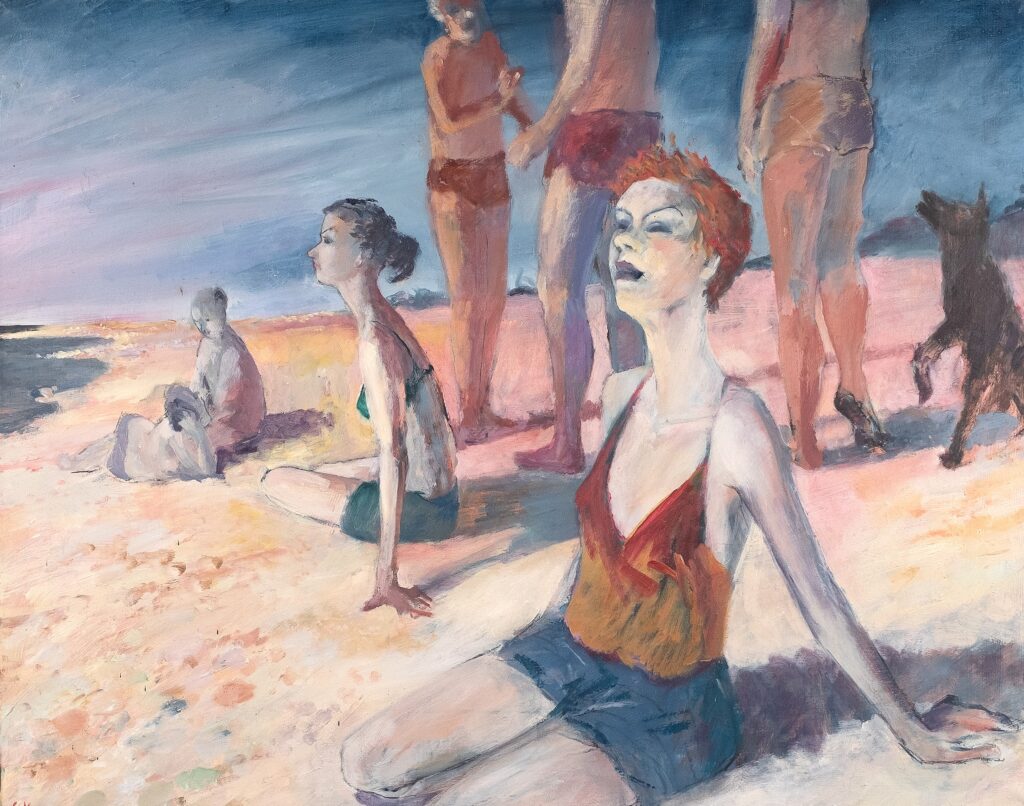
“He enjoyed the new practicalities of making painted sculpture. Boards cut to shape were bolted together. The shape, say, of a leg or tree, was drawn in charcoal and cut with a jigsaw. There were few niceties in this, the none too gentle cut of the jigsaw and its occasional splintering were not tidied up, fast drying acrylic kept things moving. Sometimes the painted images established and adhered to the shape of the cut-out, sometimes rode roughshod over it. A bewildering range of images were employed: figures, animals, vegetation, furniture, crazy hybrids.
“Steve somehow managed to make humour and bleakness exist, often side by side, within a complex formality. He managed all of this with a lightness of touch that was in no way flippant. In the studios we were amazed, gobsmacked, by these works. They had appeared so suddenly and had established such a change of direction.
“Poet, Marianne Moore, reflecting on her own craft, made the following observations. “We must have the courage of our peculiarities”; we need to be “as clear as our natural reticence allows us to be”; and that “novelty is always a by-product”. I am put immediately in mind of Stephen, of his love of art, and his dedication to the making of it.
“Beguiling”
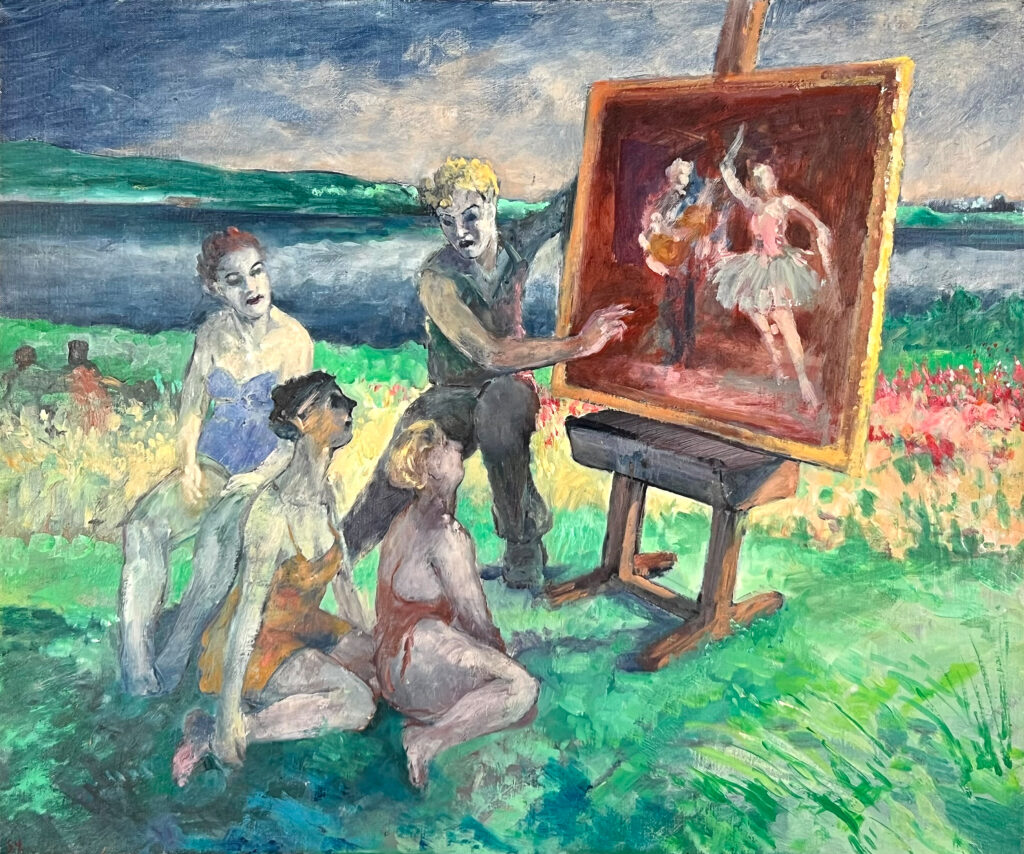
Art historian, Paul Greenhalgh shared: “Enigma isn’t so much a tool as a subject matter in Steve Young’s paintings. The two questions we ask when we are in front of them are ‘where are we?’ and ‘what is going on?’ We know objectively that the landscape backdrop in much of the work is the shoreline of South Wales, but we also know that it isn’t really where we are: he’s thinking of somewhere else we are less familiar with. And having depicted his characters with a surprising level of detail, much of it from his daily life, he leaves it to us to decide who they are, and what they’re up to.
“It’s a murky evening in Moth (2014) for example, in which we appear to be looking down from height onto a stage from a wing. The people on the stage aren’t ignoring us: they just don’t know we’re there. There’s something ungraspably cruel about the scene but we don’t know why. Two little dancing girls, dressed like Degas ballerinas; a spotlit woman in her underwear, fixing her hair; across from her, two other women and a man, also seedily undressed, and a technician of some kind, probably adjusting the stage lighting. Are they getting ready to perform? Probably not, because they’re so casual, self-absorbed and unprepared, and the stage has no house or audience. More than this, it couldn’t have an audience: it looks out onto a bleak, scruffy landscape, with a rough sea impinging on it. It’s not a landscape for lingering in either, but for passing through. The sense of isolation is frightening.
“Not that the work always had this darkness about it. He had a wide emotional range, much of it having a joie de vivre born of a gentle positivism: innocence, domesticity, eroticism, celebration. But like Moth, virtually all of it has a Surreal sense of dream and contradiction. Symbolic complexity underpins Stepping Stones (1989), Summer Evening (1990), The Art History Lesson, Alfresco (1995), The Plinth (1999), Dance Away (2014), The Egg 2 (2008), On the Town (2017), and others. In Summer Evening the main foreground figure has pulled a bottle of champagne out of an ice bucket and is pouring herself a drink. Two others cavort in drunken dance. In the centre, dominating the composition, a male figure on a large stepladder is hanging a string of coloured lights, and so we know a party is about to start. His hapless friends aren’t helping and have already drifted into debauch. We don’t know what the lights are for, or who is coming to the party. The Egg 2 is a fête galante of elegantly clad women and strangely fragile men, at a delightfully bourgeois dinner party, at a table inexplicably on a beach by the sea.”
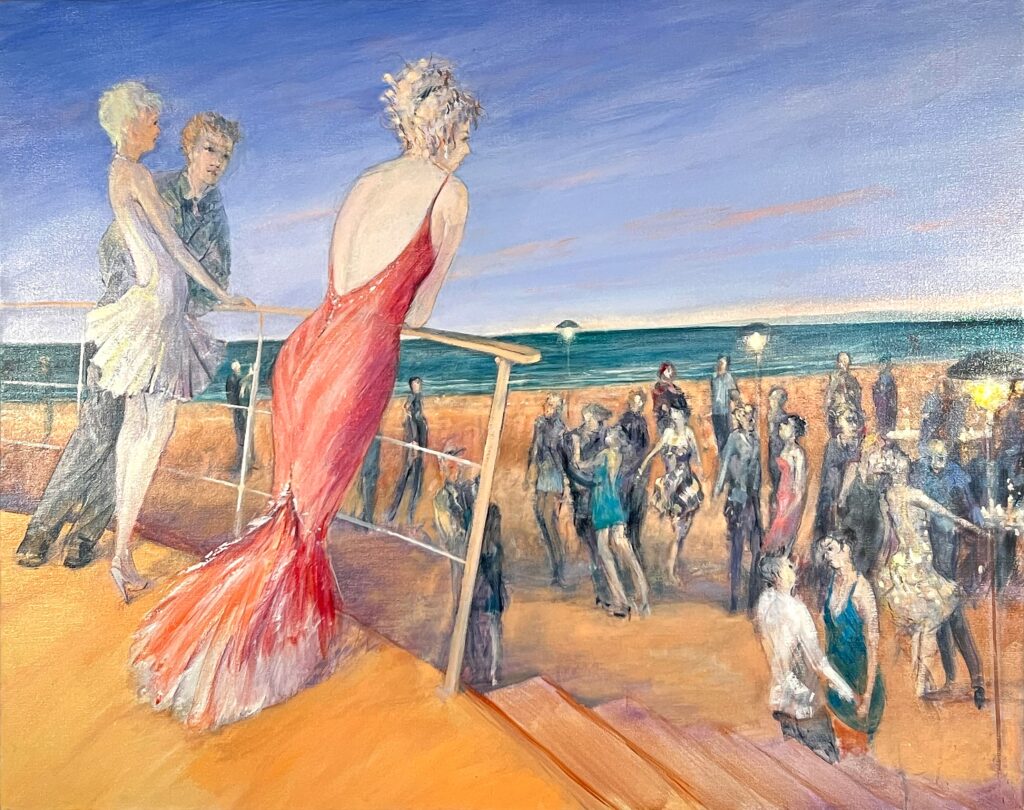
“We realise this is an art of situations in which we are always interrupting and never there at the start. The actors are already absorbed in what they are doing before we arrive. We get the sense that something has just happened, or something is about to happen, so our curiosity holds us and makes it difficult to look away.
This hypnotic power comes from a number of oppositional forces that shaped the artist’s outlook. In fact, these were the stuff of the modernity we are all swimming in: the past in relation to contemporary life; mythology as a vehicle for interpreting reality; objectivity as a means of coping with subjectivity. Steve’s art lives resolutely in the normative present, but describes it to us through references to past art; in every canvas we can see the accoutrements of day-to-day living – cork-screws, shoelaces, step-ladders – nestled amid mythologies from another universe; and always, objective knowledge was animated by the artist’s personal view of things.
Steve was intensely well-read. His work reveals this through a deep but untrumpeting eclecticism. Like Poussin, he usually placed his situations in the open air; his compositions and treatment of nature have a lot to do with the Rococo, especially Watteau, Fragonard, and Lancret; Picasso’s classicising provided a Modern example. Contradicting all that gentility, I was surprised when he told me he admired Julian Schnabel’s calamitous Plate Paintings from the later 1970s. Technically, much of Steve’s work has the feeling of coloured drawings, in which the graphic dimension generates the structure and space. This puts one in mind of Toulouse Lautrec and Degas. Like Steve, these two painted what they found around them; but unlike him, they didn’t use it to generate an empathetic mythology.
The paintings are the culmination of a phased development which in broad terms had three parts to it. An early period of meticulous geometric Abstraction which hovered somewhere between Constructivism and De Stijl. Most of the artists in those movements were keen to eliminate narratives – story-telling – in a search for an abstract universal language. We assume that this was at the core of Steve’s thinking at the time, and it was an approach that earned him national recognition. The second phase, from the later 1970s, constituted a pretty abrupt rejection of these previous values. He moved back into overtly representational works – again, story-telling – with three-dimensional constructions covered in painted imagery. It was a kind of expressionist furniture that still defies categorisation. The imagery that developed in those works then fed his last and longest phase, his move into painting.
“In this last, grand period, the artist took the things that were all around him, a place of unfettered happiness – family, work, teaching, friends – and used it to invent other places, the Arcadia and Hades that he kept inside himself. In so doing, he gave us a profound illustration of the world, and some of the most beguiling, and for me significant representational paintings of our times.”
View the Arcadia, Interrupted, an exhibition of Stephen Young’s works online now or in person at Celf Gallery, Roath Park Hall Bangor Street Cardiff CF24 3NA until 5 July.
Support our Nation today
For the price of a cup of coffee a month you can help us create an independent, not-for-profit, national news service for the people of Wales, by the people of Wales.
Get more trusted Welsh news
Choose Nation.Cymru as a preferred source in Google News to see more of our journalism.


