

‘If I was living in London, I’d be distracted by the shrimp noise’: An interview with Aaron Kent
Gwenhwyfar Ferch Rhys
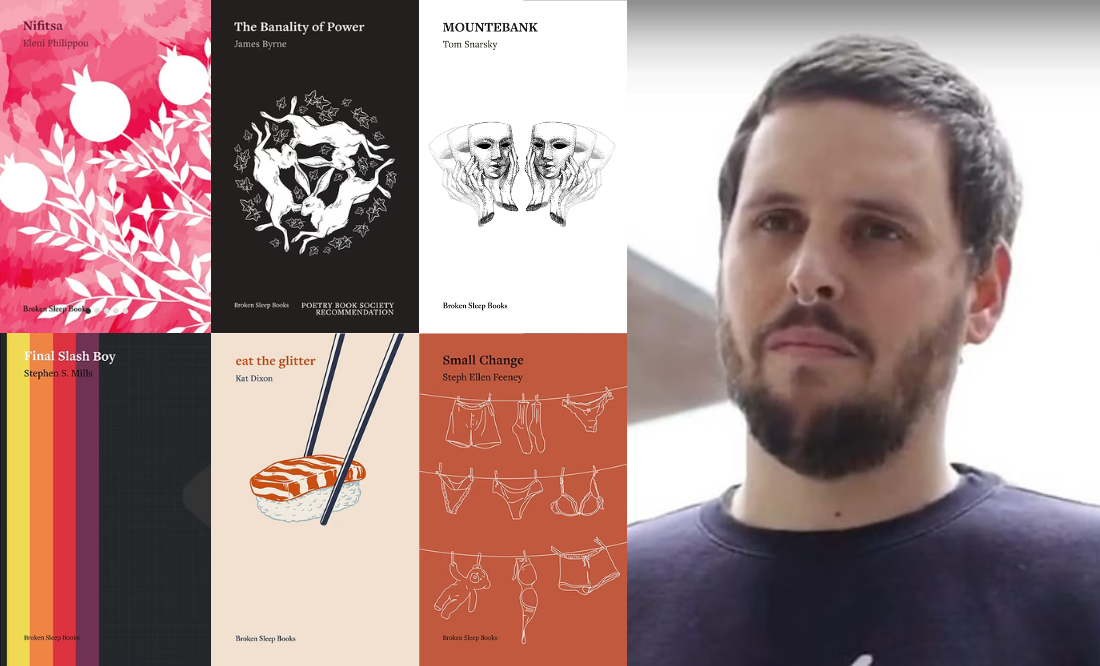
Hot off the heels of winning the Small Press of the Year Award for Cymru, we sat down with the Broken Sleep Books founder to talk access, funding, and running a poetry press from rural Ceredigion. This interview has been edited for clarity and length.
Hi Aaron, and congrats again on your Small Press of the Year win! First off, can you introduce yourself and give us some background on Broken Sleep?
So, I run Broken Sleep Books with my wife, Emma Kennedy; she’s the administrator and I’m the editor. We started Broken Sleep in 2018 when our daughter was nine months old, it was a wild decision. I’m a very working-class bloke… I didn’t think arts was something I was ever allowed to do… [it] was just something rich people did as a hobby. But the aim [with Broken Sleep] was: how do I make it so that more people like me who believe they can’t get into [literature] can get into that field? So Broken Sleep started to de-gentrify the arts, to widen access.
And can you tell us what it means for you to win the Small Press of the Year award, both personally and professionally?
I didn’t expect [us to win]. And not because I don’t believe in what we’re doing, but because it feels like there’s already a status quo and we’re not part of that. So I thought… we’re the outsiders, we do things a bit differently. They don’t want the de-gentrifiers to win. And they did, and it was lovely. It was nice recognition, when it feels like you’re toiling away and getting nothing – the literature bodies in Wales haven’t really engaged with us in general! But even winning this…Small Press of the Year for your country, you’d think one of them might congratulate us – we’ve heard from none of them. So it’s nice to go, okay, others appreciate us.
I’m very interested in the fact that Broken Sleep is based in Llandysul, in rural Ceredigion, rather than, say, Cardiff or London. Would you say that being kind of out of the way gives you a different perspective as an editor?
Yeah! I think if you’re living in the cities, you’re always aware of who’s doing things, who’s putting on events, who’s the next big poet or author, and you end up chasing that because you’re comparing yourself to that sort of thing… so my analogy of this is always that when I was 19 I joined the military as a sonar operator on the nuclear submarines – which is wild, because I’m vociferously anti-military now – and when you’re under the surface, you hear a lot of shrimp clicking all the time and it sounds like a standing ovation, so wherever you go it sounds like applause. And that’s dangerous because you might miss the noise of a fishing boat, and hit their nets and drag them down and kill them all. Or you don’t want to miss whale song, because it’s beautiful, it’s stunning, but you can miss it because you’re distracted by the applause. And that’s the way I see it: if I was living in London, I’d be distracted by the shrimp noise. Living here means no shrimp noise.
Wow, that’s a fascinating analogy! I always think being based rurally is a barrier in arts, but I guess it also gives you breathing room to do things your own way. On that note, Broken Sleep is quite unique in the contemporary scene, publishing unproven authors and ‘Wild Card’ projects that other publishers might not bet on. How can you take that risk?
I don’t take a wage from Broken Sleep, I earn my money as a teacher, so … if one month books don’t sell as well, it’s not gonna mean our children can’t eat. So I can take risks on books that might not sell so well but deserve to be published. We’re not really a profit-driven press. We haven’t had funding for god knows how long, it’s just not something we do.
And is that sustainable?
We had to diversify a little bit … every year we run an online course, it takes you through the whole process [of writing a book], it keeps the press ticking over. Our costs are relatively low – and this is where the Books Council of Wales was like “you don’t need our money” – but the thing is, at the moment it has worked, at the moment we’re comfortable. And I think for the time being that’s sustainable. In two years time, publishing might be down, and I’ll rejig the business. We just play it by ear.
You mentioned the BCW there, echoing Jannat Ahmed’s criticism of them we published last year. Do you think that we need to get these funding bodies to care more about indie presses, or does the solution lie in structuring publishers to function more independently from them?
I’d love to see more publishers spring up, so we can start to take the arts back. [But] the institutions that exist to fund the arts don’t actually wish to fund the arts. What they want to do is maintain the status quo – why facilitate the work of marginalised individuals when you can just chuck the same cash at the same places? And my theory is, if you create more indie publishers, more people engaged with the arts, then the funding bodies can’t ignore it anymore, because we create an arts culture that changes lives. You can’t ignore that.
Excellent! Finally, are there any projects that Broken Sleep is currently working on you’d like our readers to know about?
We’re doing a Queer Cymru anthology, really looking forward to that – if you consider yourself Welsh, you can submit! I’m giving a talk in Bath on the 28 March, and we’ll be at the Free Verse Poetry Book and Magazine Fair in London in April. But if anyone’s interested, and can get in touch with me, I want to do a similar thing [to the Free Verse fair] here in Wales – a big day of poetry publishers from all over the UK!
Support our Nation today
For the price of a cup of coffee a month you can help us create an independent, not-for-profit, national news service for the people of Wales, by the people of Wales.


