

Interview: Hannah McPake on Alice: Return to Wonderland
Rhys John Edwards
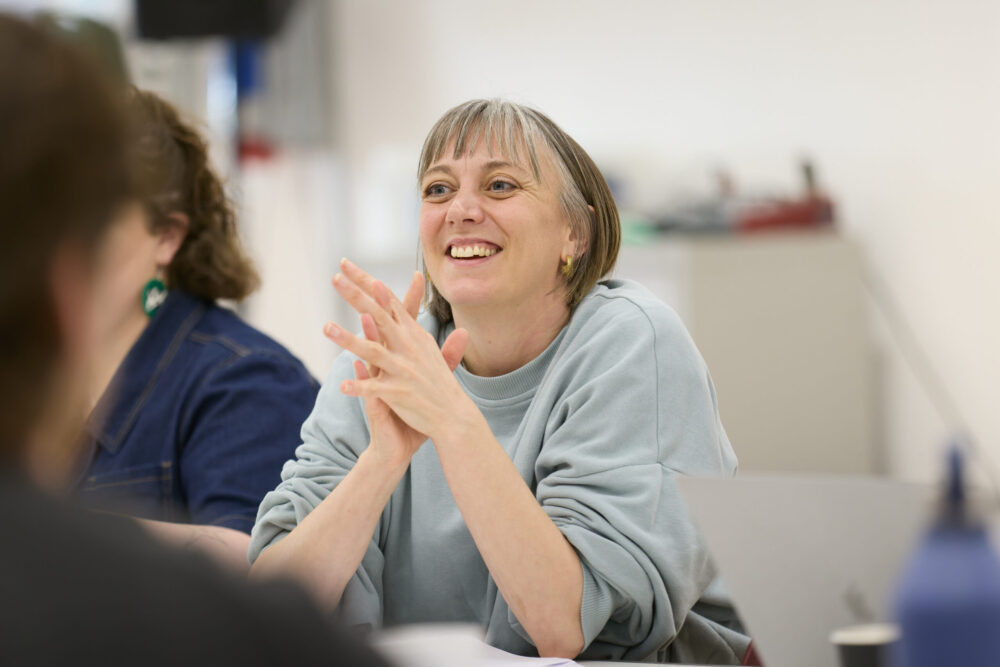
Actor, writer and director Hannah McPake is no stranger to reinventing classic children’s stories. After putting her own spin on Little Red Riding Hood and other works from the Brothers Grimm, she’s now turning her attention to Wonderland with a reworking of Alice Through The Looking Glass.
True to her style, this isn’t a straightforward modernisation. Whilst you might expect an updated version of the story to feature Alice glued to TikTok or Wonderland rebuilt as a glossy metaverse, McPake’s approach is subtler and much more creative. Her Wonderland lies not in cyberspace, but hidden beneath Cardiff in the 1940s.
‘Looking back is a way of looking in…’
“I’m a history geek, I just love history,” she explains. “I think Cardiff has an amazing history… but we don’t talk about it or dig into it that often.”
She was especially drawn to the 1940s, finding this period of social upheaval to be the perfect backdrop for her version of the story. “Post-war Cardiff is really interesting. It was obviously one of the cities that was really badly bombed… and there’s something about that time and the possibility of rebuilding the world that inspired me.”
McPake’s research also revealed surprising parallels with the present day. She was already interested in exploring environmental themes – particularly, the fight to protect green spaces in a society more focused on concrete expansion than ecological growth – and was intrigued to learn that this seemingly contemporary issue was actually nothing new.
“When I was digging into some of the official papers, there was such an emphasis on the importance of green spaces on people’s mental health and wellbeing. And these are all things that we think of as really modern but actually have their roots in something much older.”
Looking back, she says, is a way of looking in. “It allows us to look at where we are, but through a slightly distanced lens.”
‘I would never have called myself a writer…’
McPake began her career as an actor, then later, a deviser – but says she didn’t have the confidence to call herself a writer till the pandemic.
“I’ve been a performer for about 25 years, which is a really terrifying amount of time,” McPake laughs. “I have done a lot of devising – where you’re creating shows in the room through improvisation and games. But I would never have called myself a writer until lockdown, when I couldn’t do the things that I was used to doing… that’s when I really started writing.’
“But I still started by doing improvisations… just talking to myself and then writing that down. Over time that shifted. As I wrote more and became more experienced, I began to love structure… plotting out the whole story and then filling in the blanks.”
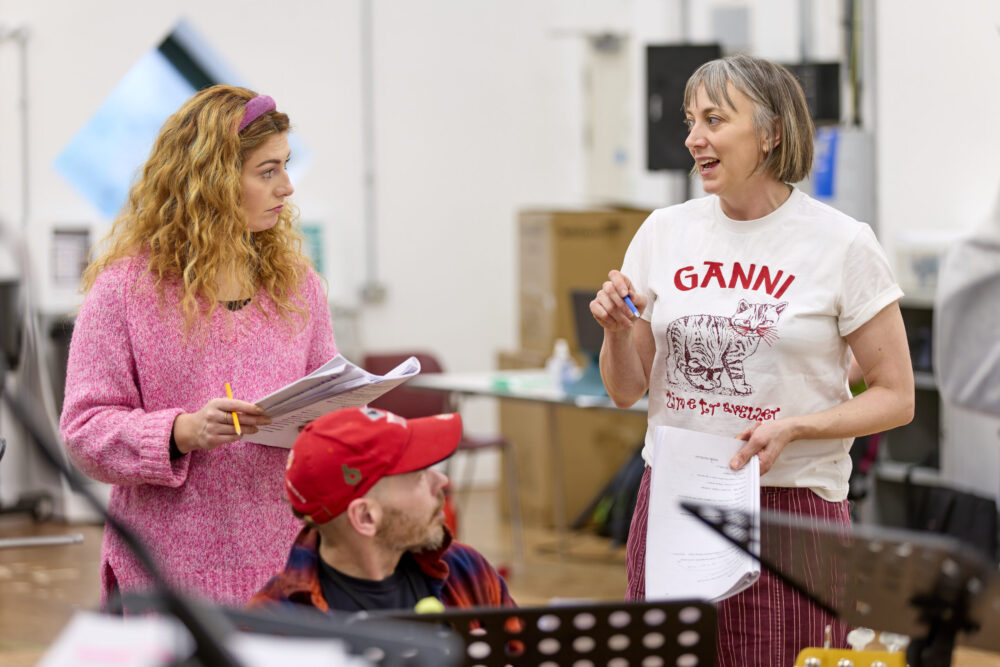
Hannah runs the theatre company Gagglebabble with Alice’s composer Lucy Rivers. Music is central to their collaboration. “Lucy just writes the most brilliant songs… and having the band live on stage gives our shows a kind of ‘gig-theatre’ element.”
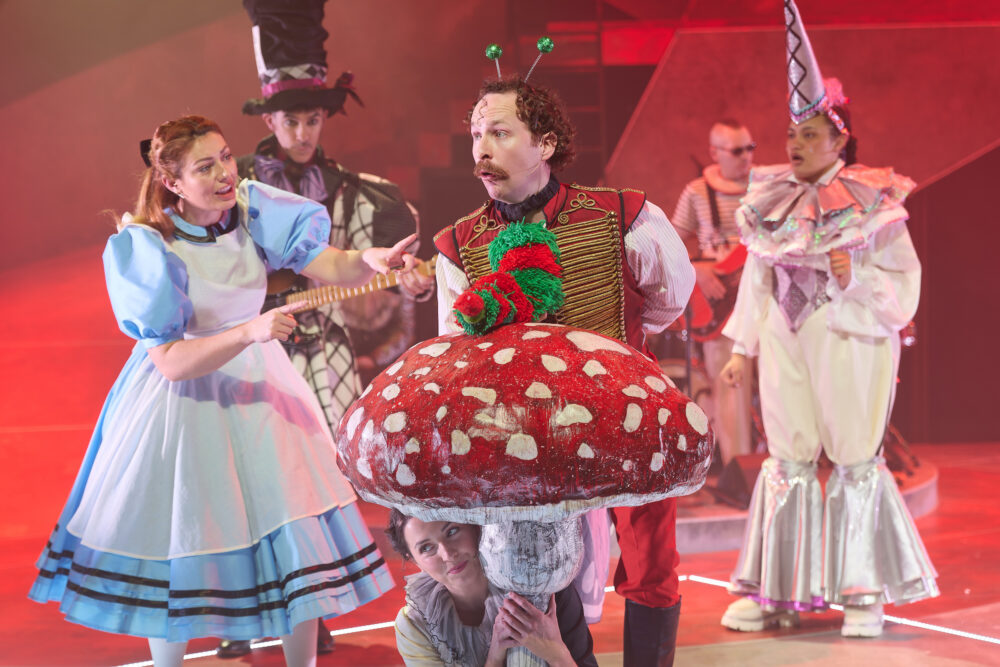
It’s true, their shows are not strictly musicals. There’s a less constricted approach to the mix of music and drama – a rejection perhaps, of the expected formula of a musical – and they often feature actors doubling up as musicians. In Alice: Return to Wonderland, the Mad Hatter regularly jumps back into the band to play electric guitar, while Alice herself happens to be a dab hand on the saxophone.
‘How dark can you go?’
The duo have tackled classic children’s stories before. “They’re iconic,” McPake says. “These characters and worlds are part of our cultural consciousness… it’s the magic of them, the larger-than-life characters and personalities, I love.”
Her first memory of Alice in Wonderland is ‘…probably the Disney film’ which she found very frightening as a child. “There’s a bit where the path gets dusted away by a kind of dog-broom… for some reason I found that terrifying… that image really stuck with me.”
“With these traditional children’s stories, they’re often warnings… moral tales,” McPake says. “Dark and light… it’s about finding a balance between them.”
“At Christmas, that balance is particularly important but ‘a little bit of a thrill, a little bit of danger… gives it depth.”
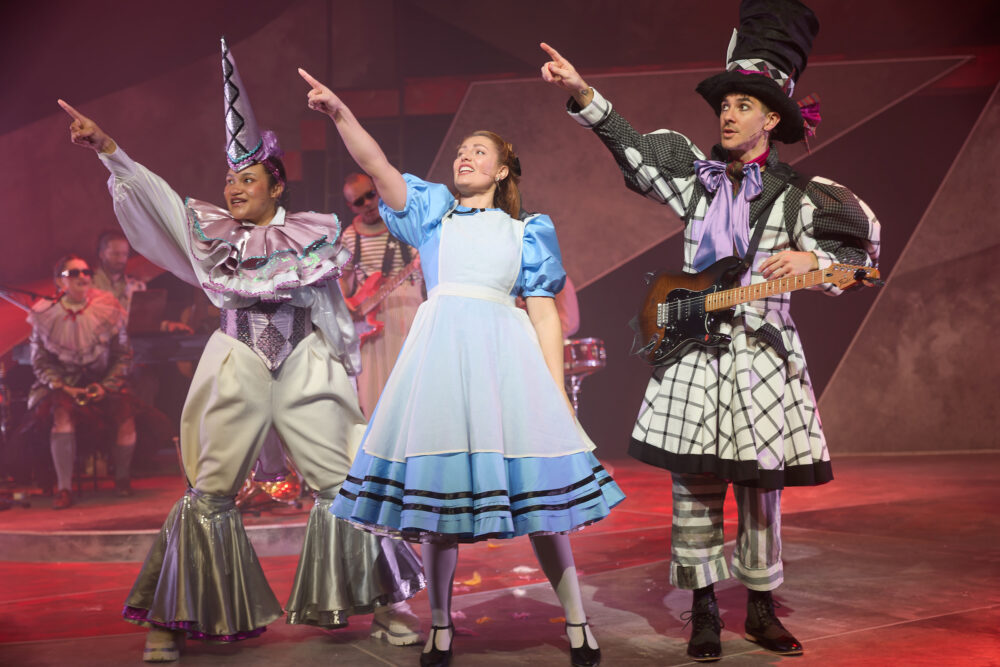
She’s acutely aware of the line though: “How dark can you go? A lot of people have come for their annual family outing… but I definitely also want to challenge audiences.”
Christmas is the busiest time of year for theatres, with festive shows and pantomimes often attracting audiences who may not return till the following year. I wonder if this adds pressure? Do theatres like the Sherman hope the success of Christmas performances may persuade families to visit more often?
“It can be seen as a bit of a recruitment drive,” she acknowledges, “but I also think we have to take each moment for what it is. Lots of those people will never come back other than at Christmas.”
“What we can do is excite people… particularly young people and children… that is how we build an audience for the future.”
‘I love a bad joke!’
Hannah’s work to date has predominantly been focussed on children and families. I ask why this kind of audience still appeals to her. “I just love writing for them, because I know that audience really well,” she says. “I’ve performed a lot for them… and I think I know what works and what doesn’t.”
The genre also allows her to be playful – to embrace her inner-child – a key theme in Alice: Return to Wonderland.
“Growing up I was a massive Monty Python fan… the really silly stuff. So, I love to just chuck a big dose of that in – all that fun and nonsense – and bad jokes! I love a bad joke!”
A sense of humour is clearly important to her – and an obvious theme running through her work – but heart, anchors everything. “Alice is a big story… but also it’s a very small story about a mum and daughter who are struggling to connect… we’re trying to root it in something that feels real and recognisable for a child.”
“For some people it will be their first experience of Wonderland,” McPake says. “For others they’ll be revisiting somewhere that they know and love.”
“I hope what they come away with is… the importance of community and imagination. That’s the way that we can change the world.”
Alice: Return to Wonderland plays at the Sherman Theatre in Cardiff till 3rd January 2026.
Support our Nation today
For the price of a cup of coffee a month you can help us create an independent, not-for-profit, national news service for the people of Wales, by the people of Wales.


