

Interview: Roberto Pastore on his poetry collection ‘Graveyards on Other Planets’
Imogen Davies
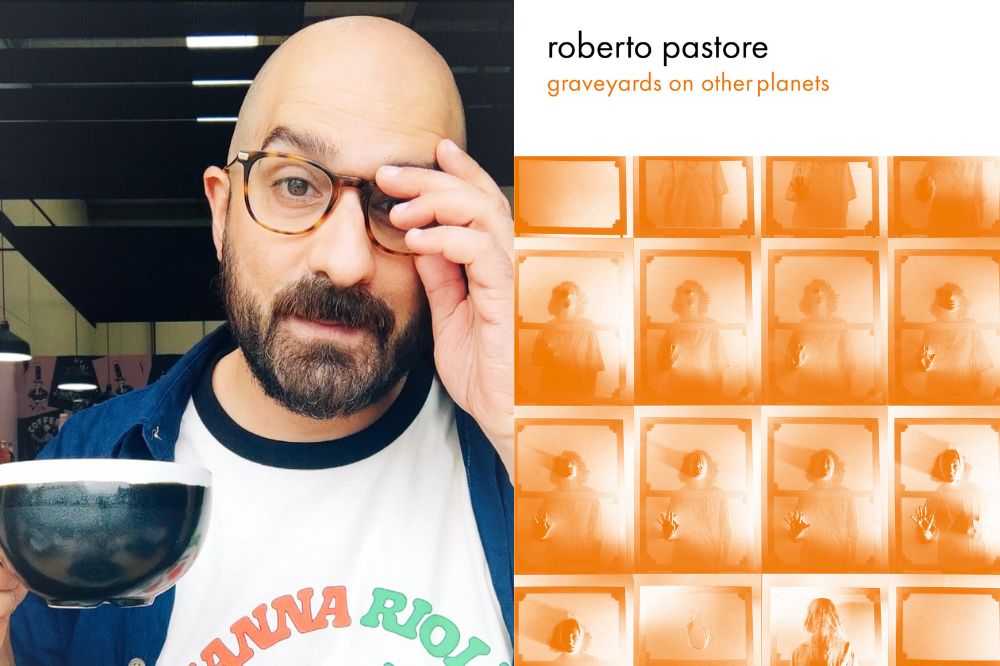
‘Graveyards On Other Planets’ offers up a patchwork of epiphanies, missing people, stigmata, Steven Carrington’s eyes, power cuts and the shadow of war.
In his sophomore collection, Roberto Pastore hones in on an era of constant flux, violence and grief, offering a kind of bewildered solace with a misfit voice that feels truly renewed. ‘I attend the reunion of myself./ Swapping out lime water for chamomile tea./ Comb-over days in which we refuse to accept what is lost.’ In poems that are self-reflexive and elegiac, yet full of flashes of the unexpected, we are invited to look tenderly and unflinchingly at our own mysterious experience of living, our own ‘sad heartsong’. Here are poems that feel both intimate and timely, yet somehow beamed in from another planet, far, far away.
What was the creative process behind writing ‘Graveyard on Other Planets’?
I write as often as I can, and am always reading, so one thing I do is try to be deliberate about my reading. I try to absorb material that feeds into an idea of the work I’m doing. ‘Graveyards On Other Planets’ captures a particular year or so in that ongoing process, during which time I ate many Mexican bean rolls in Scaredy Cat, and wrote, and read W.S. Merwin, Carolyn Forché, Michael Lally, Pema Chödrön, and wrote, and watched a lot of Time Team, watched a bad Monkees biopic, listened to Eileen Myles talk about the pathetic, had anxiety, had neck pain, read A Little Devil In America, read a novelisation of Basic Instinct, attempted Tonglen Meditation, I fried kale with garlic and coconut aminos, focused on strong, clear words like ‘light’ and ‘long’ and ‘good’ and I wrote and redrafted and redrafted and eventually we had a book.
Music and song seem to have deeply influenced you in this collection, your poem ‘Freedom To Stay’ references the song of the same name by Waylon Jenings and ‘Blue’ by Lucinda Williams, while in ‘Don’t Be A Stranger’ the speaker is “singing ‘Who am I’ by Country Joe & The Fish”, how and in what ways has music shaped your poetry?
I like poems that mention specific things like books, films, and songs – it’s just very real and reminds you that the action of the poem takes place in the world. It always frustrates me when writers allude to things but don’t name them, it’s so unnecessarily vague and annoying. I write about memories a lot and often how I remember specific times in my life is through music. When you’re trying to convey what a time felt like, mentioning a song can do so much work for you. I’ve realised that a lot of the time I’m writing to my own generation, so these references might hold a kind of shared cultural resonance for people my age, especially in the UK. ‘Freedom To Stay’ is a poem about something that happened to me, but it’s loosely framed by that whole alt-country moment of the early 00s. In hindsight that was an interesting pocket of time, because it was a rejection of the excesses of the 90s, and the rise of forward-looking electronic music etc. – it was regressive. We forget how much anxiety there was around the millennium and I’m interested in how these external conditions play out in our lives; at the time there was a sense of ‘do we keep the party going, or are we all feeling the fear?’. The poem touches on these conflicting urges, which were reflected through that music. Words like ‘real’ and ‘authentic’ became a kind of currency in music journalism, that language feels quite gatekeepery. If you look at the wellness industry right now those terms are everywhere again, and once again I think we can read the intimations of whiteness, patriarchy and appropriation imbedded in that language.
A number of the poems, including ‘Venus Infers’, which begins “I’m getting used to the night again” and ‘Mania’, beginning “As if I needed to be reminded the night can’t see me / I go out to look at it”, are set at night, is there something about nighttime you find especially intriguing or inspiring?
Not really. I suppose when you’re younger all the best stuff happens at night, but at this point in my life night is a bit more elusive because I don’t inhabit it in the same way. I forget how lovely and clandestine it feels to be out when it’s dark. I find the daytime a bit boring to be honest, 4 pm onwards is ok.
In the poem ‘I See Her Now In A Blue Dwarf Star’, you say that “language is telepathic & can be made to stretch”, do you believe the same is true for poetry and poetic form? Especially as you write in free verse, allowing the poems to take their own shape on the page.
When I wrote that I was thinking specifically about the function of language and how the naming of things, which appears to be fundamental for us, has a transactional quality – the thing we name is altered by the interaction. Language directly effects how we see the world, it brings us both closer and further away from things, although I suspect that ultimately it just becomes its own thing, at odds with its own purpose; removing the world from us. That isn’t necessarily a negative thing though, I think you could see that as a spiritual breakthrough – language becomes just another object in a world of objects and maybe then we won’t need to name, and by name I mean colonise, own, have dominion over, all things. While I do think poetry and poetic form shift and evolve in their own way, I don’t think they do so in tandem with language, although both poetry and language feed and respond to themselves and are in constant dialogue with their own histories. Language never sits still, poetry moves much slower – it is much more enamoured with its own past.
Given that ‘Graveyard on Other Planets’ is your second collection, how and in what ways has your writing changed and developed since penning your first, ‘Hey Bert’, published in 2019?
I think more than anything, the world has changed. As a writer you have to avoid the obvious responses to what’s happening and think deeper. I’m writing outwards a bit more. There are some poems in this collection that feel closer to where I want to be as a writer, little instances where I recognise a shift in myself. I just want to keep getting better, really. Martha Graham wrote ‘No artist is pleased. [There is] no satisfaction whatever at any time. There is only a queer divine dissatisfaction, a blessed unrest that keeps us marching and more alive than the others.’ I don’t know about the ‘more alive than the others’ bit, but I agree with the rest.
What do you hope readers will take away from this collection?
I just hope they have a nice time reading it. Maybe they’ll have a Mexican bean roll, maybe light some candles and have a cat come sit on them, or they’ll go to a nice cafe and have a favourite hot drink, maybe it’s a day off work. I’m just grateful that they’d give me that bit of their day. I hope that one or two poems give them that good tummy feeling.
‘Graveyards on Other Planets’ is available now, published by Parthian Books.
Roberto Pastore is a poet based in Cardiff. He studied Art History & Creative Writing in Carlisle where he was part of the renowned Speakeasy spoken word scene. His first collection Hey Bert (Parthian, 2019) was highly commended by the Forward Poetry Prize and subsequently appeared in the Forward Book of Poetry 2021. In 2022 he released a poetry pamphlet entitled Absolute Joy which led to a collaboration with artist Rob Churm. Graveyards On Other Planets is his second full collection. Instagram: @bertpastore
Imogen Davies is a writer and creative from Aberystwyth, currently undertaking a masters in modernist literature at the University of Edinburgh. Named as one of sixty New Welsh Poets ‘to watch’ by Poetry Wales, her first collection, DISTANCES, appeared in 2024.
Support our Nation today
For the price of a cup of coffee a month you can help us create an independent, not-for-profit, national news service for the people of Wales, by the people of Wales.


