


Lost wartime diary offering glimpse of rural Welsh life published after 80 years
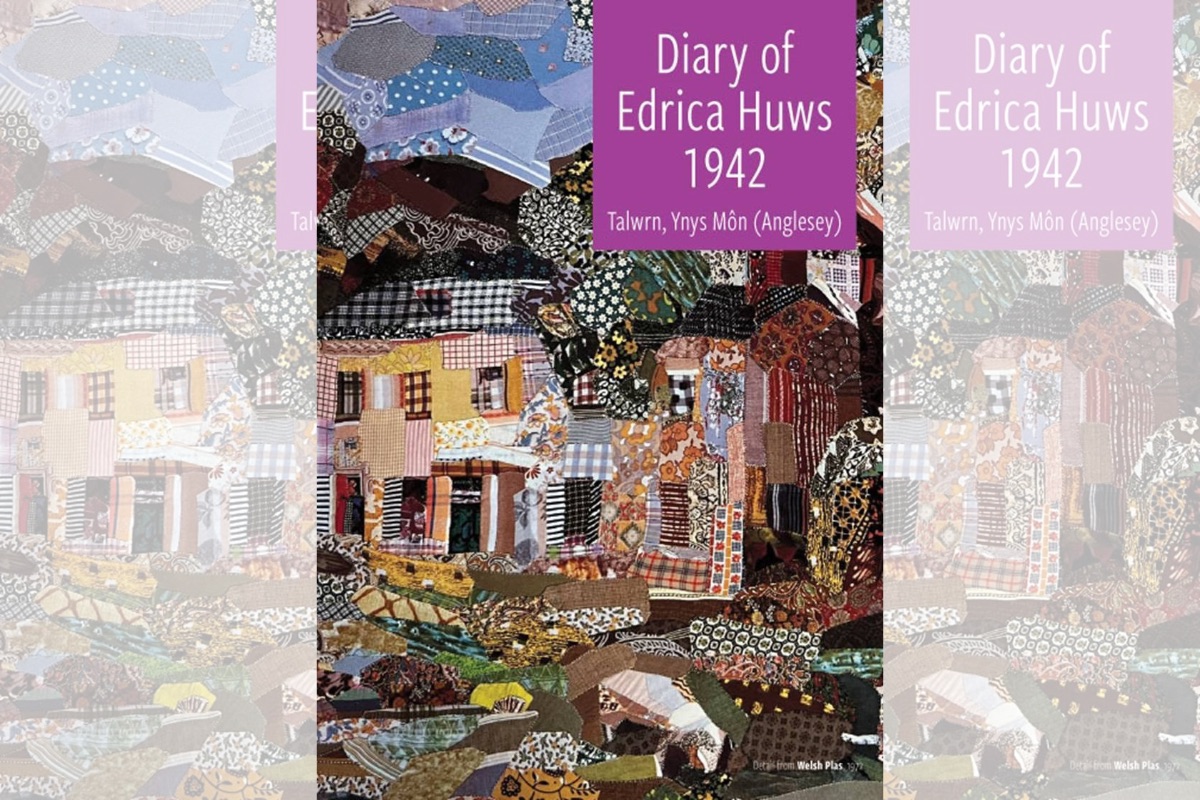
A previously unpublished wartime diary offering a glimpse into everyday life in rural Wales during the Second World War has been published more than 80 years after it was written.
The Diary of Edrica Huws 1942, published this week by Y Lofla, includes entries dated from June until September in 1942 detailing wartime life on Ynys Môn, as well as a biography of Edrica and various Appendices.
Born in London in 1907, Edrica Huws trained as an artist at the Chelsea School of Art and earned an ARCA diploma at the Royal College of Art in.
She shared a studio with Barbara Nicholson, worked freelance, exhibited with the London Group, and showed lithographs with the Senefelder Society.
She married Welsh industrial designer and naval architect, Richard Huws in 1931, and they had five children – the two eldest being born in London before the family moved to Talwrn shortly before the outbreak of the Second World War.
Edrica, who became famous for her ‘Patchwork Pictures’, started the diary three years after moving with her family to the rural village, which was without both running water and electricity.
One of Edrica Huws’ daughters, Catharine Nagashima, describes her mother as ‘an improviser’, saying: “[Edrica] managed to be creative amidst scarcity, whether making a wreath for a funeral, underwear for her children or concocting family meals.
“Being able to improvise was something she passed on to us, her children. She never pushed us with school work, but did give us summer holiday homework: collecting and drawing wild flowers, learning a poem by heart. She was herself a published poet.
“One of the appendices included in The Diary of Edrica Huws lists all the plants Edrica painstakingly identified after her walks around the village. Collecting scraps of material was also part of her creative improvisation.”
The diary was found amongst Edrica Huws’ papers after she died in 1999. Catharine explained: “My brother Daniel made cyclostyle copies to distribute to his surviving siblings.
“It never occurred to us to publish, until, as we grew older, we began to appreciate the value of diaries depicting daily life just as it was. Small, passing details acquire new, unexpected levels of interest.”
The diary chronicles daily life through anecdotes about her children, neighbours, gardening and love of poetry and flowers, alongside reflections on the progress of the war.
Catharine added: “It is a valuable record of village life and the progress of the war. There was a temptation to edit out some of Edrica’s frank remarks about marital rows, but we stuck to the reality. Time heals.”
One of Edrica’s great-grandsons, who grew up in Talwrn, commented: “My thoughts are that The Diary of Edrica Huws was written at a time of great anguish, grief and uncertainty.
“The resilience and collective warmth of Talwrn residents stands out. It represents a notion of hope and resilience that we should all cherish.”
While raising her family, Edrica turned to reading, gardening and poetry, collecting scraps of material that she later used to create Patchwork Pictures depicting rural life and memories of Talwrn.
Catharine said: “Edrica speculated that in her old age she might use the scraps of materials that she collected for patchwork. When empty nest came in 1958, she tried her hand at patchwork and found it boring. She instead produced The Greenhouse. Her husband’s admiration motivated her to continue.
“When she held her first exhibition at the Blue Coat Gallery in Liverpool in 1973 she had completed a dozen, by 1999 one-hundred-and-eighty-six Patchwork Pictures. Forty years of “making order out of chaos”.
The Diary of Edrica Huws (£8.99, Y Lolfa) is available now. The publication will be celebrated at Oriel Môn, Llangefni on the afternoon of Saturday 17 October between 1 and 4pm.
Support our Nation today
For the price of a cup of coffee a month you can help us create an independent, not-for-profit, national news service for the people of Wales, by the people of Wales.
Get more trusted Welsh news
Choose Nation.Cymru as a preferred source in Google News to see more of our journalism.


