

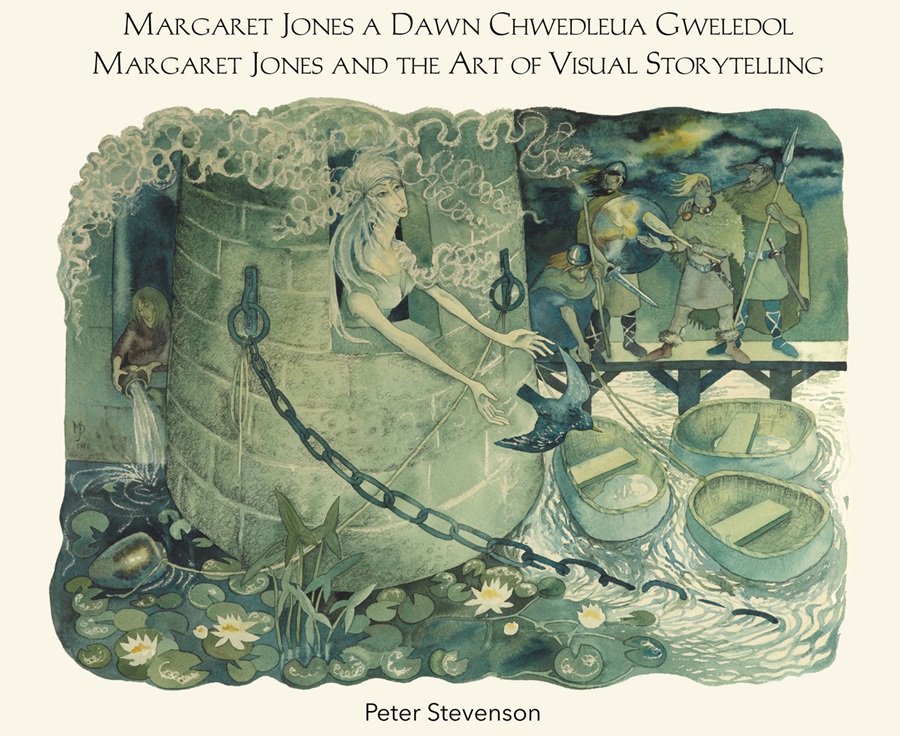
Margaret Jones and the Art of Visual Storytelling’ by Peter Stevenson
Julie Brominicks
Pssssst! The book pesters me from the shelf, its cast of characters demanding attention. Monsters, witches, thieves. Owain Glyndŵr, King Arthur, Branwen and more.
I take it down. It’s a weight in my hands, I pass it from one to the other. Like a Christmas stocking or an extra blanket at the foot of the bed, some weights – such as this – are delicious.
‘Margaret Jones and the Art of Visual Storytelling’ is Peter Stevenson’s tribute to the life and work of the artist who is best known for her intricate illustrations of Welsh folklore.
The text is bi-lingual (translated by Siân Lewis) and just the right length; that is to say it supports but does not dominate Margaret’s artwork, reproduced here in splendid quantity.
I let the pages open at random. Here, from the book ‘Culhwch ac Olwen’ published in 1988, is a depiction of ‘Ysbaddaden Bencawr’, a warty giant whose eyelids are propped open by men with long sticks.
Although administered in brown and black, there is a lustre to the firelight bouncing off the armour and the smoke, so enigmatically rendered.
I flick through the pages again. This time they fall open at a double-spread of twelve greeting cards. The designs range from a harpist in black ink to a watercolour of Twm Siôn Cati courting a woman in a red cloak set off by a leafy green background.
Labyrinthine patterns
A person could get lost in almost every image in this book, eyes drawn into labyrinthine patterns and plots. Foliage and décor at first overlooked, emerge as if by magic. Mischievous, merry, melancholy or malevolent, each character has a deftly drawn personality. Perhaps most satisfactory of all is Margaret Jones’ talent for composition.
‘It is all a matter of balance’ she is quoted as having said. ‘The artist balances vertical lines with horizontal, close-up objects or figures, against a distant background, dark against light, strong colour against weak, and realism against imaginative fantasy.’
Our author and curator Peter Stevenson, is well placed to comment on these skills, being an illustrator himself. He explains that Margaret, whose hero was Arthur Rackham, grew up in the Golden Age of Illustration, when photogravure had replaced the old printing process of engraving, and books became ‘exclusive art objects to be collected and cherished.’
Stevenson is also a storyteller. Who better then, with his trademark humour and spare prose, to narrate the tale of Margaret Jones? To do so, he draws on Margaret’s autobiography ‘It Came to Pass,’ his personal memories, and anecdotes from Margaret’s family and friends.
The result is gentle and affectionate. We learn that when as a child, Margaret was reprimanded for drawing on the walls, she instead carved a face in the fireplace. And that excited years later by a positive review of her book on Radio 4, brandishing her stick she burst into the room in which her husband was watching the rugby, and smashed the lightshade at exactly the same moment Wales scored a try.
Margaret Jones was born in Kent in 1918. When her mother died young, she was sent to boarding school, where she thrived. Whilst training to be a missionary, she met Welsh Presbyterian Minister Basil Jones. The couple married and were missionaries in India before moving to the Aberystwyth area in 1955 with six children.
Energetic
Margaret was an energetic, happy and capable woman devoted to family and faith. As is often the way in fairy tales, fame and opportunity resulting in the repertoire of art we know and love today did not come our heroine’s way until earlier tasks – in her case raising a large family – had been cheerfully accomplished.
Even then she found time to draw, and included here are examples of that early unpublished work. Indian figures and scenes, Capel Bangor landscapes, and illustrated alphabets made for her children. So too, are photographs of the dolls now held in Amgueddfa Ceredigion Museum, that she made from ping-pong balls and coat-hangers, and dressed in accurate costumes, for teaching history at Plascrug School. The groundwork and influences that would nourish her professional career are hereby revealed.
Margaret Jones was sixty when she was granted, at her own request, an exhibition at Aberystwyth Arts Centre. The show led to a commission from the Arts Council of Wales to illustrate The Mabiniogion by Gwyn Thomas and Kevin Crossley-Holland, which was published in 1984.
Until her eyesight failed, there followed a plethora of her now familiar art; calendars, cards, books such as ‘Tales from Celtic Countries’ by Rhiannon Ifans, and her gorgeous maps; particularly famously, The Mabinogion.
Sympathetic
I appreciate Stevenson’s wry and sympathetic account of Margaret’s adventures in publishing, as even this fairy-tale finale is not straightforward and there were the usual problems and rejections. ‘Arthur Rackham would never have had this trouble’ she grumbled to the Arts Council who complained that her work was not colourful enough.
As it happens, the one tiny issue I have, is also regarding colour. Having been inspired to seek out some of Margaret’s original artwork in the National Library of Wales (which I recommend you do, there are scrolls to unroll and boxes to riffle through) I found it a shade or two brighter. Something presumably unavoidable about the reproduction process, has darkened the background in print; not that it detracts at all, from the brilliance of Margaret’s art.
In fact, as we have come to expect from the H’mm Foundation (who published this book in partnership with the National Library of Wales), this is a beautiful volume. The sheer quality and quantity of expensive colour plates at a time when publishers have never been so broke, is astonishing. Margaret Jones died in 2024 and this is an excellent tribute.
As in times gone by remembered by Margaret Jones herself, here we have an artwork to be collected and cherished by art historians and art lovers of all ages.
Support our Nation today
For the price of a cup of coffee a month you can help us create an independent, not-for-profit, national news service for the people of Wales, by the people of Wales.



Margaret is probably most famous for her wonderful Map (Poster y Mabinogion, 1988) easily available books or art sites, bookshops.
I am struck with guilt that my new book just published all about the Mabinogi does not feature Margaret Jones. Introduction to the Mabinogi. I did try to squash as much as possible in a small book but I do not love excuses so will not hide my failure.
Ave Margaret I will try to do better by you.
Oh that made me smile in sympathy – I can take criticism no probs but live in mortal dread of offending or omitting someone every time I write anything. Loved your pieces on Y Mabinogi here, look forward to your book.