

Obituary: Remembering Jack Crabtree, the artist who captured the lives of Wales’ mining communities
Tony Curtis
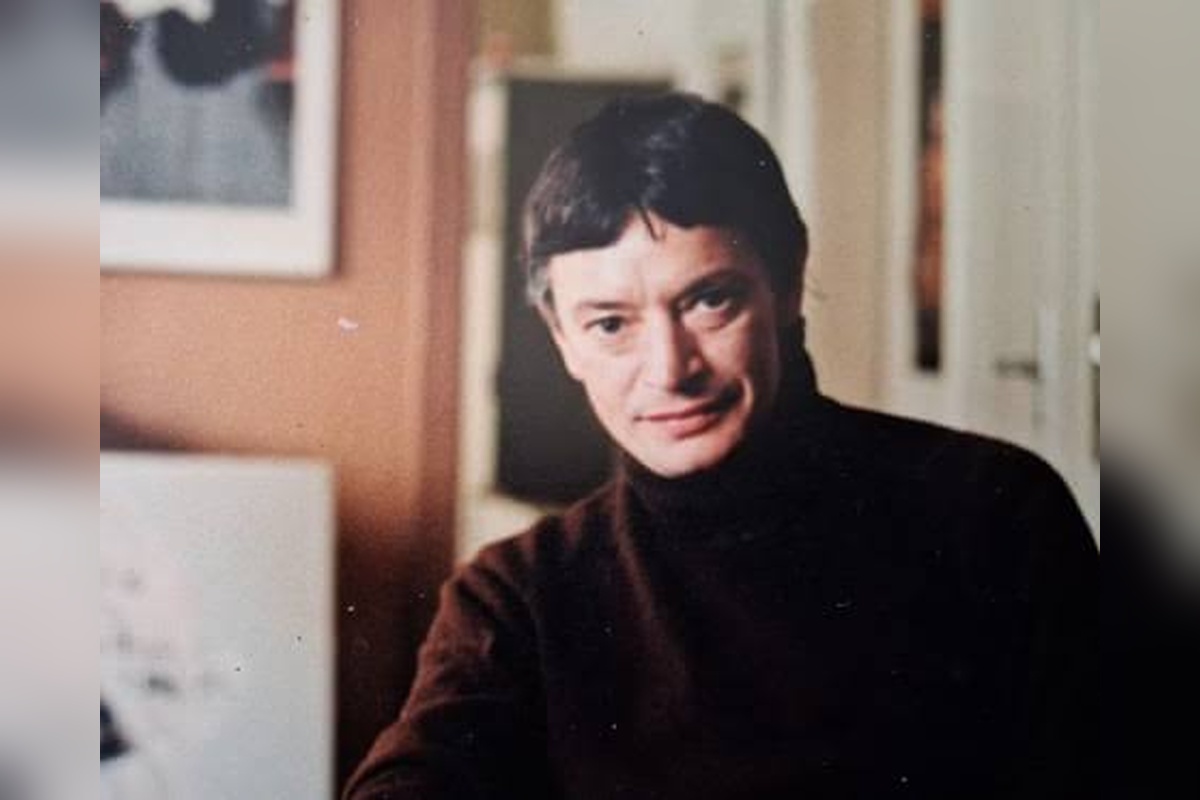
The painter Jack Crabtree, who has died in north Wales aged 87, came to Wales in the 1970s to teach at Newport College of Art and went on to make an invaluable contribution to the Valleys mining communities.
Jack had been one of the first artists I got to know. His was certainly the first studio I had visited and the books he loaned me and the conversations we had were formative in my entry to the world of contemporary art. Our return to Wales coincided with Jack’s rise in fame and fortune, for in 1974 he was given leave of absence from his lecturing job at Newport College of Art to undertake a year’s residency with the National Coal Board; he would record in drawings and paintings everyday life in the pits of south Wales.
He had to be trained in safety procedures below ground and then had pretty much unlimited access to the mines and the miners. No-one had been given such a broad and generous brief since Josef Herman had been befriended by the miners of Ystradgynlais over thirty years before. This commission had been set up by Billy Cleaver, a former Wales international and British Lion, who was an executive big-wig in the Coal Board and the Secretary of The Contemporary Art Society of Wales.
Through Polly Crabtree and her baby-sitting group in Barry we became friends with Jack. His colleagues at Newport included John Selway, Ernest Zobole and others. So, through Jack I got to know some of the most notable painters at work in south Wales at that time.
The pit managers expected a couple of drawings and canvases; what they got was an astonishing series of works from the final glory days of the industry, most of which were to be hung in their offices.
This wiry former Teddy Boy from Rochdale clearly empathised with the working men around him and was generally accepted. From Rochdale he had gone up to London, to St. Martin’s and then the Royal Academy School. In the 1970s, Jack was featured in a TV film, had regular exhibitions and, in 1977, he was awarded a Ruhr Arts Fellowship from the German government; there he also picked up lucrative commissions from the Ruhr industrialists in Germany. In Wales, he became a member of the 56 Group and had a Fellowship at Gregynog Hall from 1975-76, which has in its collection “Landscape with Derelict Pylons.”
When Jack finally moved from Barry for a post in Northern Ireland, he left that huge house overlooking the Butlin’s car park on Barry Island: from his personal troubles to The Troubles. Jack left Wales behind; and a parting gift of a drawing of miners for me. He returned a few years later and had an exhibition at the newly opened Martin Tinney Gallery, then in Jacob’s Wharf in Cardiff.
Jack’s subject-matter had shifted to Northern Ireland and many of the new works were addressing the volatile political situation and challenges of that country. There were some canvases with toy guns attached to them. It was a memorable opening, not just because of the strength of the art, but because we were all evacuated further up the street towards Cardiff Central Station as there had been a bomb warning phoned through to the gallery. The exhibition never re-opened.
Dramatic
There were few more dramatic characters or lives in the south Wales art scene than Jack’s. The parties he and Polly threw in their large sea-captain’s house on Barry Island were legendary. That house on Redbrink Terrace overlooked the Butlin’s car park and Jack had raided the amusement arcades on the Island to secure slot machines and arcade games as they were modernised and thrown away. His was a house of high art and trashy distractions. You needed a large cheque-book for the art and a collection of old-style coins for the slots.
But within a few years of moving from Barry he also moved out of our focus, rarely exhibiting here and shifting the roots of his personal and professional lives.
The last time we saw Jack was at Peter Prendergast’s funeral in Bangor in January 2007. Ever the Dandy, he came at us wearing a long black leather coat and insisted on hugs and kisses. The year before I had driven Peter up through the Nantlle Valley and he had pointed out an impressive Georgian pile. He said that it was Jack’s.
But what of his legacy? Over nearly five decades, as the pits closed, well over a hundred paintings and drawings of the miners have been scattered, resold or lost. Some turn up at auctions, but rarely fetch the kind of sums they deserve.
If you do not have a family or direct link to the industry or to specific miners, then why would you want to live with Jack Crabtree’s strong men with their pained and angry faces? Some of the scenes he painted are specifically political; the coal mining industry was in the final and often violent throes of its existence. Within a decade it would be doomed.
Public collections
He is represented in public collections – The National Museum of Wales, The National Library, the Cyfarthfa Castle Collection, The Glynn Vivian in Swansea, The University of South Wales, MOMA Machynlleth, The Arts Council, Gregynog Hall, in Dublin and Belfast, and in the National Coal Mining Museum in Wakefield. And yesterday I found a miner’s head in an auction in Germany; it was estimated at over 2,000 euros.
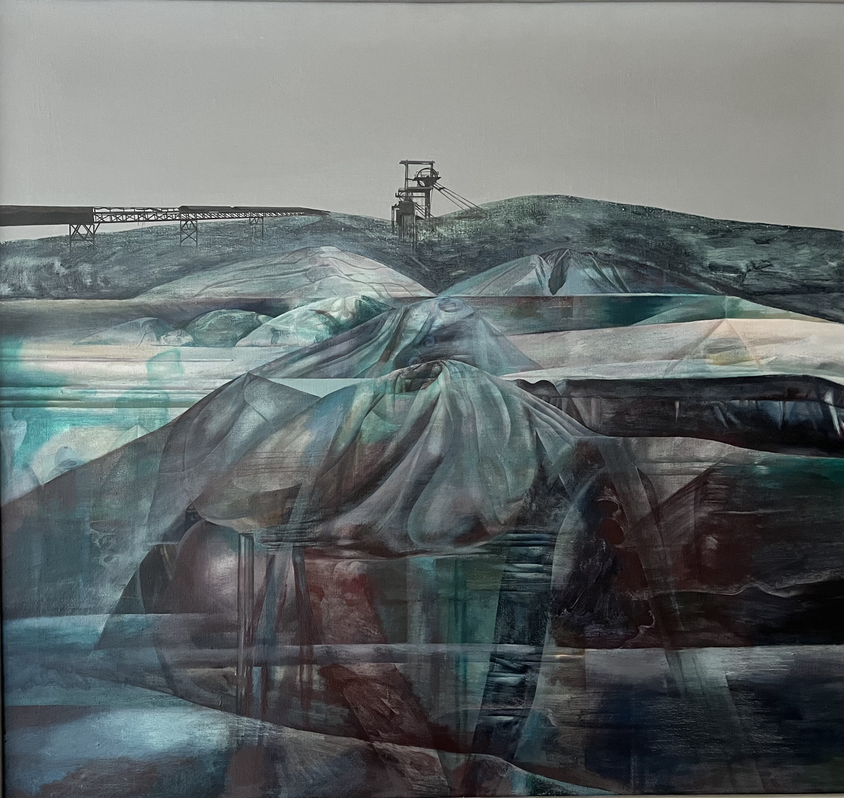
The drawing Jack gave me when he moved away started to fox at its edges and I eventually parted with it. But we do have a large oil, “Landscape with Conveyor”, which just pre-dates his NCB residency. Beneath the pit-head is another world of levels and colours and substrata. It is alive and moves with its gases and wreckage and roads. Although the raised track reaches for the pit, it is empty and the winding gear itself is already some kind of memorial in waiting.
When I edited Coal: An Anthology of Mining in 1997 (Seren), we used the pen and inks of Josef Herman as illustrations. It opened with Wilfred Owen and closed with Philip Larkin. There was a foreword by Tony Benn. He said, “Unlike those in the City who earn their living by outsmarting their neighbours, miners survive by relying totally on those working with them at the coal-face, sharing the adversity of explosions, roof falls or other possible calamities. Miners – like fishermen and farmers – have evolved a special type of tribal solidarity because they are up against a nature which can be very harsh.”
That particular tribe welcomed a skinny guy with his northern accent into their world; he rewarded them with the committed gaze of a skilled artist; with an honesty and admiration which is both a celebration and an accusation.
I still enjoy visits to the painter Charles Burton, from Treherbert, now in his ninety-eighth year. As a boy, he remembers each day that his father went off to the pit he lived with the dread that he would never see him again. When Margaret Thatcher’s name comes up, Charlie snarls, but says, “Closing the pits was the only good thing she ever did.”
Coal has gone: though it still runs under and through us. For most of my life in Higher Education I worked either within sight of what had been the biggest coal exporting port in the world, or driving up past a working pit in Nantgarw to the former School of Mines in Trefforest, where, for a few years, we still had some day-release miners on liberal studies courses. In my last collection of poems – Leaving the Hills (Seren 2024), just before the sequence written to commemorate the Aberfan disaster, there is a poem based on a large oil painting on the university campus. It is one of Jack Crabtree’s strongest.
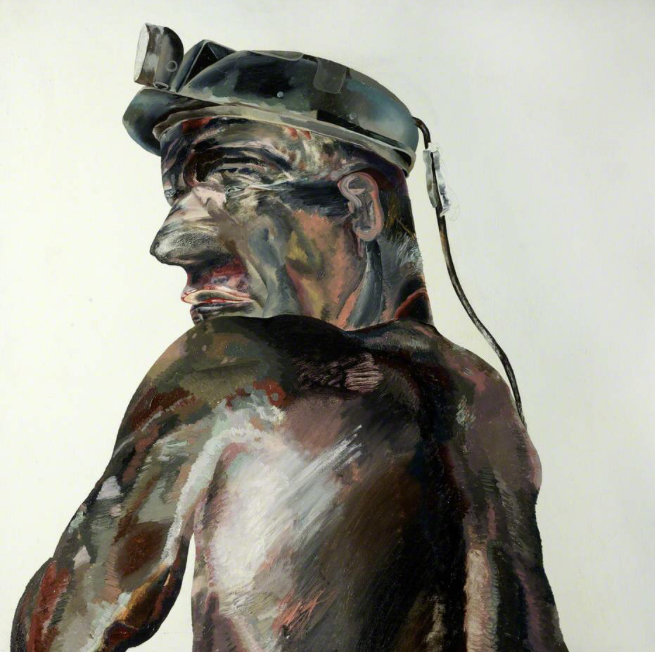
At the G6 Face
For Jack Crabtree
Someone has called his name
and you catch him as he turns
away from the coal-face,
his lamped helmet perched back,
eyes squinting in the half light.
Even at the Face, damn near naked,
breathing dust, men are not black.
Their lamps and the Anderton Shearer’s glow
shows their skin as a tough, sinewy covering,
a tapestry of flesh tones – brown and red and blue.
The arm muscles flexed and full,
his shoulder is a slag heap with the gorse taking root,
and the rib-cage is taut and wiped clean
where the skeleton shows through.
Support our Nation today
For the price of a cup of coffee a month you can help us create an independent, not-for-profit, national news service for the people of Wales, by the people of Wales.
Get more trusted Welsh news
Choose Nation.Cymru as a preferred source in Google News to see more of our journalism.


