

On Being a Poet in Wales: Aled Jones Williams
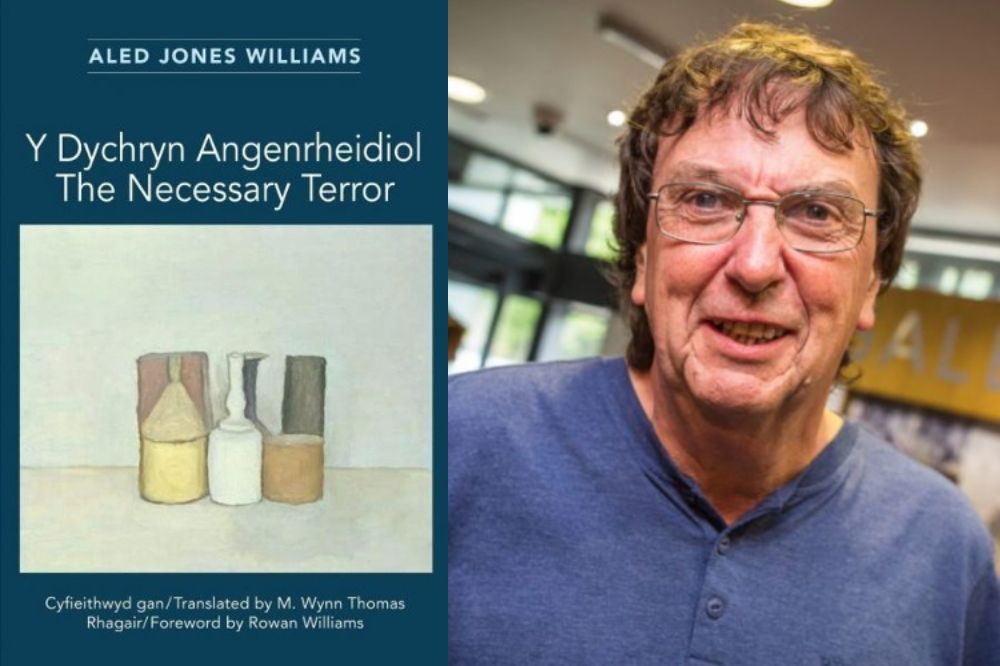
Aled Jones Williams writes about his poetry, translation and his newly published volume, Y Dychryn Angenrheidiol/The Necessary Terror.
There was a bit of a to do when I was awarded the crown at the National Eisteddfod held at St David’s that year, 2002, for a pryddest on the theme Awelon (Breezes). A poem to be looked at as much as to be read. A collage made out of words. I must have been rather naïve to think that there would not be a reaction.
After all these years, the criticism, as far as I am concerned gone, I consider Awelon one of the most important pieces I ever wrote.
Why would that be? It was a beginning. Full of latent things waiting for me to dis-cover them.
There is, I think, a false belief about winning the major prizes at the Eisteddfod. A belief that somehow you have finally arrived. The zenith of poetry has been reached. You are now a Prifardd. Mm!
It is a mere beginning, that you must leave behind.
Reflecting on Awelon – the actual poem – what did I dis-cover? Years of reading. I detect Beckett. Not the dramatist, but the more important prose writer of brief texts like Ping, Lessness, or Fizzles. My constant companion amongst Welsh language writers, Morgan Llwyd; his, on the whole, brief works and startling imagery; his complex sentence construction yet easeful when spoken out loud. Ezra Pound and my many dives into the Cantos, coming out occasionally with things like: “The ant’s a centaur in his dragon world./Pull down thy vanity….” A small volume of criticism by Angharad Price, Smentio Sentiment, an introduction to the Concrete Poets of Wien, writing after the Second World War in the German that had been deeply tarnished by Nazism. And how this poetry was not some fad or gimmick but a deeply political reaction to a period of unfathomable human darkness. All these things and more were there.
In time Awelon ‘deconstructed’ itself into the small, brief poems, each one with the title ‘duw’ – ‘god’ – that I have been writing ceaselessly for the past ten years or so. I could never be a Talwrn poet – appearing as part of a team on BBC Radio Cymru’s Talwrn y Beirdd, or write a nature poem – apart from finding in nature images for ‘duw’.
With a title like that these poems are unashamedly religious, indeed Christian. ( Not in any sense churchy – I left the church ages ago.) And that will not endear me to many in contemporary Wales. But what would be my alternatives: a bland atheism, and its companion, a secularism that has cashed out-literally-as consumerism? Or, even worse, the exchange of Welsh for that misty, and on the whole meaningless word ‘Celtic.’ We are all Celts now it seems.
The ‘duw’ poems are about the ability of the Welsh language itself to make space for the Transcendent. Not by naming or – impossibly, of course – describing, but the words moving aside to make room for ‘visitation.’ Poems of annunciation, I suppose, actualized by the white page, the aporias between words, the verbal absences – not the Absence of R.S. Thomas, please note – yet impossible without the Welsh words themselves on the paper. I have sought a ‘new’ way of writing the religious.
My practice was to write them by hand in small books and send them as ‘gifts’ to a small number whom I thought might get ‘something’ out of them.
One of the recipients was Professor M. Wynn Thomas who found in them sufficient worth to translate a number into English. That was a big moment for one who had constantly resisted translation for years. My amazement at Wynn’s translations prevailed. No easy task, since my practice is to break up the Welsh words in order to find other words hidden within. Language as sacrament, if you like and the linguistic equivalent of the breaking of the Eucharistic host. Hence the book Y Dychryn Angenrheidiol/ The Necessary Terror, published by Ali Anwar of the H’mm Foundation. It is not my book, but our book: Wynn’s and mine. I had never before appreciated the symbiotic relationship between the first writer – the author – and the second writer – the translator.
As I hold the book, I hear distinct voices, primarily: the two major religious poems in Welsh from the last century, two poems that I have constantly pendulated between them: Mewn Dau Gae by Waldo Williams and Gweddi’r Terfyn by Saunders Lewis. And from Saint Beuno’s, the by now Jesuit Retreat Centre in Tremeirchion, the spirit of Gerard Manley Hopkins calls, and his sprung rhythm which parallels cynghanedd, making Hopkins as much of a Welsh poet as he is an English poet. These and others are the Awelon that flow past me and caress me. Leaving behind enough Welsh words in which the Transcendent may ‘nest’.
Y Dychryn Angenrheidiol/The Necessary Terror by Aled Jones Williams is published by the H’mm Foundation and was a Books Council of Wales’ Book of the Month for March 2026. It is available from all good bookshops.
Support our Nation today
For the price of a cup of coffee a month you can help us create an independent, not-for-profit, national news service for the people of Wales, by the people of Wales.


