

On Being a Writer in Wales: Anne Keer
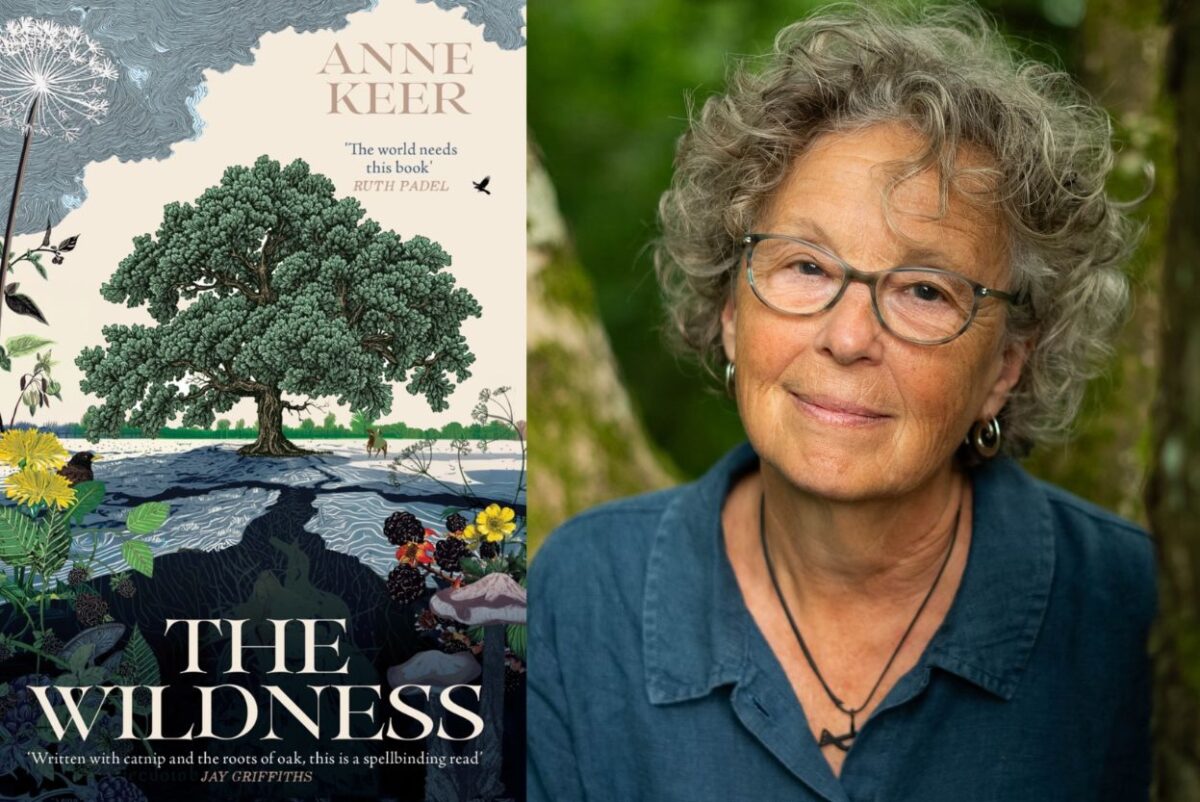
Anne Keer
Every Friday for the past 25 years, my walking group has set off into the Montgomeryshire countryside. Our favourite mountains, moors, hills, valleys, rivers and lakes will have seen us pass many times: a small group of women, curly haired mostly, generally chatting. As the walk lengthens and we fall silent, we may spread out single file along the path. If we are yomping pathless over a moor, we’ll keep an eye out for each other, like a flock of starlings moving through a field. Many of us have gone grey over the years. The children we walked to disentangle ourselves from have grown and gone. Work that had to be fitted around has come to an end.
This moving through landscape with only what you carry on your back allows boundaries to dissolve. We are purposeful, but not very. There’s ground to be covered but the limping buzzard over there has halted us; the swathes of bluebells on the adjacent hill are not a backdrop – that’s not possible when their scent is in us. We breathe. We sit and rest. The friend we have lost may come to mind. A curlew may soothe with its distant, bubbling call.
Wordsworth was onto something when he gave us ‘wise-passiveness’ – that tendency for nature to inform us just by being in it, quietly. He sits on a rock in the Lake District (as we women have done many times in Wales) while his friend chastises him for not spending his time more productively in improving reading or thought. But what Wordsworth knows is that our eyes see, our ears hear and our bodies feel wherever we are, without us having to try – and by letting this happen we can be nourished. Sitting on a rock, noticing, beside a lake, is also a way to understand the world, but not in the way we usually imagine.
I hadn’t heard of ‘wise-passiveness’ when I began writing my novel The Wildness, but I did know, instinctively, that the way we are generally taught to ‘know’ the world around us wasn’t enough. I suspected that seeing the natural world as inanimate, unfeeling and separate was having an adverse effect on the actions we humans were taking. For as the planet struggles to sustain all its life forms, and people are lost to wildfires and floods, our actions seem well out of kilter. Even the wildflowers on a roadside verge could be victims if they were mown too soon.
I knew this loss of balance was relatively new. Had there been a different, earlier way of knowing in relation to the natural world? A way that we’d lost?
My protagonist, Hannah Sentance, living in England at the end of the eighteenth century, would have been better placed to answer than me. At that time, a pre-modern culture was still hanging on at the edges. Karen Armstrong, historian of Comparative Religion, writes that in every pre-modern culture, people, ‘…still see a continuum of time and space, where animals, plants and humans are all permeated by an immanent sacred force that draws them into a synthesised whole’. In my novel, it is the cunningfolk, Linnet and Jael Withycombe, whose world this is, and while they may not be saints, Hannah (unhappy, young wife from the big house) is drawn – of course – to their worldview. With them the land is alive; the natural world is singing and fecund; the way they live is woven with reciprocity and connection. Hannah knows wise-passiveness.
But already modernity is pressing, and her thoroughly modern husband, Walter, sees things differently. Unconstrained by respect for the past or concern for his poorer neighbours, he sees the natural world around him as a blank canvas. A private, Gentleman’s Park is within his sights.
Writing Hannah’s story was not just a way to lure a comfortable, bodiced lady outside the confines of her Jane Austen-style drawing room (something I suspect I had always wanted to do). It has helped me understand what I had first, instinctively mistrusted: our dominant, utilitarian view of nature. The novel is set in England because this is where it all began several hundred years ago, when the natural world, devitalised, became mere matter to be used for human ends. For centuries in the West, a perfect, but gradual storm of thinkers and events had been brewing, until our separation from nature was complete. Industrialisation and empire sent it worldwide. Our lives since may have been upgraded, but at the expense of all other species, and increasingly, ourselves.
Over a long period of returning, you can’t help noticing changes: fields less vital, birdsong sparser, fewer butterflies and other insects. A motorway of a track slicing an expanse of hill, or a chicken farm quietly humming where a ploughed field had been.
Since writing the novel, I have wondered how things might have been if a different set of paths had been taken. Not for the characters in the book whose lives are fixed, but for those of us alive now, human and other than human. Yomping where there are no paths to follow can be exhilarating, and it probably was for those of our ancestors taking the lead. Shrugging off the old veneration for nature must have felt like progress. But for those trailing behind – the poor, the natural world itself, then and now – it hasn’t been progress at all. Not often do we walkers have to declare we’ve gone the wrong way, but if it happens, a bit disgruntled, we can turn round. All that matters is to get home safely by nightfall by whatever route. That’s not so easy for the planet now.
This sorrow can be hard to carry.
Yet we walk… and a hen harrier graces us with her silent glide past. How is it, in taking our breath away like this, or simply getting us puffed, this ancient and varied landscape still works on us? Through its persistence, perhaps. With the undoing of our purpose and intention – with the luscious quiet and the noticing – with simply being there – we find ourselves back where we belong, IN not outside the natural world.
Anne Keer lives on a hill in rural mid Wales where nature and the land have shaped her ideas about the natural world. Previously she worked as a journalist and in television documentary and drama. She has a PhD in Creative Writing from Aberystwyth University and tries to give nature a bit of space on the land she and her partner look after. The Wildness is her first novel, and is available here.
Support our Nation today
For the price of a cup of coffee a month you can help us create an independent, not-for-profit, national news service for the people of Wales, by the people of Wales.
Get more trusted Welsh news
Choose Nation.Cymru as a preferred source in Google News to see more of our journalism.


