

On Being a Writer in Wales: Mark Hubbard
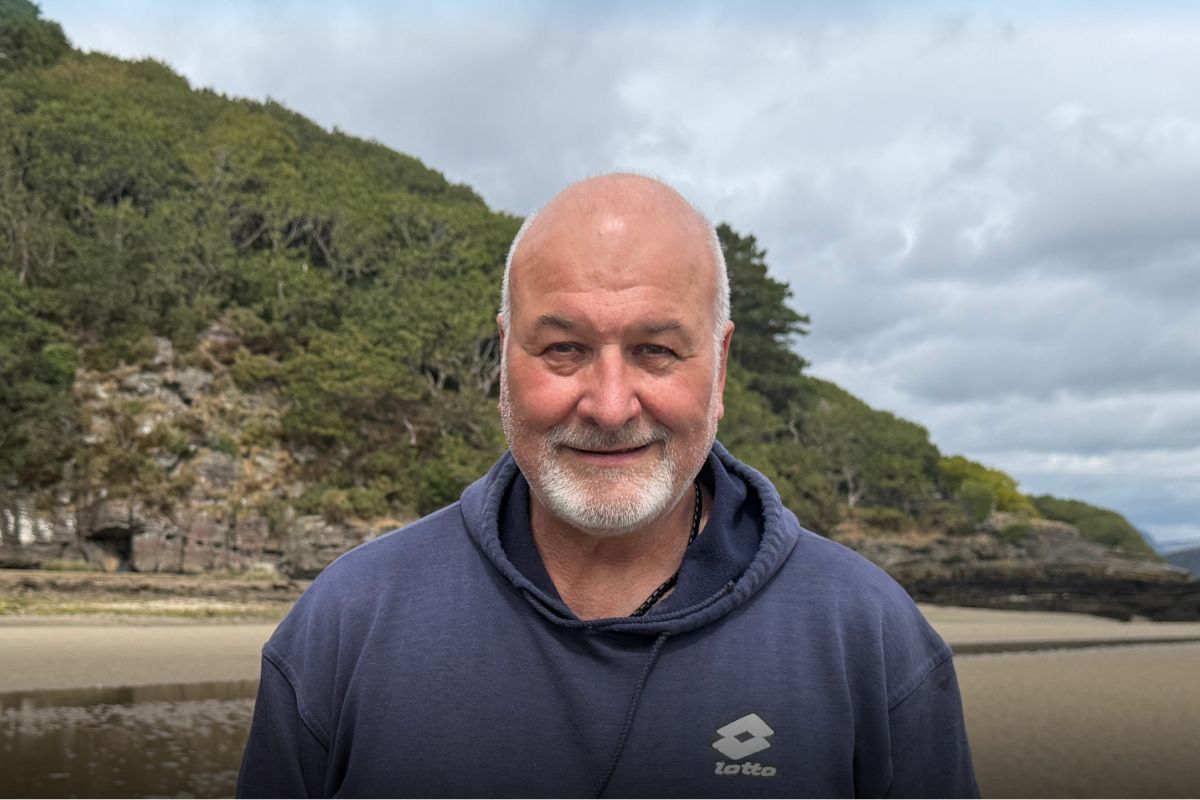
Gellilydan-based author Mark Hubbard considers the pleasures and discoveries of writing his debut novel.
I was born an alarmingly long time ago when televisions still used tubes, buses had their engines at the front, and Mars bars were the proper size.
The first four years of my life were spent in Devon before a change of career for my father – he joined the police – meant we had to move to Southampton. It was there that I started my education, a term I use loosely because, despite the commendable efforts of my teachers, I failed to achieve anything noteworthy in any of my examinations. In my defence, I suffered from awful hay fever throughout the exam term and had to cope with my parent’s divorce.
After some hard thinking, I decided to join the Army and spent the next ten years dressed up like a bush. It was a time filled with long periods of tedium and shouting (mostly at me) interspersed with moments of exhilaration. There’s nothing quite as exciting as blowing up the officer’s mess for a laugh.
Once they had had enough of me – it took around ten years so I can’t have been that bad – I left the Army behind to live in the southwest of England. My ambition was to make a living in the music business. I had an album of songs, an agent in London, and high hopes. Sadly, although they liked my music, the record companies weren’t that keen on me. I was twenty-six by that time and they said I was too old for them!
Fortunately, that rejection turned out to be one of the best things that ever happened to me. It led to a complete change of direction, and I started work as a part-time youth worker running a rural, one-night-a-week village youth club. I also met my future wife; we married and had two beautiful daughters, Loren and Sophie, who are now both grown up. They are wonderful and I am a very proud dad.
My work at that youth club and with the wider youth service led directly to many of the stories in the pages of my book. Whilst it is supposed to be a work of fiction, there’s a lot in it that really happened. I may have embellished it here and there, but as is often the case, the strangest, and sometimes funniest things are to be found around us if we take the time to look.
Up Dinc-Bottom is the story of Dinctum Village Youth Club, a one-night-a-week youth club in the fictional southwest county of Dorkshire. It tells how Agnes Braintree, a disillusioned and bitter headteacher, starts a campaign to have the club shut down. She regards it as a den of left wing, namby-pamby, liberal thinking and believes that it ‘infects’ the minds of her pupils with notions of empowerment that undermine her authority, driving her ever deeper into the large bottle of brandy she keeps hidden in her desk.
Agnes has suffered abuse and humiliation throughout her teaching career and prompted by a very public display of cheek from a junior youth club member, out of his tiny mind on vodka, she decides the time has come to act and she sets out to force the club’s closure by any means possible. However, the senior club members (young people between the age of 12 and 18) prove to be more than a match, coming up with a cunning strategy aimed at stifling her plans and bringing about her downfall.
After a promising start, events spiral out of control, and the police, who were struggling to keep the peace from the start, call in troops from a nearby garrison. That only adds to the farce especially when TV crews with mobile satellite dishes turn up to broadcast the spectacle to a news hungry world. Cars are set on fire, a house is blown to smithereens, ferrets are raced, cows sing, missiles are launched and a frog croaks. You will have to read the book to see if life ever gets back to normal, or whatever passes for it, in that corner of rural England.
This being my first book, it was something of a voyage of discovery for me. I had no idea how best to approach the process of building a story that was only loosely mapped out in my head. I had a lot of notes and countless ideas, but I didn’t know how to bring them all together in a cohesive whole. What I ended up doing was writing a series of stories and then, thanks to a very large computer monitor, having them all on display so that I could pull bits from the various texts and assemble them into a master file. It is a process that worked well once I was used to it.
Even so, I didn’t find it at all easy. A lot of the humour in the book is based on funny or farcical situations which I ‘see’ – if that makes sense. I found it challenging to find a way of writing these ideas down in a way that other people would understand and see in the same way I did. Anyhow, I seem to have succeeded because the feedback I have from readers so far is encouragingly positive.
My primary tool for writing is Microsoft Word and secondly a desktop publishing application – Affinity Publisher – which I would highly recommend as a cost-effective alternative to better known applications such as InDesign. I also used a tool in Microsoft Word called ‘read aloud’ (under the Review menu). It was incredibly useful to have every line of text in the book read out loud in real-time using this feature and I could immediately hear if something didn’t work or lacked rhythm.
People always ask who influenced my writing. I guess we take something from every experience we have so it would be difficult to give a precise answer. However, my book is most like the writing of Tom Sharpe in terms of the type of story it tells. I would also mention Terry Prachett. I wouldn’t dream of comparing anything I have done to his amazing work, but I love the easy style of his writing. My sense is that he didn’t set out to impress people with anything other than a good and well told story. I love that and have tried to keep that in mind when I write.
The book was largely written over twenty years ago, long before I moved to north Wales. Having lived in Bavaria and near the Rocky Mountains in Canada, I knew that I felt most at home and at ease in the mountains. I needed to get back to them and so, when I was looking for somewhere to move to, North Wales was the perfect choice. I had spent time in Eryri way back in 2002 doing a Mountain Leader qualification at Plas y Brenin, the National Outdoor Centre – where I now work – and was here a few times on holiday with my daughters. Living in Eryri has given me an amazing boost creatively and I was able to finish the book and publish it. The landscape and people here are wonderful, and I am so grateful to be part of it. I found a two-hundred-year-old cottage in Gellilydan where I live with my partner, the artist, Sesga Jones. We absolutely adore each other, and I am undoubtedly the happiest I have ever been.
There’s one other thing I would add to all of this: although the book was mapped out in my head, it often wrote itself and took me on an adventure to places I hadn’t expected to go. For me, that is one of the great joys of writing. I found I could set the characters loose and see where they went. It was a lot of fun.
Up Dinc-Bottom by Mark Hubbard is available to purchase here.
Support our Nation today
For the price of a cup of coffee a month you can help us create an independent, not-for-profit, national news service for the people of Wales, by the people of Wales.
Get more trusted Welsh news
Choose Nation.Cymru as a preferred source in Google News to see more of our journalism.


