

On Writing Weights and Measures – a story made in Swansea
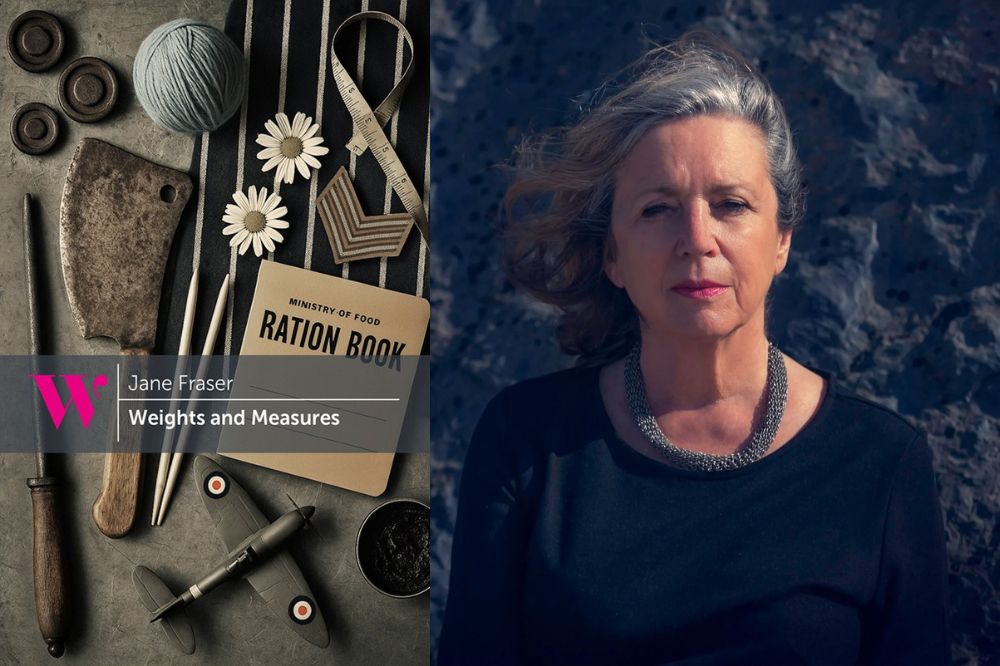
Jane Fraser
It was the absence that sparked it, all gone: the butcher’s shop, the school, the church, the chapel, the old ‘square’, and above all the people of Cwmbwrla, Swansea. This was the ‘milltir sgwar’ of my childhood, that of the first half of my father’s life, and the adult life of his parents, too.
All I’d done was to take the car for service in a garage off the immense roundabout that now dominates Cwmbwrla, finding myself with time on my hands as they sorted the engine and the inner workings. Time to walk once familiar streets and sniff out the past.
As I walked the paths I walked as a child, almost seventy years before, memories, and an unexpected sadness crept into me, in through the pores of my skin, up through the soles of my feet, such was my deep connection which had a profound effect on my ‘inner workings’.
Writing the gaps
I realised that with my grandparents long-dead, and my father almost ninety-eight, my last link with the past and the rich stories it carried would soon disappear. There would be a gap – that absence – and an empty feeling that it somehow never existed at all.
It is said that the gaps are a fertile ground for writing fiction. And it was then, I felt compelled to tell the story of the place and its people. As Maya Angelou says: “There is no greater agony than bearing an untold story inside you.” I had to make sense of loss in its widest sense.
From fact to fiction
So Weights and Measures take some historical accuracies. My grandparents (the fictional Jim and Mary Froom) did run the butcher’s shop at 141 Middle Road. One of their children, Peter, did win a scholarship to study at The London Choir School and later to join the RAF ahead of WW2. Though I only remember my grandparents as very old people, my father told me that in his father’s younger days, he was particularly partial to a flutter on the horses and was also very secretive, and sometimes very disturbed, about his experiences in WW1. But that’s where facts end and fiction begins.
The ‘phoney war’
I was inspired to create a fictional story about the Froom family that plays out over the one-year period between September 1939 and September 1940. I wanted to focus the lens on how the shift from the so-called ‘phoney war’ to the ‘real war’ affected members of the Froom family, there in, and behind, the shop on the home front, in a working-class suburb of Swansea, exploring their lives of fear, passion and hope. And their public and private selves.
Jim Froom, the butcher, hides things: his gambling, his black market antics, the fact that now his son William has enlisted, he is haunted afresh by the carnage of the Great War. Mary Froom is a capable woman, perpetually frustrated. Mother to four – five if she counts Jim, who needs watching too – guiltily, she lives for the day when her youngest will be out from under her feet at primary school. Teddy is thirteen, but already obliged to fill William’s shoes. Working in the family butcher’s shop, he dreams of becoming a surgeon, a dream as unattainable as that of his sister Dora, eldest Froom child, returned to Swansea from a life of relative freedom in London…
Preoccupied with their secrets, they live in almost suspended animation, waiting for an end to the weeks and months of apparent nothing – the so-called ‘phoney war.’ None of them are prepared for the real war when it begins – devastating and senseless, reconfiguring their lives forever.
Untold stories
I have told the first part of the novel deliberately unhurriedly to mirror that ‘almost suspended animation’ and then upped the pace in part two to show the sudden impact of the ‘real’ war. I put my hand up and can say that this novel is not a page-turner, but I hope a ‘slow-burn’ and immersive experience for the reader.
The narrative is told through three perspectives: Jim, Mary, and thirteen-year-old, Teddy, as I wanted to give voice to members of whole family, not only to butcher, Jim, but to a woman and a young adult, whose stories are often left untold, exploring the devastating effects of war: how it not only thwarts ambition, but also offers opportunities. I am also interested in family dynamics – and dysfunction – and I wanted to focus on that, too.
A sense of place
The writing of Weights and Measures, started with place (as did my first novel Advent). Being brought up in that butcher’s shop at 141, walking the streets of Cwmbwrla, attending its school, drinking frothy coffee in the Italian cafés that used to be at the heart of Cwmbwrla Square, enabled me to cast my intimate knowledge of the territory back in time to 1939, and move my characters though the narrative with, I hope, a degree of authenticity. I would love my readers to feel satisfied with the story, to say: I can imagine what it felt like to be those people, living in that place at that time.
A love letter to Swansea
Weights and Measures has found the best home I could wish for at Watermark Press. As a Welsh-based writer I am delighted to be published by a proudly Welsh-based press. Weights and Measures is not a story merely set in Swansea for cosmetic purposes, but truly made there and part of its DNA. It is an homage to a Cwmbwrla that once was and is no more.
As the wonderful BAFTA-winning Film and Director, Euros Lyn, puts it: Against the epic backdrop of the Second World War, Fraser’s intimate love letter to Swansea bursts with passion, humour, and heart.
I hope readers will enjoy the novel as much as I have enjoyed writing it.
Support our Nation today
For the price of a cup of coffee a month you can help us create an independent, not-for-profit, national news service for the people of Wales, by the people of Wales.
Get more trusted Welsh news
Choose Nation.Cymru as a preferred source in Google News to see more of our journalism.


