
Poet Profile: Angela Graham
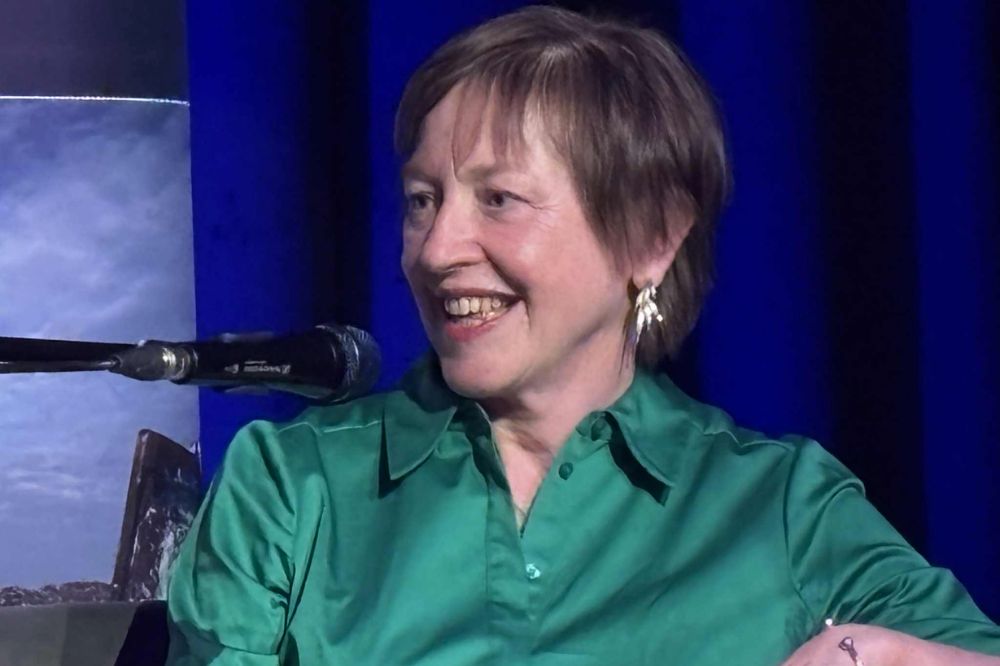
Angela Graham is a BAFTA Cymru-winning filmmaker and journalist who turned to writing poetry full-time in 2017. Her work has appeared in The North, The Honest Ulsterman and Poetry Wales, amongst many others, and her first collection – Sanctuary: There Must Be Somewhere – was published by Seren Books in 2022.
To mark the February release of her latest collection – EXPOSURE: war, media, democracy – Graham joins us here for our ongoing Poet Profiles series in which we pose our burning questions to writers shaping the modern literary landscape.
- Do you remember what first drew you to poetry?
Poetry has always been part of my life. I wrote my first poems aged six – short rhyming verses – and my mother was so surprised that she typed them up. I still have them. She submitted one of them to a weekly magazine and it was published. Because I was so young my headmistress had had to write and confirm my identity and age but she claimed I was eight. The editor stated beneath the poem, ‘Authenticity vouched for in the usual way’ but I knew our fearsome headmistress was lying – in print! So I learned something about unreliability.
And those words had such an intriguing sound, ‘Authenticity vouched for …’ What did they mean? This was my first encounter with ‘vouched’. And my poem was suspected of being not real in some way? I took words seriously while finding them very pleasurable.
- Who are some of your favourite living poets, and what resonates with you in their work?
I love Gwyneth Lewis’s work, in Welsh and English. She has a forensic sense of which word is just the right one for the task in hand. This precision appeals to me. She does the work of weighing experience and emotion and intellect and giving to each proportionate heft within a poem. Her, ‘Treiglo’ (Barddas, 2017) is a masterpiece of sustained attention to a subject and of using a metaphor (that of linguistic mutation and other sorts of change) to support and deepen her engagement with the subject. Her most recent collection, ‘First Rain in Paradise’ (Bloodaxe Books, 2025) is a pleasure throughout. Her excellent prose memoir, ‘Nightshade Mother’ (Calon, 2024) won the Wales Book of the Year 2025 Creative Non-Fiction Award.
- What have you read recently that excited or surprised you?
I am enjoying Menna Elfyn’s trilingual, ‘Let the World’s People Sing / Caned Pobl y Byd’ (H’mm Publishing, 2025). She writes in the introduction, ‘The original Welsh poems were rendered into English and subsequently crossed another bridge; that of Arabic.’ by means of writers Rawan Sukkar and Lara Matta. Elfyn declares the book to be ‘a clarion call for people of all languages to respect their neighbours’ ‘mother tongue’. This appeals to me because I’ve always seen language as a bridge rather than a barrier. In each of my books there is at least one language other than English. In my new collection there is a trio of poems, for instance, which begins in Ulster-Scots, moves to Welsh and then to English. It’s a huge pleasure to be able to use the characteristics of languages to ring changes on the act of expression through language. Each has virtues and strengths for the writer and reader to enjoy.
Currently there is an exhibition in Belfast’s Linen Hall Library of poems commissioned for its Fragments of Scotch Poetry Project. I was one of ten poets asked to read through their collection of Enlightenment poetry (which includes Burns and contemporaries) and write in response. I was struck by the political passion of these writers. So, using Standard Habbie metre, a strict rhyming form very popular in that period and well-known as the ‘Wee, sleekit, cow’rin, tim’rous beastie…’ of Burns’s ‘To A Mouse’, I wrote about a stage in Netanyahu and Trump’s dealing with Gaza.
- What inspires you outside of literature?
Images. I wish I was a talented painter. I have to use words to ‘paint’. I’m often inspired by paintings, photographs and film. I worked in documentary and feature film and that involved handling thousands of images. My new collection, ‘Exposure’ is prompted by journalistic coverage of conflict, often through still or moving images, and I find the contemplation of these endlessly challenging and rewarding.
- What projects or poems have you been working on lately?
I’m working on my next book, a prose/poetry memoir, for which I have received a grant from the Arts Council of Northern Ireland. I’m also preparing an essay for the Journal of Cross-border Studies in Ireland, drawing on my forty-five years in Wales to consider language issues in Northern Ireland (Irish, Ulster-Scots and English).
- One last thing! Would you like to share one of your poems and tell us why you chose it?
Since I’ve been writing about images, I’ll share this poem from ‘Exposure’. I’ve felt from an early age that the images we allow into our minds, or are forced to let in, have the potential to affect us deeply. We have to be vigilant about our role in what an image might achieve in us. No matter how manipulative a photographer or film-maker may be, we have some control over how we respond. We live in a deluge of images (hence the title of my collection, ‘Exposure’) so that control is often hard-won, and it’s precious because we don’t want to be hard, impermeable. Maintaining compassion and avoiding cynicism – staying open – is a major task in modern life.
DIALOGUE
In a pail of water I am looking up at myself looking down.
Does the water know?
The saint in the icon appears to return my gaze
but the painted pupil is a door, opening ….
Does the photograph return my scrutiny?
As a window reflects. I bring myself to what I see.
Whichever hunger dominates the heart
prompts the human gaze to flinch, devour or savour…
The eye of the photographer knows this, invites
collusion – cruel, compassionate or joyful –
but always there are ripples it will never see, and can’t control,
for the gaze hosts image upon image and,
even if the photographs are cached,
they are still, in your life and in mine, proliferating;
never neutral;
like a kiss from Christ or Judas.
Support our Nation today
For the price of a cup of coffee a month you can help us create an independent, not-for-profit, national news service for the people of Wales, by the people of Wales.


