


Poet Profile: Hilary Watson
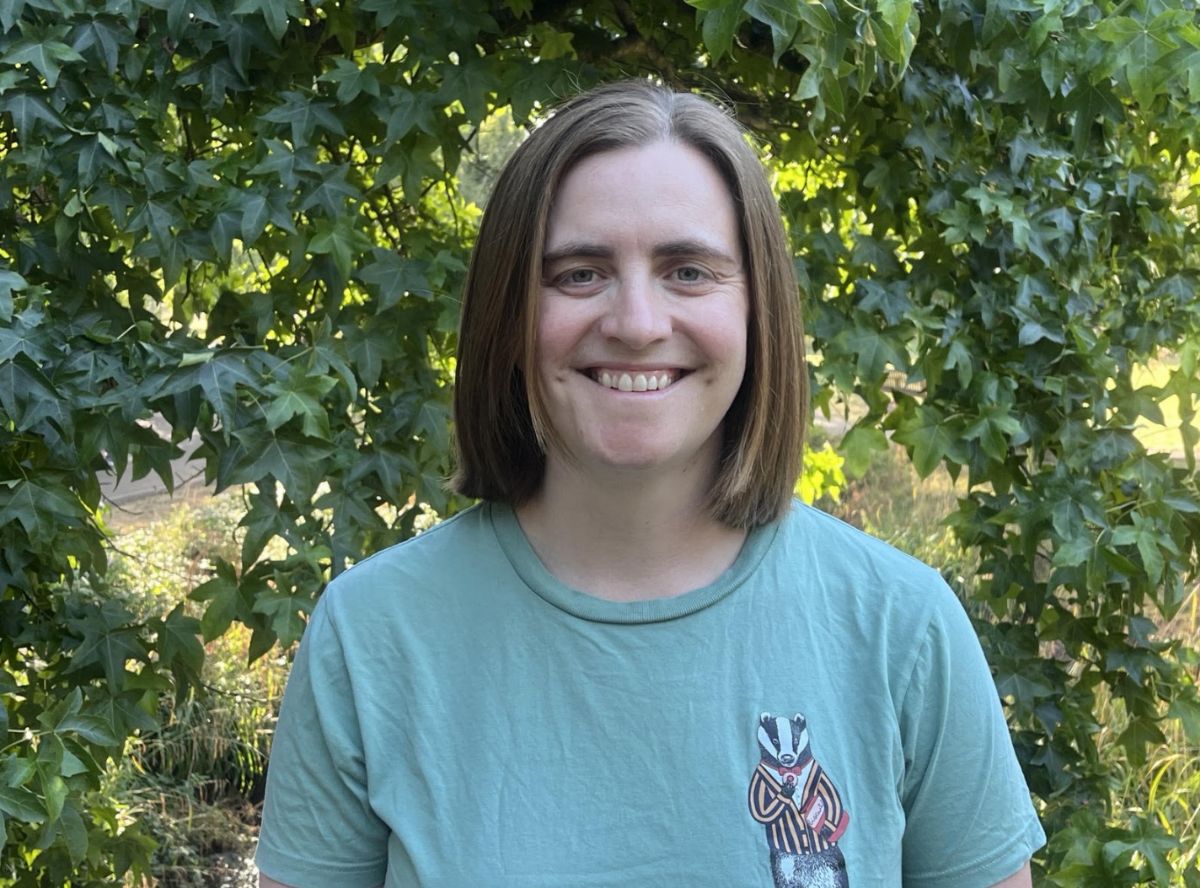
CJ Wagstaff
Hilary Watson’s debut collection, Menagerie Street, arrived from Seren Books in July 2026, and she joins us this month for our ongoing series of Poet Profiles, where we pose ten questions to poets shaping the literary landscape of Wales.
A former Jerwood/Arvon mentee and member of The 57 Poetry Collective, Watson has increasingly turned to Thrutopia in her recent projects: a cultural and narrative movement that aims to picture hopeful futures for the planet.
Watson’s poems have found homes in journals such as Poetry Wales, Butcher’s Dog and The Interpreter’s House, and along the way she’s picked up shortlistings for both the Troubadour and the Live Canon prizes.
Here, the poet talks word-play, sighthounds and poets writing novels, as she pulls back the curtain on her creative process.
Do you remember what first drew you to poetry?
I remember enjoying poetry at school – the lessons on the ballad ‘The Highwayman’ by Alfred Noyes stands out. It’s so dramatic and a great story (brought to life by Loreena McKennitt’s musical recording). But it wasn’t until sixth form, when I was already writing short stories at home, that I held Carol Ann Duffy’s ‘Selected Poems’ and realised that poetry could be so witty, reflective of life around me and ‘Warming Her Pearls’ was one of the first poems about lesbian desire that I read. It was an extension of my love for literature, which was nurtured by my English teacher, Edward Treacy.
Plus, I was incredibly lucky to have clare e. potter teaching for a short while in my school – a note on a piece of writing I’d handed in lead to her encouraging me to write outside of class. Her first poetry collection came out from Cinnamon Press when I was 18 and I remember her getting a grant to write about the impact of Hurricane Katrina on New Orleans in the immediate aftermath, in the city that she lived in for many years, which offers the backbone for that book. So I had a new love for poetry and ‘a real life poet with a published book’ right in front of me, the quote from heart a line of Carol Ann Duffy’s poem ‘Head of English’.
Who are some of your favourite living poets, and what resonates with you in their work?
This year I’ve been doing the Sealey Challenge (where participants aim to read 31 poetry books within August) so I’ve revisited a lot of golden oldies or books I haven’t picked up from my shelves for years. A couple of those have been pamphlets from Seán Hewitt (‘Lantern’) and Kim Moore (‘If We Could Speak Like Wolves’). I’ll always pre-order new books by Seán and Kim because so far, I’ve yet to be disappointed, so reading their early work has been really interesting – seeing what’s still going strong and what they’ve moved away from in more recent work.
In these interesting times when perhaps we’re in the market for new myths, ‘The Half-God of Rainfall’ by Inua Ellams is an astonishing book-length poem and a modern epic. And my goodness, Joelle Taylor’s ‘C+nto’ and more recent ‘Maryville’ (in book form and the way she performs on stage) bring extraordinary characters to life, foregrounding often marginalised butch lesbian experiences.
And in terms of poetic elders, Gillian Clarke, Naomi Shihab Nye, Sharon Olds, Ellen Bass, Carolyn Forché – are all people I return to. Their work is all different but they speak with emotional intensity and poetic authority that is rooted in human relationships, nature, witness, and they share their experiences of the world, which are different to mine but grant many interesting lessons whenever I read them.
Is there a poem by someone else you wish you’d written?
Sometimes I see new forms and think that it would have been great to have thought of that first. At which point I realise anything at all could be used to create poetry. I’m thinking of ‘(Un)certainties’ by Regi Claire, which uses the structure of a multiple-choice form and won the Women’s Poetry Prize in 2019. Likewise, Hera Lindsay Bird’s poem ‘Wild Geese by Mary Oliver by Hera Lindsay Bird’ is a pretty bold move and I’m here for that! When I saw the work of grammatically playful Patricia Esteban, translated by James Womack, in the magazine Modern Poetry in Translation, I was utterly delighted – that’s footnotes, line end hyphens, ‘cut-here’ lines galore. The moral of the story is play with form, invent it if that give you greater joy, play!
And recently I’ve reread Emily Blewitt’s collection ‘This is Not a Rescue’ and absolutely loved the poem ‘How to Explain Hiraeth to an Englishman’, not least because it unexpectedly begins: ‘Take greyhounds.’ and goes on from there. I find it very unlikely that I will ever marry an Englishman myself (so perhaps I couldn’t have written the poem exactly), but as a sighthound lover, I adore how slant the whole poem is, very unexpectedly swerving from the title to the body of the poem. Brava!
What have you read recently that excited or surprised you?
I’m going through a phase of really enjoying the novels of poets I really love. I’ve just read ‘May We Feed The King’ by Rebecca Perry, and ‘Martyr!’ by Kaveh Akbar is brilliant. I also love Seán Hewitt’s poetry, and prose including ‘All Down Darkness Wide’ and ‘Open, Heaven’. I’ve finally got my copy of Ella Frears’ ‘Goodlord’ back from a long procession of poetry lovers, who couldn’t resist sharing it amongst themselves too.
There’s something about how poets write novels or book length poems in a completely different way that I get excited about. For example, Ella Frears’ ‘Goodlord’ is in the form of a book-length email and has been up for poetry awards. You can see Rebecca Perry’s poetry in her vignettes throughout her novel – I don’t even know how to describe this book and that’s one of the reasons I love it. It’s unparaphrasable, like poems. And it’s gaining more and more traction in the novel charts and with prizes, which feels like good news for literature, poetry and novels.
What inspires you outside of literature?
I heard recently that people get to a certain age (around their thirties) and suddenly they become interested in birds. I tried this theory out on a relative, who lives outside the UK and she wasn’t sure what I was talking about. But I think there was a big shift for me during Covid lockdowns of appreciating and noticing nature close to home, and that coincided with me getting to the top of my allotment list and starting to grow my own vegetables. Rather than relying on knowledge of the natural world from the ‘adults in the room’ I realised I could learn, and witness and grow this knowledge myself.
And then there’s inspiration from any other art forms and from life itself. There’s a lot of great word-play out in the world, whether it’s intentional or not. Play within writing and outside of it are pretty interchangeable and important.
What projects or poems have you been working on lately?
A lot of my time and focus has been studying and playing around with a new concept called ‘Thrutopia’ – which is a way of differentiating between utopia and dystopia and instead mapping a way through to a liveable, thriveable future that we would want to manifest, given the very real state of the crises we are facing. I am one of five writers who have co-founded the Substack magazine Bending The Arc, which concentrates on sharing Thrutopian writing and art. Together, we are trying to work out what a thrutopian story, or poem would look like, and that’s meant a lot of invention, discussion and creating new forms or repurposing old ones. Inspiration for this work has had to come from the world around us, not from literature and the written word, because it is so grounded in what’s happening now. One of the quotes that keeps me anchored is that ‘the future is already here, it’s just not evenly distributed’ so you have to keep your wits about you and look for hopeful messages about what’s already working and what might be suitable in any given situation.
Ilse Pedler, Alice Willitts and I have especially been concentrating on writing and teaching thrutopian poetry, and published a collaborative collection of poetry ‘We’ll Meet You There‘ with Dialect Press in the spring. My first solo collection ‘Menagerie Street’ from Seren Books also houses some of my newer thrutopian poems, including a longer series, made up of a Duplex crown – the duplex is a type sonnet invented by Jericho Brown and as a crown, it is a series of seven interwoven poems.
Do you have any rituals or habits that help you write?
Reading a lot of poetry is important, and making sure I’m excited by new things that I am reading. But also carving out a lot of time to write. I’ve had the good fortune to spend some of my free time over the last decade in Tŷ Newydd Writing Centre and in Gladstones Library, where I’ve managed to surround myself with people who adore writing as much as I do, and getting deeply into the work. As I work fulltime throughout the year, these retreats are really important to me. And I do also really benefit from attending workshops, particularly with writers I admire. January Writing Hours, run by Clare Shaw and Kim Moore are great for getting to spend time in the dark, cold month of January with others who love poetry. And that enjoyment of reading some intriguing and interesting new poems and discovering new poets’ work to explore is another wonderful part of that.
What’s one word you wish you could use in a poem but never have?
Hmm. Sometimes I wonder if I’ll ever achieve a greater rhyme than Lily Allen’s ‘Tesco’ with ‘al fresco’ in her song LDN. Otherwise, I’m not sure a specific word stands out. I’ve probably used the words in poetry drafts, they just might not have made it out into the wild yet.
If your poems were a type of animal, what would they be and why?
That’s quite a difficult question when there are so many animals in my collection, ‘Menagerie Street‘. Because of that, I’m going to go for an ancient Greek mythological creature, the Chimera, because it is a hybrid of many animals – a lion with a fire-breathing goat’s head popping out of its back and a snake’s head, sometimes with dragon wings. It’s all quite unexpected, unconventional and exciting. I hope that comes through in my poems, no matter the subject matter (and no matter whether there is an animal in the poem).
One last thing! Would you like to share one of your poems and tell us why you chose it?
In ‘The Traditionalists’ I’m playing with the notion of traditions and norms, queering the experience of a wedding ceremony for two women, when even the rights for two women to marry are so new and so fragile – we’ve seen the rights of LGBTQAI+ folks, such as same-sex marriages granted and then revoked, so there hasn’t even been time for traditions to set in. Poetry logic cares not about such facts. The emotional truth of the world is that queer people have been bound and wed for millennia, and we’ve had fun with it because we’re not bound by such fixed notions of what a wedding is. So here’s a new tradition at play, offered the same assured certainty that any other tradition gives us to hold on to:
The Traditionalists
And here she is: tall, brawn,
in a tailored tux
walking herself down the aisle
to meet her bride at the hand-crafted altar
made from the tibias and mandibles,
sacrums and atlases brought by guests.
Then it goes the usual way –
the words and scratch of nibs,
a day-long hunt through woods
with the short shout at the moon,
heads tipped back in laughter.
Dusk, through the French doors –
wedding guests dance the twists
and formal curls of initiation –
a Lebanese cedar looms in silhouette
and on the patio, the carriage is here then gone
with our couple, while remaining guests
sleep off the elderflower wine
under the cedar’s shadow. The spoils of the hunt
hang in the billiards room; antlers, as tradition dictates
already blessed with holy water, tipped
towards the rise of tomorrow’s sun.
Support our Nation today
For the price of a cup of coffee a month you can help us create an independent, not-for-profit, national news service for the people of Wales, by the people of Wales.
Get more trusted Welsh news
Choose Nation.Cymru as a preferred source in Google News to see more of our journalism.


