

Poet Profile: Jamie Woods
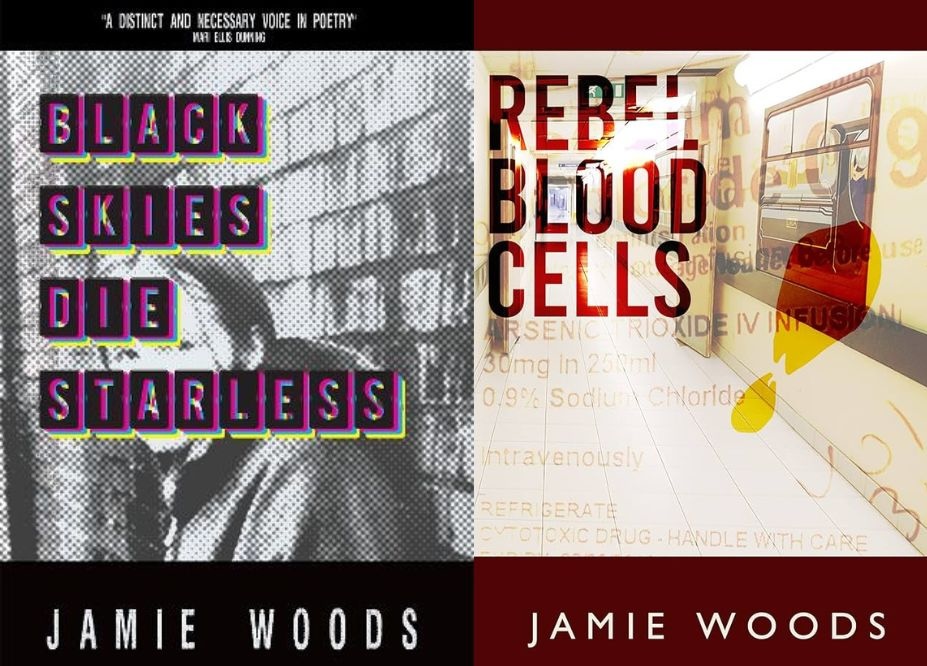
Named as a 2025 “poet to watch” by Poetry Wales, Jamie Woods first gained acclaim for his debut pamphlet, Rebel Blood Cells, celebrated for its tender and humorous reflections on leukaemia treatment and PTSD. His latest pamphlet, Black Skies Die Starless, was published in 2025 by Punk Dust Poetry, with proceeds benefiting Leukaemia Care UK, where he is Poet-in-Residence.
Ahead of his appearance at Cheltenham Poetry Festival on 18th April, Woods becomes the latest in our ongoing series of Poet Profiles, where we pose ten burning questions to poets helping shape the literary landscape of Wales.
Do you remember what first drew you to poetry?
Reading: English A-Level, mental health escapism and my Manic Street Preachers obsession got me reading Larkin, the Beats, Plath; then onto e.e. cummings, Dylan Thomas, Lloyd Robson and Patrick Jones. I loved the precision of language, the ability to create love or apathy or disgust or violence or rebellion with such stark form and impact.
As a writer, I wrote song lyrics, short stories and micro-fiction. There was always a poetry to my writing – I was very minimalist, and concise; unable to write exposition and plot but rich on detail and language. I wanted to write a novel, but I never had enough words: I’d try to write a novella and end up with a short-story. I still loved reading and listening to poetry.
It was only while I was having treatment for leukaemia that I started accidentally writing it. As I tried to make sense of my illness, the timeline, the incidents and the feelings, that was when the words started to hit the pages of my notebooks as fragments of poems rather than medical records or a journal, which became my first published poems, which became my first pamphlet, Rebel Blood Cells.
Who are some of your favourite living poets, and what resonates with you in their work?
Most of my favourite poets are still alive.
I’ve been a fan of Natalie Ann Holborow since heard her at an open mic about 12 years ago and loved the way she retold Medea, and have been following her ever since. Her work goes from strength to strength – Little Universe is an incredible collection that captures the minutiae of existence and plants it into the heart of the universe – you’re looking at the stars and the soil at the same time.
There are so many amazing writers that I’ve been lucky enough to meet or hear read in Wales: Richard Gwyn’s prose poems have genuinely had a life-changing effect on me; I wouldn’t be writing this if I’d not read Walking on Bones back in 2011. Bethany Handley raises the benchmark for writing about disability with her use of form and meticulous detail; Patrick Jones with his huge delivery and urgency and important things to say and yet such delicacy of language; Mari Ellis Dunning’s Salacia was a fug of menthol cigarettes that made me excited about reading poetry after a break; Ness Owen, Phil Jones, Tracey Rhys, Clare Potter, Abeer Ameer, Matthew MC Smith, Rhian Elizabeth, Christina Thatcher, Rachel Carney, we could be here for a while…
Further afield I’m a huge fan of Dean Rhetoric, who writes tender yet industrial poetry of bodily fluids and alternative music; Daniel Sluman and Hannah Hodgson who both really helped me understand more about writing illness; Raymond Antrobus is a genius; JP Seabright who is not only brilliant but incredibly prolific at capturing filth, glamour, mundanity and pop culture… and there’s so much beautiful and heartbreaking and hard-to-read but vital-to-read poetry coming out of Gaza at the moment. Places like Instagram are so great to be able to amplify these voices.
Is there a poem by someone else you wish you’d written?
There are three answers. Answer one is The Committee Weighs In by Andrea Cohen. Read it now because of spoilers before I talk about it. It’s a couple of paragraphs down in this article – https://www.poetryfoundation.org/featured-blogger/85696/humor
It is so clever and intricate and specific while being incredibly universal, and the twist gets me every single time damn it. I wrote something of a similar theme about my friend who died, and I still see him in my dreams and he’s as good as alive, but I think this is a better poem and it makes me cry and there’s no higher praise.
Two – on the other hand, I don’t ever want to be in a position to have to write this poem, about a parent dying. And I’m not a poet by choice – I don’t write about flowers, unless they have petals the same colour as tobacco-stained fingers, or are spreading contagious diseases via pollen. I write not through choice, but because I have to, to confront difficulty, to comprehend trauma, to fight. It’s bad enough having lived through some of the things that I have written poems about. I’d rather never write another poem if it meant that things were OK. As it is, I have a voice, a platform, a privilege and while I have the energy I should use it, right?
Answer 3 is the lyrics to the song Yellow by Coldplay, and then I’d call out their plagiarism really early on and either end their career before it had really started – thus saving the world from every other Coldplay song, or just be really rich from the royalties and use my ill-gotten gains for good.
What have you read recently that excited or surprised you?
I really enjoyed Rhian E. Jones’ book Rebecca’s Country about the Rebecca Riots. I have a real interest in riots, having been a kid in south London in the 80s and 90s they were an almost mythical thing – Brixton, Broadwater Farm, the Poll Tax, Brixton again, through to watching the 2011 ones unfold on TV from the safety of my little house in a village outside Swansea.
One of the Rebecca instigators, Daniel Lewis, lived near where I live now, he was a poet with the bardic name Petrys Bach. I can’t imagine many poets on horseback leading an anti-taxation free-trade revolution, although if John Cooper Clarke donned a frock and saddled up, I’d consider burning down a tollgate or two. Then you see Patrick speaking to the Together Alliance rally, or the women of Wales who have come together to write They Call Us. But that’s what poetry can do – it can truly inspire.
Sadly many of us have read the On Learning to Dissect Fetal Pigs by Renée Nicole Macklin. An incredible poem that I wished I’d become aware of in any other circumstance than the author being murdered by an enforcement officer of a fascist government.
What inspires you outside of literature?
Music. I love music more than literature – I’m just better at writing than I am at playing guitar, not for the want of trying. I don’t write every day, but I do play guitar everyday.
Lyrically Manic Street Preachers will always be a huge influence – Richey and Nicky’s words on the rock ‘n’ roll depressive angry bombast of the first two albums, the precision editing and utter genius and complete devastation of The Holy Bible, Richey’s dark horrors and humour of Journal for Plague Lovers, and then Nicky’s thirty years of yearning melancholia, self-deprecation, observation and spite – there’s so much there.
The most recent album, Critical Thinking, is an incredible record, and Rewind the Film (2012) makes me cry, and is such a mature, delicate, heartbreaking human defeat of an album. I listen to Loveless by My Bloody Valentine at least twice a week. It swirls around my head and takes me places.
And the state of the world. It’s so noisy and frustrating and terrifying but it makes me write.
What projects or poems have you been working on lately?
I’m not a prolific writer. This article has taken me two months. I’ve finished three poems in the last year. They are really good though. I’m slowly putting together something. Another pamphlet for sure.
Ideally, I’ll write enough to make a full collection, but let’s not get carried away. It will be about celebrity and politics and mental health and cults and hoaxes and heists and identity and body image and neurodiversity and and and… and probably something about Star Wars and the Manics just to keep on brand.
But I have no attention span, and I’ve started a band and a YouTube channel and a new job and I’ve written a couple of chapters of a novel and I am so far behind on my TBR and on TV shows. Instead, I’m playing video games, haven’t been able to finish reading a novel in six months, and am rewatching Mad Men.
Do you have any rituals or habits that help you write?
I send myself emails with words that are stuck in my head or phrases that I’ve been playing with. That’s about as close to a routine that I have. If time allows, which it doesn’t anymore, I do love the enforced ekphrastic fugue state of listening to a song on repeat all day long and then writing under the influence. It’s not for the faint-hearted, or those with caring responsibilities or steady employment. But it is really successful for me.
I’ve done a couple of ekphrastic ‘poem a day’ challenges run by the brilliant Paul Brooks of The Wombwell Rainbow, and although I churned out some dross, some of it was pretty good.
What’s one word you wish you could use in a poem but never have?
Any word that clearly rhymes with the last word on the preceding line. For me it only happens due to not paying attention with my slant rhymes during the edit. Or in an extreme edge case, that one poem I have where every line ends with the same three words. I’ll always write for the meaning, never the rhyme.
If your poems were a type of animal, what would they be and why?
I don’t really like animals, but saying “human” would be both a massive cop-out and also such an annoyingly cheesy pretentious thing to say.
I’m gonna go with one of those feral cats that live round the corner from me, up by where the Bont poet Daniel Lewis used to live. You think they’re all playful and sweet and so you’re all here kitty and making twitchy sounds with your fingers and clicky sounds with your mouth, but when then they feel threatened and scratch you, bite you, and give you a horrible infection that you need antibiotics for. And what’s worse is that you knew this was going to happen, but you wanted to feel something, just once.
One last thing! Would you like to share one of your poems and tell us why you chose it?
I’m sick of 90s nostalgia. My second pamphlet, Black Skies Die Starless is all about my 90s – not the day-glo flashes, singing Wonderwall and watching Euro 96; but the blank, godless, perpetual rain of a decade which was supposed to be the future but is now an embarrassment and an era of shame.
This is the only poem of mine that rhymes for reasons we’ve already mentioned, and there’s a video too so you can hear me read it over some very fuzzy guitar playing.
In setting the tone of the book it’s very important. And for drawing my line in the sand. Iris by The Goo Goo Dolls is a terrible song, and the whole of the 1990s smelled of fag-ash and stale cider. Let’s all listen to Kenickie’s Come Out 2 Nite and find beauty in the darkness.
https://www.youtube.com/watch?v=gGEJ74r9i0c
THE 90S
Nothing really matters in the 90s
We’re gonna live forever in the 90s
Choose life take drugs in the 90s
It’s all so fucking ironic in the 90s
Drink Perestroika vodka in the 90s
Smoke knock-off cigarettes in the 90s
Watch second-hand bands in the 90s
Paint my eyes dress for war in the 90s
60s nostalgia in the 90s
70s obsession in the 90s
Escape from the 80s in the 90s
Smashed-glass dancefloors in the 90s
Bacterial infections in the 90s
Crushed by Prozac in the 90s
Blurred out-of-focus prints in the 90s
Black skies die starless in the 90s
Support our Nation today
For the price of a cup of coffee a month you can help us create an independent, not-for-profit, national news service for the people of Wales, by the people of Wales.


