

Poetry review: Chronic Women/Menywod Cronig
Katrina Moinet
When certain powerhouse poets gather, the air fizzes with a kind of magic reserved for comet sightings and double rainbows. Rare wonders have similarly sparked with the arrival of Honno’s latest anthology, raising the voices of women in Wales living with pain, illness and chronic conditions, with its aim to bring about legislative change.
In a literary landscape drained of funding streams, it brings delight to see Arts Council Wales, Literature Wales, and the Wellbeing Lottery Funding support a project which builds bridges beyond poetry’s borders – to a vista encompassing the NHS hospitals, GP surgeries, Women’s Health networks – and ensure these poems reach places where the words will resonate most: spaces where the ability to articulate your embodied experience, your daily challenges, your pain, has the potential to change your patient pathway.
I sit in Ysbyty Gwynedd’s Physiotherapy Outpatients department on firm pale blue pleather awaiting my referral appointment to the Musculoskeletal Assessment & Treatment Service – CMATS. Hospitals have their own language, acronyms, vocabulary, tone. This, for me, recalls Hannah Hodgson’s ground-breaking Seren collection, 163 Days: how our inner and physical selves must separate to navigate medical settings; how we often journey this territory alone, criss-crossing a gulf between what we feel inside and the manifestation of how our bodies function (or fail to); how vulnerability and strength forcibly become flipped sides of the same coin.
The water fountain clunks and judders. A rubber-rimmed door squeaks open, spilling a scatter of voices into the bland corridor: I wait. This limp silence allows time to reflect on the slim but vital volume resting on my lap: poems by fourteen women poets living with ongoing health conditions, with translations by eminent Cymraeg poet Sian Northey and illustrations by Elizabeth Akerele.
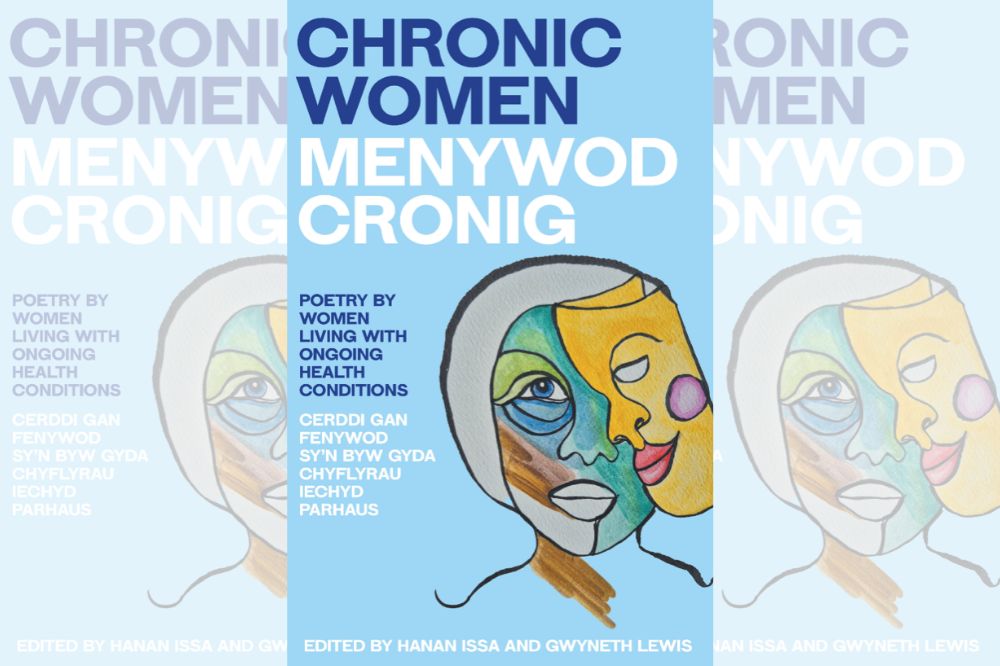
The cover is dressed in staff-nurse blue, a familiar shade which speaks to medical settings. This collection camouflages as literature which belongs in healthcare spaces and hospital waiting rooms yet hints at testimonies different to the generic advice leaflets that litter these places, with their relentless “easy fix” narratives. This is stealth poetry, poetry as activism. Where better to stow a book offering women new ways of thinking than somewhere laden with waiting where, in the lull, we become unexpectedly time-rich and open to distraction? Perfect pocket of time to nibble on a poem and digest the seismic shifts to come.
The illustration which opens the section ‘Crisis | Argyfwng’ as counterpart to Lal Davies’ poem ‘Hiding-Injury’ hooks me in. We encounter a silhouette tattooed entirely with eyes, most struck through. Today’s society burns women with its constant gaze, offering few contexts in which to fully consider our embodied experience. Health care settings become a space where women are asked to reach under the surface, explore what’s hidden within. In doing so, like Lal, we ‘close in on uncertainty / glosio at ansicrwydd’: what we carry but keep cached, from others and occasionally ourselves. As someone who has lived with a hidden health condition this poem illuminates the journey of unearthing which can take years to unfold.
Describing symptoms to a professional is itself a translation: rifling through a vocabulary inadequate to explain inner experience, pain pinpointed using little more than intuition. The bilingual arrangement renders the book widely accessible, allowing it to reach beyond the page across a Cymru of core readers who may not speak the same first language but are often fluent in each other’s pain. Some readers will pick up this volume and hear their illness described with breathtaking accuracy. For poets, having their chronic poem translated by another poet must be a liberating experience of witness. A handful translated their poem from the original, as if to say: “I live my pain through two languages; hear me in both, understand me in either.”
I had the privilege of hearing an early draft of ‘Facial Feminization Surgery’ – a pleasure to see this in print! – its shifting cuts of doubt and certainty becoming the fragmentation and rebuilding of identity. Nia Wyn Jones decodes dissonance by deploying the mirror metaphor in a way that’s fresh, that sings. She swings open the bay window on a world few of us know intimately. Her skill and craft drew me into a space of recognition and compassion: for the mental anguish of her trans journey, and struggle through a system maladapted to women’s comfort and dignity. There’s joy in witnessing Nia cross the threshold beyond ‘where the natural light comes in / ble ma’r golau naturiol yn dod mewn.’
There is growing acknowledgement that women continue to face unacceptable misogyny in our health system – as the forgotten gender in medical research, through alienating language normalised by the medical profession (terms like geriatric pregnancy for the over 35 years), in dismissals of pain from lack of understanding, training, or compassion – with a pervasive effect on women with chronic conditions who confront these discriminations with higher frequency. For some, the path of resistance to such barriers is to avoid diagnosis.
Mel Perry’s ‘The Art of Hearing’ moves us into a space of deep listening, to feel ‘the depth of deafness from which I call back / dyfnder y byddardod â minnau’n galw’n ôl.’ This poem becomes an unapologetic declaration to live well and be ‘more confident to recognise my condition as part of me.’ To accept all parts of the self. My thoughts return to the gender data gap in medical research, how little women’s bodies are understood, and the rise in literature exposing data bias in a world designed for men, like Caroline Criado Perez’s Invisible Women (Chatto & Windus, 2019). The impact on women’s health and well-being is not negligible.
This isn’t a new phenomenon, it’s intergenerational. You needn’t live with chronic pain to understand the importance of a system which understands women’s pain better. Most women at some point will experience pain that requires hospital treatment or, given the inequalities of reproductive labour, become carers for family members who will. In these moments, we confront our inherited relationships to pain – how, over many generations, we learn to voice or simply endure it. In these moments, we are forced to confront a health system saddled by layers of patriarchy. Unpeeling these layers can bring its own pain.
Why didn’t they realise my symptoms were so serious? Gender bias in research means when you walk into a health care setting you are already up against this when describing pain. One cardiologist revoiced my mum’s burgeoning concern that hospital staff hadn’t taken her chest pain seriously – on a fourth admittance which concluded in major heart surgery – because her symptoms hadn’t matched their expectation of how heart attacks “present”. There’s a persisting assumption that if you don’t manifest dramatically, you’re not “in pain”. The cardiologist conceded that many medical professionals remain unfamiliar with female symptoms of heart failure because their textbook training taught only the male symptoms: “we now realise that women’s symptoms can be different”.
Surely the kaleidoscope of experience of chronic pain cannot fit inside fourteen poems?
Quite right. The breadth of voices chosen seeks to open a conversation, not conclude it. Through careful and considerate curation by its editors – two National Poets of Wales, Hannan Issa (current) and Gwyneth Lewis – we encounter a choir of poetic responses to illness which shows clarity, courage and ‘a joy that defies the downward pull.’ The poems invite the reader to recognise themselves, those they know, those they care for in these pages, find comfort and compassion, whilst also considering the bigger picture.
These poems offer soothing brilliance. We meet clare potter’s axe-wielding Nan who belongs to the line of women she is one of: the metallic drag of axe on stone reminds us her family knows how to fight pain, how to care with strength, salve and other sacred things. We witness Sioned Erin Hughes’ resistance to bone-heavy fatigue combated by bursts of blackberry energy. Durre Shahwar’s panicked breath turns cold before it leaves her mouth. As for many poets here, she feels an exposure from sharing what she struggles with:
‘It is because I trust you,
that I present myself unedited’
Hanan’s caffeinated spider feeds gaping holes in her work as she weathers The Calm / The Storm, how it paralyses. The earth forming two bruises on young Iola Ynyr’s knees as she scrabbles in soil for the bottle and its ‘cure.’ The beautifully rich image of Gwyneth’s foal slithering from a steaming sac to struggle on ‘too tiny hooves / lotus slippers still-soft’ giving way to ‘a flaccid bagpipe’ exhaustion as she’s once more flung from an ‘iron, bucking world.’ There is so much to love about this collection.
This book is a rallying cry to address the health inequalities which women experience in Wales. Dr Helen Munro, the Clinical Lead for Women’s Health, asks us to listen and to question these narratives which touch so many lives. Here is an anthology which reminds us, chronic conditions are not solely the visible ones. They encompass the negative spaces that Bethany Handley’s wheelchair Barbie never need confront: ‘her plastic world’s step free.’ And the new ways Kandace Siobhan Walker has had to find as an adult with autism in a ‘world humming like a prey animal.’
To live well we may seek ways for body parts to function, new ways to survive their non-functioning and new ways to thrive; we also seek ways for our pain to be acknowledged, witnessed. This is how I see this collection as fundamental and vital work.
I have long wondered how this world has managed to mis-calibrate itself in relation to pain, women’s pain in particular: how pain is ours to manage; how little society flexes around menstruation, the turmoil of adolescent hormones rising, the rollercoaster of menopause symptoms and treatments, the physical catastrophe childbirth can be, the escalation of interventions, post-partum psychosis fallout. Little of this is considered chronic and yet the physical, emotional and psychological aftershocks continue for many years. I felt strong resonance with Emma Smith-Barton’s ‘After Birth’ as a call out to midwives, and Myfanwy Alexander’s ‘Cord | Chord’ both ‘punctuated by dark shapes’, glad to see these inclusions.
The keep-calm-carry-on mantra hums a chorus call to maintain a deep-throated silence on women’s pain, as if suffering is something we as women should learn to expect. Sioned Erin’s opening poem phrases it simply as ‘sgen i ddim lle i gwyno / Can’t Complain!’ These binary states allow little grey light between the performative pain and stoic smiles of endurance.
Editorial decisions like the erasure of f—k/ff—io in ‘pretty blue flowers’ show a sensitivity to the intended setting and potential audience, of all ages, all backgrounds. We hear the soft ‘fuck’ of Rhian Elizabeth’s imagination, without needing it spelled out. Anyone who picks up this poem will find, between the piñata swings of pain and bursts of the joyful every day, an urge to be honest about chronic illness. About being a woman in pain. And still so very much alive.
I stare at a wire rack mounted on the corridor wall: a pick-n-mix of pamphlets packed in slots displaying the kind of diversity rarely recognised in other quarters of life. I wonder if this box-tick effect gives people any real sense of inclusion. Pain does not discriminate, but the Covid years taught us that systems do. Every time we are told we are all in this together, I wonder about the lives of those who have so much more invested. I am grateful to the physio who spends the first ten minutes of our appointment listening in a way I rarely feel listened to, and after a short examination concludes my back injury is unlikely to result in chronic pain. The past weeks have opened my eyes to daily pain management. Walking in the world of the seemingly well, it’s easy to forget the pain of others.
Pain can be an isolating experience. This book reminds us we are not alone. Some readers who pick up this book will hear their own chronic struggles echoed by a poet-stranger. To bear witness is to share solace, remove solitude. Others will hear echoes of joy, a reminder of their endurance, the ways to live well with illness. Perhaps chronic is another way to say we have learned to keep company with our suffering and not be consumed by it.
Chronic Women (2026), edited by Hanan Issa & Gwyneth Lewis, is published by Honno. It is available from the publisher and most good bookshops.
Support our Nation today
For the price of a cup of coffee a month you can help us create an independent, not-for-profit, national news service for the people of Wales, by the people of Wales.
Get more trusted Welsh news
Choose Nation.Cymru as a preferred source in Google News to see more of our journalism.



The volume is such an immense contribution, voicing, as it does, the silent experience of so many of us. This review does the almost impossible. It does justice to a poetic masterpiece, and it does so with a poetic flair all of its own.
Link to the publisher: https://www.honno.co.uk/books/chronic-women-%7C-menywod-cronig