
Poetry review: Exposure by Angela Graham
CJ Wagstaff
Angela Graham demonstrates that the language of documentary is her bread and butter in this sensitive and assured riff on photopoetry from Culture and Democracy Press. Across the collection, Graham positions poetry as a form of creative record-keeping as she seeks to sit unflinchingly with global conflict.
The first section, titled ‘Soldiers and Civilians’, features poems responding to contemporary war photography ranging from genocide in Gaza to Russia’s invasion of Ukraine. Here, Graham stretches her ekphrastic muscles, producing poems which are rich with restraint and physical presence. Rather than grand moral statements, she opts for powerfully understated description, as she responds, for example, to a photograph of a deceased soldier:
‘patches of camouflage
emerging like moss
in a parody of Spring’ (‘Weather’)
Graham’s specificity is what makes this work exciting. She zooms in on each scene to isolate its finer details: the steel finish of an armoured vehicle, or the sun setting behind wholesale sheds in Ukraine. Meaning is not imposed but emerges instead through the poet’s careful attention to her subjects.
Notably, the source photographs themselves are absent from the collection, leaving the reader to rely entirely on Graham’s interpretations. Some of these are undeniably graphic. Visceral moments such as a soldier ‘rotting inside his uniform’ (‘Photograph of a Dead Russian Soldier’) confront the reader with violence that is difficult to sit with. This will not be to everyone’s taste, but it stands staunchly as a testament to the role of poetry as witness. These are poems that insist on the responsibility of the artist not to turn away, even when the act of attention feels uncomfortable.
Interspersed throughout the collection are also poems that turn their gaze inward, becoming self-reflexive meditations on the photographic process. Juxtaposed with the ekphrastic work, these pieces are as unsettling as they are compelling, interrogating the relationships between subject, lens, and viewer. In ‘An Act of Mercy?’, Graham observes how ‘a perfect fan of emptied winter branches / by the top left corner / gives a sense of distance and proportion’. What might read as apathy here is a gambit in a collection that otherwise sings with compassion.
As a combined work, this feels, above all, radically human. Graham’s moral clarity is patently rooted in lived experience, having grown up during the Troubles in Northern Ireland. This is a history which has clearly shaped her ethical framework. She reflects:
‘Born into Ulster
my whole life I’ve had to think about revenge:
what was taken; what should be taken back.’
This background informs a keen sense of justice, evident in her deeply empathetic portraits.
This empathy is particularly vivid in a sequence of six persona poems spanning pages 26 to 34, in a section titled ‘I Imagine Being’. These, for me, are where Graham’s writing is strongest, most imaginative, most complete.
In the first poem of this sequence, she inhabits the perspective of unit commander Vovan as he returns to his mother after active duty, marking what is arguably the most powerful moment in the collection. Graham contrives an intimate proximity to these narrators, imagining gestures of care and domesticity in an otherwise hostile world – ‘Mama cried out, My golden boy! My little fish!’ – effective reminders of the real lives and stories continuing on despite it all.
This is a meticulously structured collection, with poems divided into clear categories and sub-categories. Its second half, ‘Citizens and Politicians’, shifts toward a more abstract, idea-driven mode. Here, Graham’s personal politics are more overt as she addresses world leaders and offers observations on the global sociopolitical climate. But while this section contains moments of sharp insight, it is admittedly less consistent than the earlier work.
Graham is at her strongest when dealing with the concrete, drawing significance from lived or closely imagined experience rather than reaching outward. This is demonstrated in ‘Trump, Vance, 28 February 2025’ with a well-meaning reference to lynching that feels slightly jarring in the broader context of the collection. The best moments remain grounded in tactile detail: the advance and retreat of snow in Ukraine; a climbing frame-turned-memorial piled with teddy bears and flowers. Images that leave space for the reader to locate their own response to the work.
Overall, this is an ambitious collection marked by moments of profound clarity and beauty. Graham’s commitment to noticing, alongside her disciplined formal approach, results in a collection that is rigorous, innovative and thoughtful. While ever-so-slightly uneven in places, EXPOSURE offers a sustained and serious engagement with the practice of looking, culminating in a worthwhile and timely read in 2026.
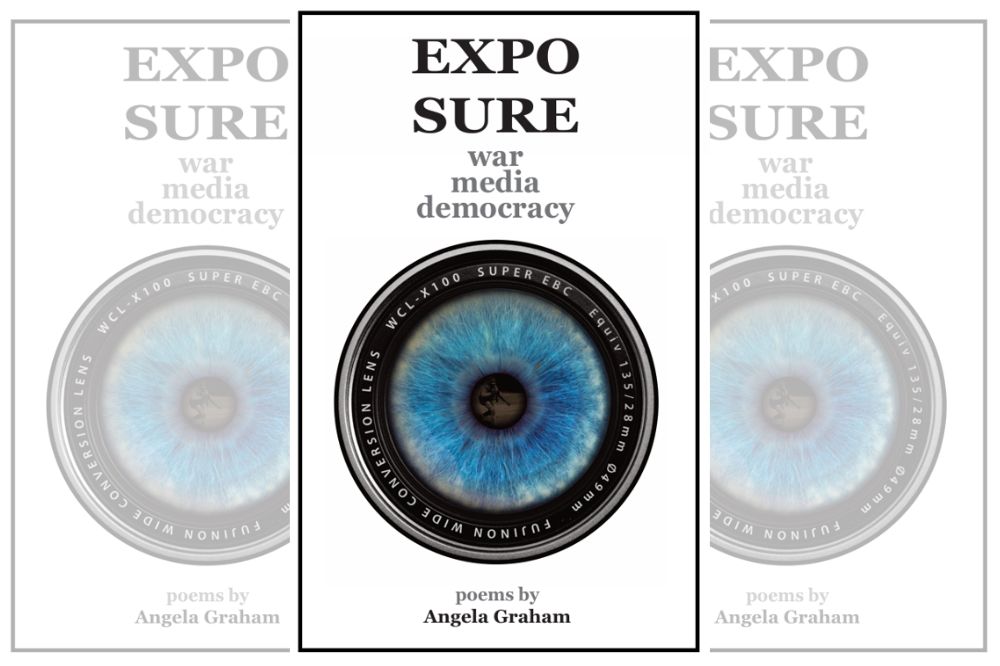
Angela Graham’s EXPOSURE is published by Culture and Democracy Press.
Support our Nation today
For the price of a cup of coffee a month you can help us create an independent, not-for-profit, national news service for the people of Wales, by the people of Wales.


