


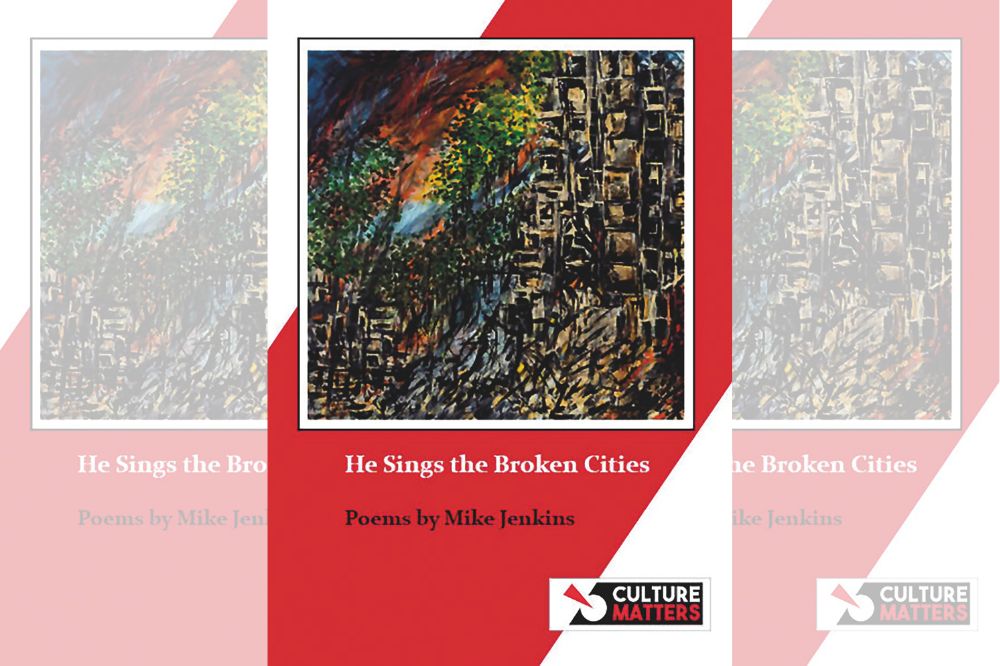
Poetry Review: He Sings the Broken Cities by Mike Jenkins
CJ Wagstaff
In this volume from Culture Matters, Mike Jenkins presents a triptych of movements from Palestine to Ireland and finally to Wales, giving the collection a sense of widening and narrowing focus as the poet shifts between the international and the intimately local.
The opening section, centred on Palestine, offers raw and unsparing scrutiny. Jenkins makes concrete observations that illuminate moments of inhumanity from the past three years of genocide. In ‘A Sign’, he references the killing of five-year-old Hind Rajab, recounting “355 shots into the car” with devastating restraint. In ‘Let Them Eat Bullets’ he turns to the violence documented at aid stations, underscoring the systematic dehumanisation at work in occupied territories.
‘While They Were Sleeping’ echoes the quiet devastation of Abeer Ameer’s Forward Prize-winning poem ‘At Least’. The collection is dedicated to Ameer and to other poets committed to the work of witnessing, and Jenkins’ poems here operate in that same register of testimony.
In general Jenkins favours plain, declarative language to generate emotional force. An exception is ‘Palm Reaching’, where a hand emerging from rubble is likened to the sapling of an olive tree. This comparison risks sentimentality, though it’s precisely this gesture towards hope which makes the poem sing with its tragedy.
Moments of joy and normality intensify the impact of these poems. Laughter, music, food and family life appear in stark juxtaposition to surrounding violence, suggesting lives stubbornly persisting under impossible conditions. These flashes of ordinary humanity deepen the profound sense of loss.
With ‘Connolly in Kilmainham’, Jenkins turns his attention closer to home, invoking the legacy of British colonialism. This middle section feels more formally controlled than the first: the poems are tighter, more stylistically assured. Jenkins begins to play more visibly with language as he moves towards Wales. The sounds and textures of Welsh dialects slowly start to surface, as the poet begins to construct a phonetic register of his own.
The latter part of this section moves fully into dialect poems. On first reading, their intention may seem ambiguous: are these stylistic experiments, acts of reclamation, or do they risk caricature? For us readers who grew up in working-class Wales, the voices may evoke nostalgia, though at times they brush uncomfortably close to familiar scripts of mockery. Yet Jenkins appears to inhabit these personas with familiarity and warmth, acting as conduit for the cadences of the Welsh valleys, even if the edge in his tone occasionally sharpens.
These pieces sit alongside observational poems, musings on Arthurian legend and portraits of Welsh revolutionaries, some of which are presented originally in Welsh with English translations. ‘Redhouse’, one of the most structurally experimental poems in the collection and among its strongest, explores the semantic elasticity of the word “house”, presenting it as both shelter and symbol.
In ‘NoGood Boyo, Clwb-y-Bont’, the poet creates a vivid and satisfying sound world while recalling a gig in Pontypridd, cataloguing the crowd: “Stompers / Screamers / Reel-to-reelers / Clwb regulars / Total strangers / Gathered together movers / Changers.” It appears that Jenkins is at his best when he resists over-explanation, allows rhythm and accumulation to carry a poem’s meaning.
The collection closes with a series of heartfelt tributes to lost friends and fellow poets. In these final pieces, Jenkins writes with a stripped-back sincerity and authenticity, creating a poignant end to these collected works. Considered as a whole, He Sings the Broken Cities is a difficult but necessary book in today’s climate, heavy with troubling images yet threaded with warmth, compassion and hope for the future.
He Sings the Broken Cities is by Mike Jenkins and is published by Culture Matters. It is available directly from Culture Matters.
Support our Nation today
For the price of a cup of coffee a month you can help us create an independent, not-for-profit, national news service for the people of Wales, by the people of Wales.


