


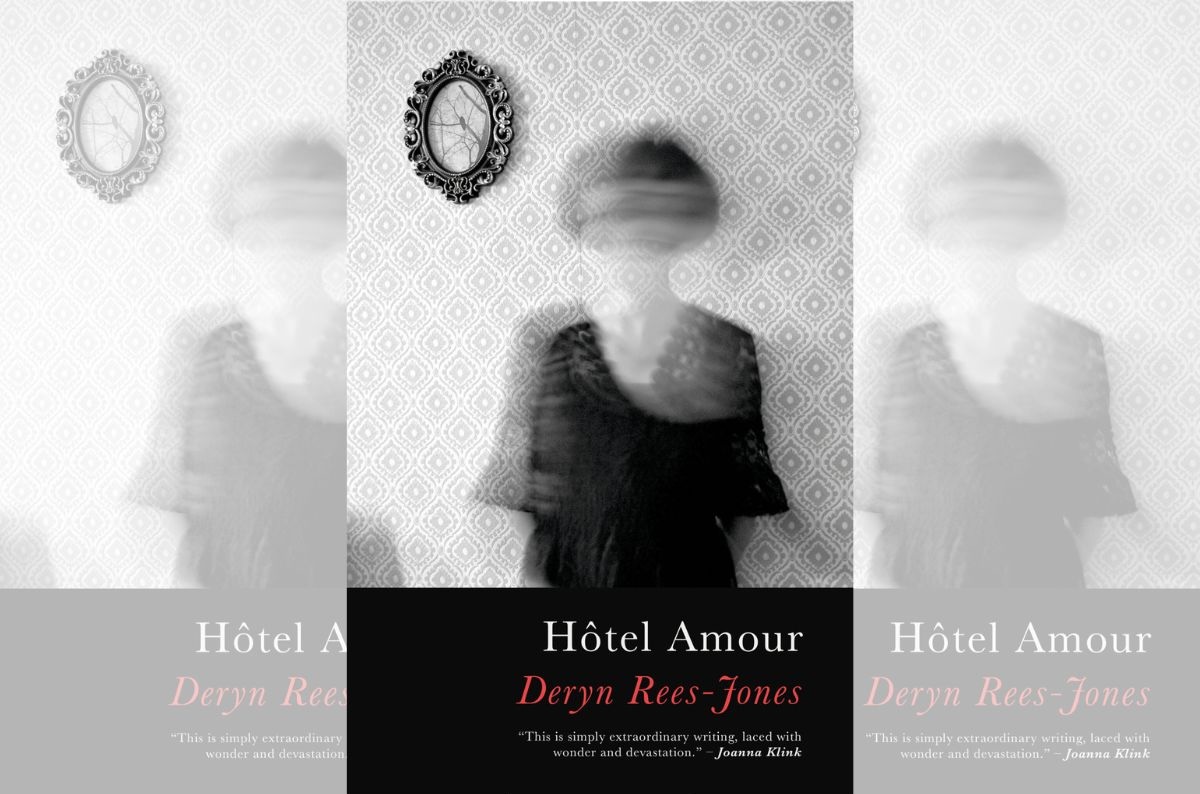
Poetry Review: Hôtel Amour by Deryn Rees-Jones
CJ Wagstaff
Few poets navigate the terrain of grief and memory with the same authority and daring as Deryn Rees-Jones.
Celebrated both as a writer and Professor of Poetry, Rees-Jones has long established herself as one of the most formally ambitious poets working today. Her latest collection brilliantly upholds this reputation. In this high-concept hybrid work, she summons a vivid fever dream of Paris, a city simultaneously real and mythologised, where place is sodden with memory and time itself seems to exist all at once.
This urban landscape becomes a collage, assembled both from invention and the lingering memories of a post-COVID city, all revolving around the imagined titular location, Hôtel Amour:
“she liked to imagine the couples who had been there before her, the
temporary residents, ghosting and overwriting themselves in
captions of feeling…”
This book unfolds across three distinct parts. The opening section, The Hotel, introduces a woman checking into Hôtel Amour through a close third-person lens. Her story is told in delicate, near-prose fragments, allowing the poet to exploit the full spatial potential of the page, so that white space becomes a load-bearing feature of the work: an architecture in which the story’s psychic truths are left to simmer.
From there, we transition into a middle section comprising a sequence of twenty-four compact sonnets. Here, the ‘I’ of the speaker emerges. This sequence stands as the book’s greatest achievement, allowing the central conceit to recede and revealing the human currents of loss, love, desire, and self-perception running just beneath the surface.
“Think again of that thunder, that breaking sky. Think of a number,
a psalm, a future, a quiet place. Pick a card, any card. Accept
the unyielding way the world has of offering us each other.
Think of us, that last time, lost to each other’s disgrace.”
Often reading like streams of consciousness or late-night text messages, many of these sonnets are addressed to Rees-Jones’s late husband, the poet Michael Murphy, who died in 2009. Yet while Hôtel Amour is heavy with this absence, to call it an elegy feels too simple. Instead, these poems use grief as a lens through which to interrogate the self, asking how much of one person is composed of another, and what shape an individual takes once the other is gone: ‘& even now / calling out to you when who knows where in the mobius / strip of us we’ve landed’.
Each poem leaves us with more questions than answers, guided by a voice that is witty, probing, and self-reflexive, full of asides, interruptions, and the natural rhythms of conversation. These poems often tick the sonnet box only in shape, with rhyme operating largely internally, allowing the emotional acuity of the work to expand beyond its logic. This formal restlessness, expressed through sonnets, fragments, French phrases, and long silences, always feels purposeful, carrying as much meaning as the text itself.
In many ways, Hôtel Amour operates as a dialogue with Erato (2019), one of two collections by Rees-Jones to be shortlisted for the T. S. Eliot Prize, and the text is appropriately rich with echoes of that earlier work. Readers familiar with her previous collections may recognise the same blend of narrative and lyric, alongside a taste for carrying philosophical cargo in precise, economical language. In Hôtel Amour, however, these concerns arrive heightened.
This is a poet long fascinated by time, the body, and the insufficiency of memory, and these preoccupations reappear here intensified by the dual experiences of personal grief and long COVID. Ultimately, she asks readers to consider what these forces do to person and place. In the third section, The Garden, Rees-Jones returns to her fragmented third-person narrative:
“but the whole house remembered – the heart pain, like something the
size of a cathedral had collapsed inside her – how she could not breathe.”
By the final page, Hôtel Amour has safely captured a poet at her absolute best: ferociously human, philosophically serious, and beautifully alert to the strangeness of bodies and time. To call this book a collection would do it a disservice. It is something far more expansive. Essential reading.
Hôtel Amour is published by Seren, and is available from all good book shops.
Support our Nation today
For the price of a cup of coffee a month you can help us create an independent, not-for-profit, national news service for the people of Wales, by the people of Wales.
Get more trusted Welsh news
Choose Nation.Cymru as a preferred source in Google News to see more of our journalism.



Gorgeous line: ‘…when who knows where in the mobius / strip of us we’ve landed’.
Great review! Clear, succinct and insightful. Plan to pick up a copy of this collection later this week.