


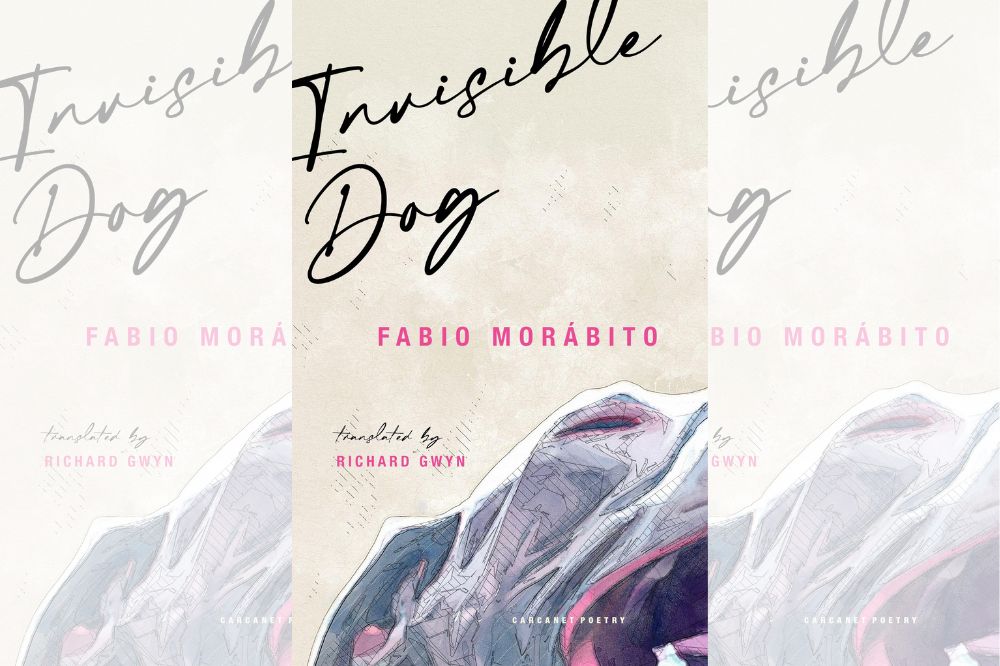
Poetry review: Invisible Dog by Fabio Morábito, translated by Richard Gwyn
CJ Wagstaff
Intimate, understated and erudite: translated by the Welsh poet, novelist and essayist Richard Gwyn, this collection gathers the finest work from a career spanning more than three decades, drawing on five treasured Spanish-language books of poetry.
Poems drawn from earlier collections Lotes baldíos (1985) and De lunes todo el año (1992) are rich with compassionate observation: a cow rummaging in a trashed field in ‘Ajusco’, a beggar at the window in ‘Farewell’. Morábito renders near-peripheral scenes with a warm and inviting tenderness, allowing his lightly confessional style to emerge at a distance.
This work returns often to built structures, especially homes, a preoccupation that feels inevitable for a writer shaped by displacement. Born in Alexandria, raised in Milan, and later relocating to Mexico as a teenager, the poet’s biography shadows the verse at every turn. In ‘Time of Crisis’, he reflects on a slowly crumbling apartment building:
“to knock it down you’d have
to knock it down right now,
later it’s going to be difficult.”
These imperfect buildings operate, I think, as subtle allegories. They may gesture toward the family unit, toward the self, or toward something that eludes translation altogether. They are heavy with meaning that never feels fully resolved.
Language itself is a persistent subject throughout Morábito’s practice. With Spanish becoming his dominant literary language in adulthood, he frequently interrogates what it means to be an outsider in a language and, conversely, what it means to lose another. In ‘Now, After Almost Twenty Years’, the speaker articulates a sense of estrangement from Italian in lines that are among the most affecting in the collection:
“With what words
will I recall my childhood,
with what will I reconstruct
the way and its wonders?
How will I complete the circle of my years?”
Later examples move more confidently into abstraction while always remaining grounded in the domestic. Quotidian observations become emotional revelations about the poet’s interior: “I haven’t loved chairs enough” becomes “I haven’t loved / almost anything enough.” Morábito shifts in scale from the minute detail of his world to the existential and back again, often arriving in his final lines at a surprising clarity.
The poems from Alguien de lava (2002) are especially notable for their self-reflexivity. Many function as ars poetica, as again and again, Morábito illustrates scenes of stillness and confinement in dawn-lit rooms: “As a matter of fact I barely write, / I watch how the day comes to life.” The sound of barking dogs echoes its way across this collection too, seeming to appear at each stage of the poet’s life and work: “listening to that barking / from who knows where”. On one level, the speaker tells us, these are the markers of his insomnia. But they also represent larger omens in Morábito’s life: exile and isolation from one’s home, language and self.
Selections from Delante de un prado una vaca (2011) and A cada cual su Cielo (2021) begin to engage more directly with mortality and spirituality. We see signs of a more mature, and perhaps more sentimental, poet concerned with time, aging and change. In ‘My Son Plays on My Back’, the speaker registers loss as his son grows beyond childhood games: “I am / no longer his horse. He doesn’t say it, / but he thinks it.” In ‘Persian Rug’, he tells a companion, “both of us are running out of sunny days”. These losses are not dramatic: linguistically, these newer offerings are still largely unembellished, though amazingly they never manage to feel under-embellished. What makes this collection shine is this precise economy of language. The force of these poems, and of Fabio Morábito’s poetic voice, lies in its restraint and clarity: there is little excess here, each line feeling clean and completely necessary.
As far as can be determined, this volume marks the first book-length translation of Fabio Morábito’s poetry into English, though his novels and prose have previously appeared in translation. Richard Gwyn applies a finely tuned, attentive sensibility to the task, and the result is a poised and thoughtful collection that offers English-language readers access to a very special body of work.
Invisible Dog is published by Carcanet, and is available from all good book shops.
Support our Nation today
For the price of a cup of coffee a month you can help us create an independent, not-for-profit, national news service for the people of Wales, by the people of Wales.


