


Poetry Review: The Storm’s Flora by Laura Wainwright
CJ Wagstaff
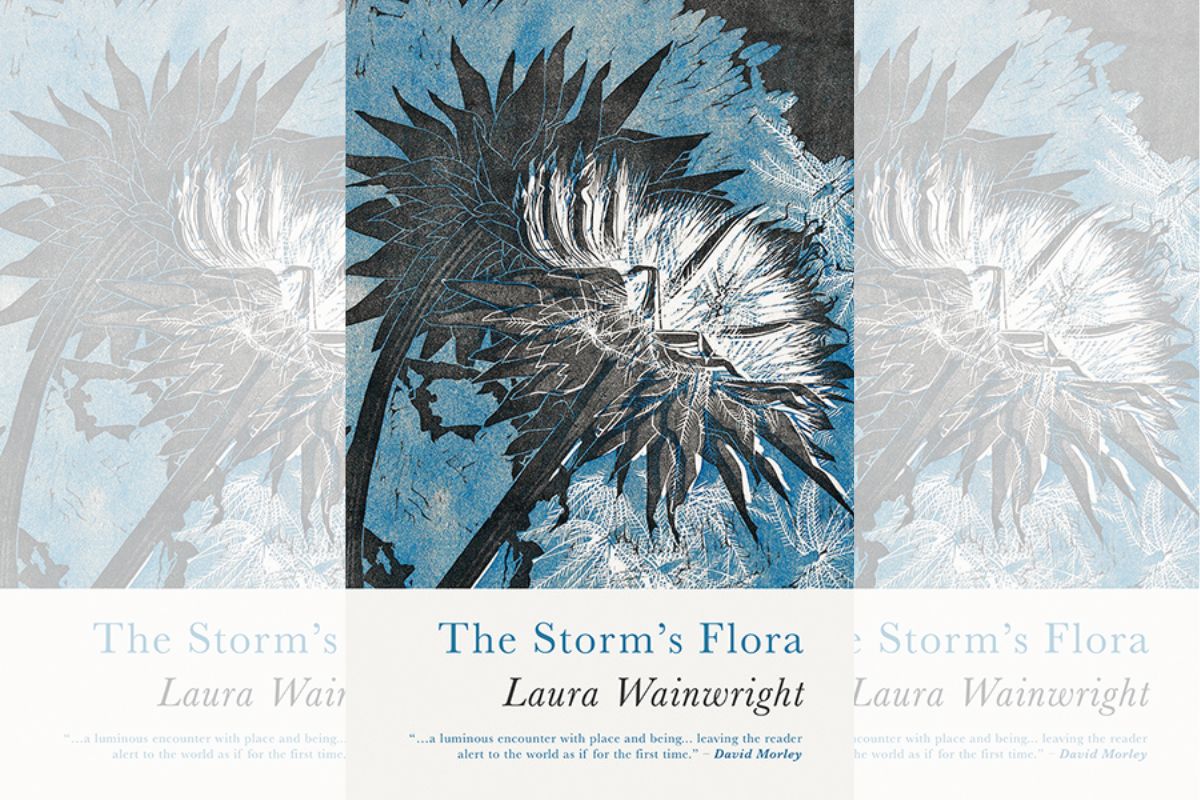
The Storm’s Flora is a collection concerned with time and place, shaped by a poet deeply attuned to her world: its plants, its weather systems, its traditions, and its griefs. These poems emerge from a practice of patient noticing, and from an understanding of landscapes as living archives, carrying memory, history and potential in equal measures. This debut collection avoids melodramatic flourish and instead carries the assurance, wisdom and generosity of a poet at home in her craft.
Early in this thoughtfully structured collection, Wainwright establishes an ecopoetics grounded in her trademark close attention: a remembered lavender bed, the analgesic properties of meadowsweet. Her poems repeatedly turn to the vocabulary of the natural world, using botanical knowledge as a means to understand her subjects, which range from historical figures to antidepressants. In these first pages, Wainwright also works confidently within the persona poem, becoming a stinking iris, or giving voice to a tree in the layered and affecting ‘Flood’, a poem that holds the biblical, the contemporary and the arboreal in near-perfect balance.
But these poems are at their most powerful when they stretch beyond the boundaries of ecopoetry. This is a poet interested in the meeting points between the natural and the human, situating modern sensibilities in the rural, and finding glimpses of wilderness persisting inside contemporary life. She exposes these ancient entanglements with a delicate application of metaphor: a wood anemone as a long-unopened envelope; a docker’s hook recalling the curve of a cormorant’s neck. In ‘III. Noctua’, too:
“Trees are lithographs in the hollowing light.
Last week’s snow is peeling on the hills like old paint.”
Wainwright excels at animating this blended world, striking a rare balance between linguistic surprise and truth-telling. Even when individual poems move away from the strictly botanical, and they often do, tiny moments of wildness remain embedded in the language: a plant name, an elemental shift. These details are just enough to keep hold of the collection’s unifying thread.
Elsewhere, Wainwright seems committed to paying homage to other artists. Some of the collection’s most compelling moments arise when she enters into conversation with other art and artists, foregrounding Wales’s vibrant and reciprocal creative landscape. It is here that her voice feels most distinctive and, crucially, most confident. Several of these poems respond directly to existing works, including a penultimate pair composed using found text. As noted in the acknowledgements, these pieces, alongside others in the collection, emerged through collaborative projects. ‘Teasels’ draws on materials from the artist and ceramicist Kim Norton, while ‘Towards Marros Sands’ incorporates words, images and materials gathered by the artist and papermaker Jane Ponsford. In this latter poem, she describes:
“the sea below
slick as slate
holding the light
all the way
and over us
dark gold”
Wainwright’s work across other artistic disciplines continually rises to the surface in this collection. Much of the book’s stylistic energy comes from its musicality: a trained ear transforms even the most grounded observation into something song-shaped, rich with rhythm and melody. Together, these poems build a sound-world that is lyrical yet level-headed, with moments approaching onomatopoeia that avoid awkwardness through Wainwright’s light touch. Music is not just a quality of the language, either. Poems that engage directly with songcraft are among the collection’s most enchanting. ‘Mulberry Tree: A Folk Song’ emulates the structure and repetition of the folk genre, and instruments recur as subject throughout: an aeolian harp in ‘Hasp’; a graveyard compared to the body of a guitar in ‘The Luthier’:
“On the coldest morning she could recall,
breath scrawled about the mourners,
who rubbed and shuffled,
while blue grass sparkled
around a sound-hole in the earth.”
These recurring motifs, song and botanical remedy alike, draw from a deep well of Welsh folk tradition, proving that at its heart The Storm’s Flora is a collection about survival: human stories and rituals lasting into a digital age, ecosystems enduring under environmental pressure. This collection feels like a salve in a time of constant threat and uncertainty, pointing ever towards the staying power of human and extrahuman worlds.
The Storm’s Flora is published by Seren, and is available from all good book shops.
Support our Nation today
For the price of a cup of coffee a month you can help us create an independent, not-for-profit, national news service for the people of Wales, by the people of Wales.
Get more trusted Welsh news
Choose Nation.Cymru as a preferred source in Google News to see more of our journalism.


