

Poetry review: We Not Me / Ni Nid Fi
Gaynor Funnell
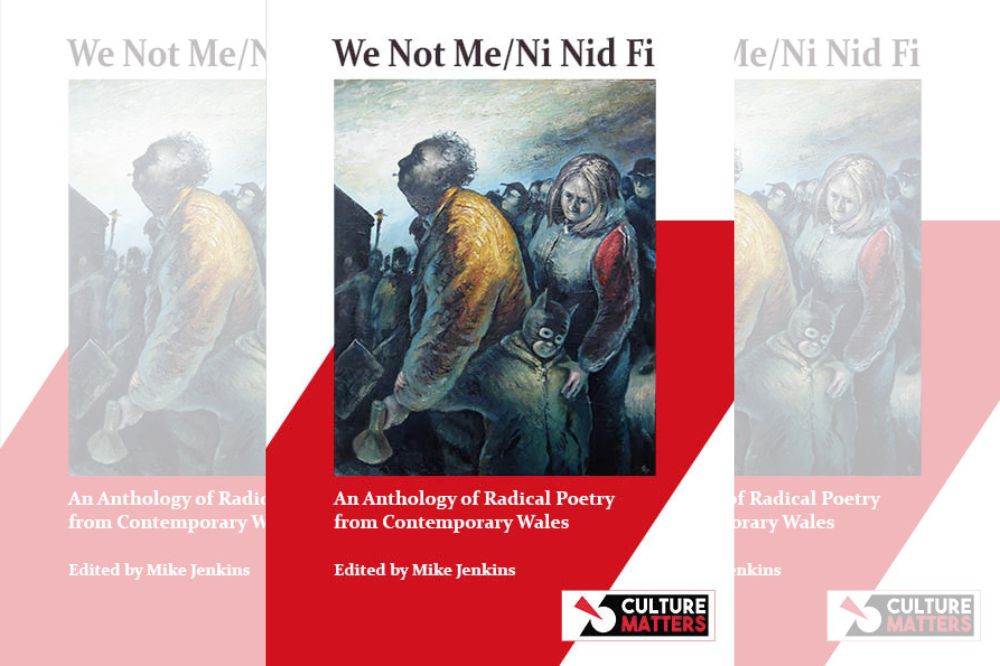
I have a liking for poetry anthologies, especially if they are curated or edited by a poet or writer, so was looking forward to reading We Not Me, edited by Mike Jenkins, poet and writer. The sub-title of the collection, An Anthology of Radical Poetry from Contemporary Wales, informs you exactly what direction these poems are going to take. It’s a diverse collection of works from people willing and wanting to say what they believe and why it matters, and this book is the fourth in a series of radical poetry from Cymru.
This anthology focuses on personal, social, and political struggles, and is divided into three parts, local, national, and international. There are poems about the health service, the closure of the mines and steel works, the drowning of Capel Celyn, the climate crisis, the suffering in Gaza. These are direct, honest poems of the heart, of love, pride, solidarity, and despair and compassion. We march with the miners in Ammanford; take our last breath with Tommy, our lungs full of coal dust; fight with Dai Jenkins to save Cynheidre Pit; forage for firewood with women in Darfur.
In ‘DividEND’, Karen Gemma Brewer asks the question,
‘Can a land be divided
other than by mountain, river, lake, or sea
or is it always divided
by lines drawn on paper and in minds’
David Lloyd says of ‘Forgotten’, his poem about climate change, that his words are both a lament for what we have forgotten and a call to remember. ‘I should do something to save us / But I’ve forgotten which herbs to burn.’
The title itself is interesting, and is an apt reflection of the book’s interior. We Not Me /Ni Nid Fi, comes from the poem ‘Life Support’, written by a former GP Jonathan Richards, on the struggles within the National Health service. He says of his poem that he’s been protesting about these issues since he was a child,
‘There, in the corner, on the floor: “ the poor”.
Each lovely, none “ malingerers” or “scroungers”.
Not even a bed for sodden travellers, seeking refuge.’
These words have presumably been quoted in the media. He asks, where is the anger? And why do so few people seem to feel it?
‘When will mutuality, solidarity, generosity matter again?
What will it take?
We not me.
Us Not I.’
There are many other worthy poems, it’s hard to know which ones to focus on. Rebecca Lowe wrote ‘Toil’ as a testimony to Welsh resilience, reworked while she stood on the picket lines at Port Talbot Steelworks, following the announcement that the two blast furnaces would be closed:
‘Our children were not
born in the usual way,
but forged from steel
plumed sparks to the sky…’
And
‘We bore our children
through industrial sweat,
our backs arched
against their labour,’
The poems about Gaza are harrowing. Owain Williams writes about Mother Orange, Gaza’s first music teacher, who was killed by an IDF sniper in 2023:
‘violins weep as the teacher’s song is muted
a bloody melody for a snipers target
auburn hair cowering under an innocent hat’
In ‘What Remains’, Abeer Ameer writes of the destruction following the Al-Shifa Hospital Massacre in Palestine. ‘I can only write what I see.’ She says. Every line of this poem apart from one details this destruction, of the buildings, of the people. It’s a hard read. One line stands out as it’s in marked contrast to the rest, ‘There was a garden here where birds / sang.’ It has the effect of making the horror worse in some way.
In a different vein, Rhian Elizabeth writes about her experience of being pregnant at seventeen, in her insightful ‘blackbirds fatten best in hard weather’. She sat her A level exams while pregnant:
‘knowing full well that i wasn’t
properly prepared to offer
any meaningful commentary
on john webster’s use of blank
verse, let alone be responsible
for another life.’
A welcome addition at the end of the collection is a note by each poet on explaining what inspired them to write their poem rather than the usual individual biography. This gives us a deeper understanding of the poems, and I wish those explanations happened more often.
This is a fine book, and at times, I find myself going back to it to re-read a particular poem. I’m from the South Wales valleys myself, so maybe that’s why many of the words strike a chord. Perhaps we’re all children ‘forged from steel’, with ‘our voices singing sparks from the flames’ as Rebecca Lowe describes so eloquently.
We Not Me/Ni Nid Fi, edited by Mike Jenkins, is published by Culture Matters and is available to purchase now.
Support our Nation today
For the price of a cup of coffee a month you can help us create an independent, not-for-profit, national news service for the people of Wales, by the people of Wales.


