


Polling finds museums are strong sources of national identity in Wales and Scotland
Stephen Price
Arts and culture, including museums and galleries, are among the strongest sources of national identity in Wales and Scotland according to new public polling commissioned by Art Fund ahead of the Senedd and Scottish Parliament elections on 7 May.
The research, conducted by public opinion research agency More in Common, shows overwhelming public support for museums and galleries across Wales and Scotland as well as strong backing for maintaining or increasing government funding in the sector.
Eight in ten people in Scotland (80%), and nearly four in five people in Wales (79%), say arts and culture, including museums and galleries, are an important part of national identity.
This ranks higher in Wales, than Welsh rugby (76%) and the Welsh language (75%), in Scotland, than Scottish football (70%) and the Scots Gaelic language (58%); and,.
The findings highlight the important role museums play in communities, with four in five Scots (80%) and more than three quarters of people in Wales (77%) saying their local museums and galleries make them proud of their area.
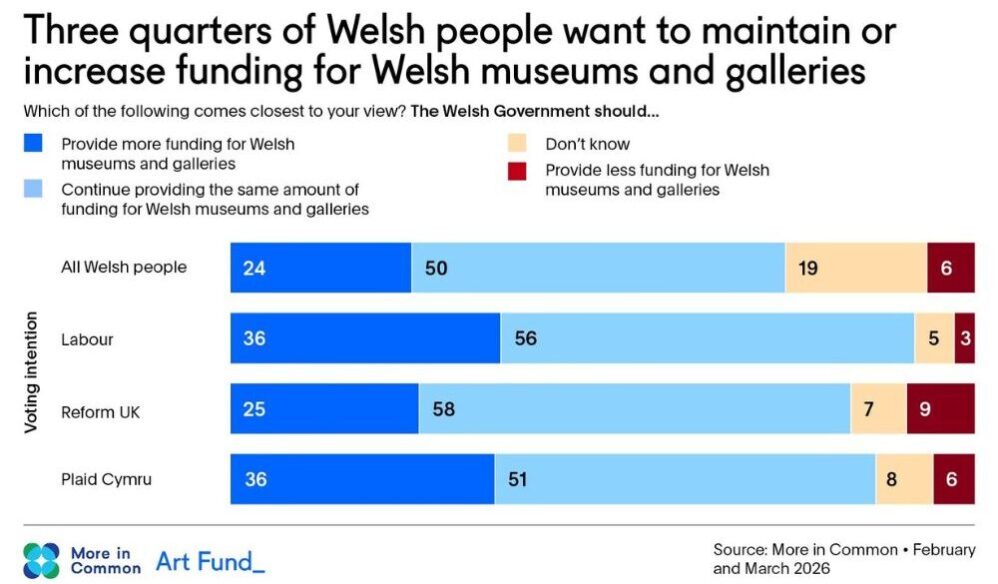
With voters preparing to elect a new government to the Senedd and Scottish Parliament, the polling also reveals strong public support for continued investment in museums.
Four in five people in Scotland (80%), and almost three quarters of people in Wales (74%), say their governments should maintain or increase funding for museums and galleries. Support spans the political spectrum.
More than half of people in Scotland (52%) and Wales (53%) say they would view a political party more favourably if it promised greater support and funding for museums and galleries.
This research is part of the Art Fund’s UK-wide advocacy work ahead of elections in Wales and Scotland, as well as local elections in England.
Art Fund Director, Jenny Waldman, shared: “We are calling for political leaders to recognise the vital role museums and galleries play, and to commit to investing in their future so that everyone can enjoy and benefit from them for generations to come.”
Funding
Art Fund’s research was published ahead of performing arts and entertainment union, Equity’s calls for Senedd candidates to pledge their support for the arts after research revealed funding in Wales has fallen by 46% since 2010.
Equity has launched a manifesto for Wales ahead of the Senedd elections on 7 May, urging candidates to sign up to five pledges aimed at investing in and bolstering culture.
The pledges include embedding fair pay and conditions for workers and recognising them as skilled professionals in essential infrastructure.
Alongside the manifesto, Equity has commissioned new research into arts funding which reveals that Wales has seen a 46% fall in arts spending since 2010, losing around £30 million per year in local council arts spending over the period.
The drop from £64m a year in arts spending in 2010 to just £34m a year in 2024-25 represents a nearly 50% cut in per capita annual funding by local authorities on local arts and culture in Wales since 2010, down from £21.03 to £10.85 in 2024/45.
Wales fares better than England, which saw a 61% cut down to £6.47 per person, per year, but worse than Scotland, where funding dropped by 18% over the same period, to £20.73 per person, per year.
Simon Curtis, Equity’s Official for Wales, said: “Culture is not a luxury – it is work – and it matters to people across Wales.
“The arts, creative and media sectors are part of Wales’s foundational economy — rooted in people, place, and public value. Yet the people who make culture possible through their performing, teaching and creating too often face low pay, insecure contracts, unsafe conditions, and chronic instability.
“A cultural nation cannot be built on insecurity, so Equity’s Senedd manifesto sets out five pledges to ensure culture in Wales is treated as essential infrastructure — funded sustainably, built on fair work, and open to everyone. We are asking candidates to sign up to the pledges and asking voters to raise these issues.”
“If culture is essential to Wales, then the people who create it must be treated as essential too.”
Polling was conducted by More in Common in March 2026, among a representative sample of 1,000 adults across Scotland and a representative sample of 850 adults across Wales. Responses were analysed by age, gender, ethnicity, voting intention, region and education level using the British seven segments model.
Support our Nation today
For the price of a cup of coffee a month you can help us create an independent, not-for-profit, national news service for the people of Wales, by the people of Wales.


