

Replaying one of the most notorious moments in Welsh TV history
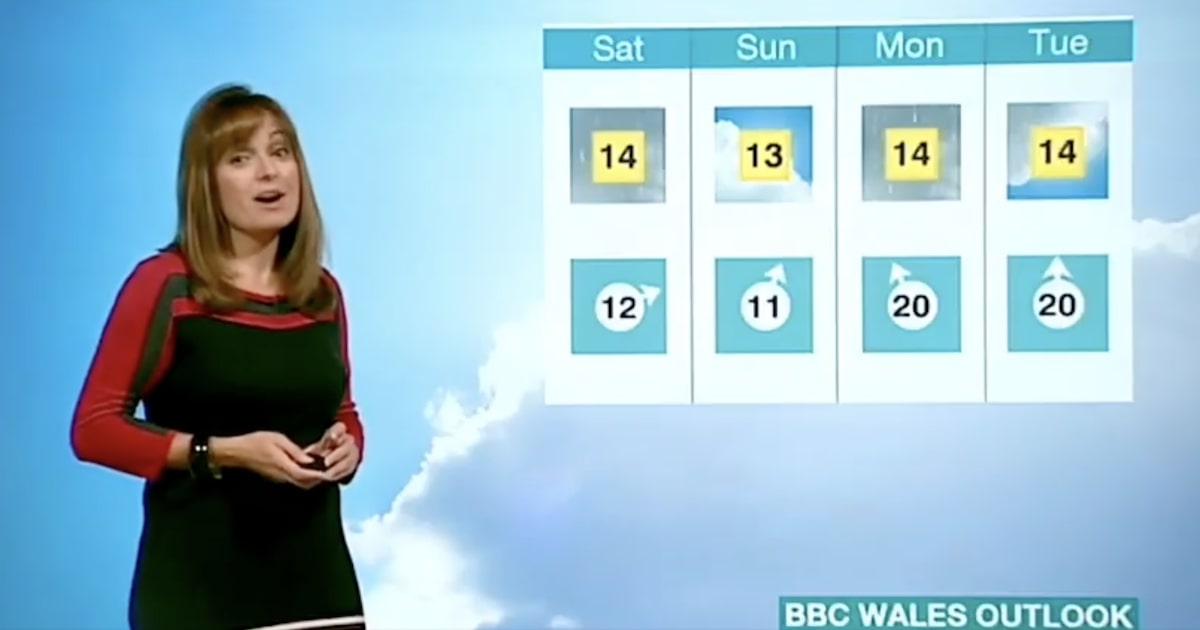
It’s every presenter’s worst nightmare – to mangle your words live on air but not just make a mistake, but one that is set to be replayed for years to come.
So it was that today marks 10 years since BBC Wales weather presenter Sue Charles said something she rather wished she hadn’t live on air while informing the watching audience that the clocks were to go back that weekend.
Thankfully, rather than hide away her error she is happy to take ownership of the legendary TV moment that keeps being replayed year after year.
To mark the occasion, good sport Sue, took to social media to rerun her televisual cock up!
She wrote: “The clocks go back this weekend… which means it’s 10 years since this live televisual cock-up. Feel free to have a laugh at my expense…”
⏰ The clocks go back this weekend… which means it’s 10 years today since this live televisual cock-up. Feel free to have a laugh at my expense…
#BST #GMT #ClocksGoBack pic.twitter.com/x3tqMnXsWg— Sue Charles (@Sue_Charles) October 24, 2025
It’s not the first time that Sue has run into some on air gremlins. There was the time when the BBC subtitling unit did her dirty with this unbelievable caption…
Not looking forward to Friday one bit. pic.twitter.com/B7vdFZI7zD
— No Context Brits (@NoContextBrits) July 19, 2021
And just this week, the legendary Welsh weather presenter proved once again what a consummate professional she is when she experienced some on screen technical difficulties when her mic fell inside her outfit.
🎙 When live TV goes wrong… had a few texts about this! The microphone dropped inside my outfit and I had to grab the emergency mic.
What you don’t see – but do hear – is presenter Jen Jones running across studio to pass the stick mic, like a baton-relay champion. What a pro! pic.twitter.com/9LJDmAF8t1
— Sue Charles (@Sue_Charles) October 20, 2025
So don’t forget clocks will go back by one hour this Sunday, bringing with it darker days, an extra hour of sleep and a time zone shift from British Summer Time to Greenwich Mean Time.
Here is everything you need to know about when and why the clocks change, how it can impact your health and why some scientists have called for an end to the measure.
When are the clocks going back?
Every year, the clocks “fall” back an hour at 2am on the last Sunday of October.
This year, the clocks will go back on October 26.
This is also known as moving from Daylight Saving Time to Daylight Standard Time.
Why do the days get darker?
When the clocks go back, the sun rises and sets an hour earlier, shifting our sunlight from evenings to mornings.
Sunrises will start later as the UK builds towards the darkest day of the year known as the winter solstice, meaning daily sunlight gradually decreases.
This year, the winter solstice will occur on December 21.

When did the clocks start changing?
The Summer Time Act 1916 was introduced during the First World War, when the UK needed to make as much use of daylight as possible to conserve coal.
The time zone has changed twice since. British Double Summertime was introduced from 1939 to 1945 to increase productivity during the Second World War.
Harold Wilson’s government trialled British Standard Time from 1968 until 1971, which saw clocks move forward an hour but not return back.
How can the clocks changing impact our health?
Dr Jeffrey Kelu is a researcher at King’s College London who specialises in circadian rhythms, cycles of around 24 hours that help govern bodily functions like the sleep-wake cycle.
He said evidence shows keeping to one time zone throughout the year would be better for our health.
Light exposure helps regulate our biological and metabolic processes, so changes in the amount of light we are exposed to can disrupt cycles within the body.
A reduction of light exposure in the autumn can also lead to a potential vitamin D deficiency, which can trigger mental health problems.

Dr Kelu said: “Given people see less light after work (when the clocks go back), this really has an impact on mood, especially for people with mood disorders.”
He said switching to one time zone would ensure maximum light exposure in the mornings and prevent our sleep from being delayed by lighter evenings.
Changes to the time we go to sleep and wake up can also disrupt our circadian rhythms.
When a person’s circadian rhythm is disrupted, it can increase their risk of developing chronic illnesses such as type two diabetes and cardiovascular disease.
Molecular biologist Dr John O’Neill said that because circadian rhythms are not exact 24-hour cycles, people can cope with slight delays to their cycle without any major consequences.
However, he said changes can still be disruptive and may be linked to an increase in road traffic accidents and heart attacks when the clocks change.
Dr O’Neill said Daylight Saving Time should “absolutely” be abolished, adding: “It’s completely ridiculous that we’re still living with this anachronism.”
How do the clock changes impact our sleep?
Light exposure triggers the production of the hormone melatonin, which makes us feel sleepy.
When the sun sets later, melatonin production is triggered later in the body, meaning it can take longer to feel ready for bed in the summertime and result in a lack of sleep.
Dr Megan Crawford sits on the executive team at the British Sleep Society, which has called for the twice-yearly clock change to be abolished and replaced by Standard Time (equivalent to Greenwich Mean Time).
She said the impact of poor sleep goes beyond disrupting our physical health and biological processes.
Dr Crawford said: “Sleep and mental health are incredibly interlinked. Poor sleep predicts a development of things like depression and anxiety, so it has an impact on our mental health too.”
Support our Nation today
For the price of a cup of coffee a month you can help us create an independent, not-for-profit, national news service for the people of Wales, by the people of Wales.


