

Review: ‘And I own it’ The Trouble with Buying Art by Ian Rowlands
Lewis Davies
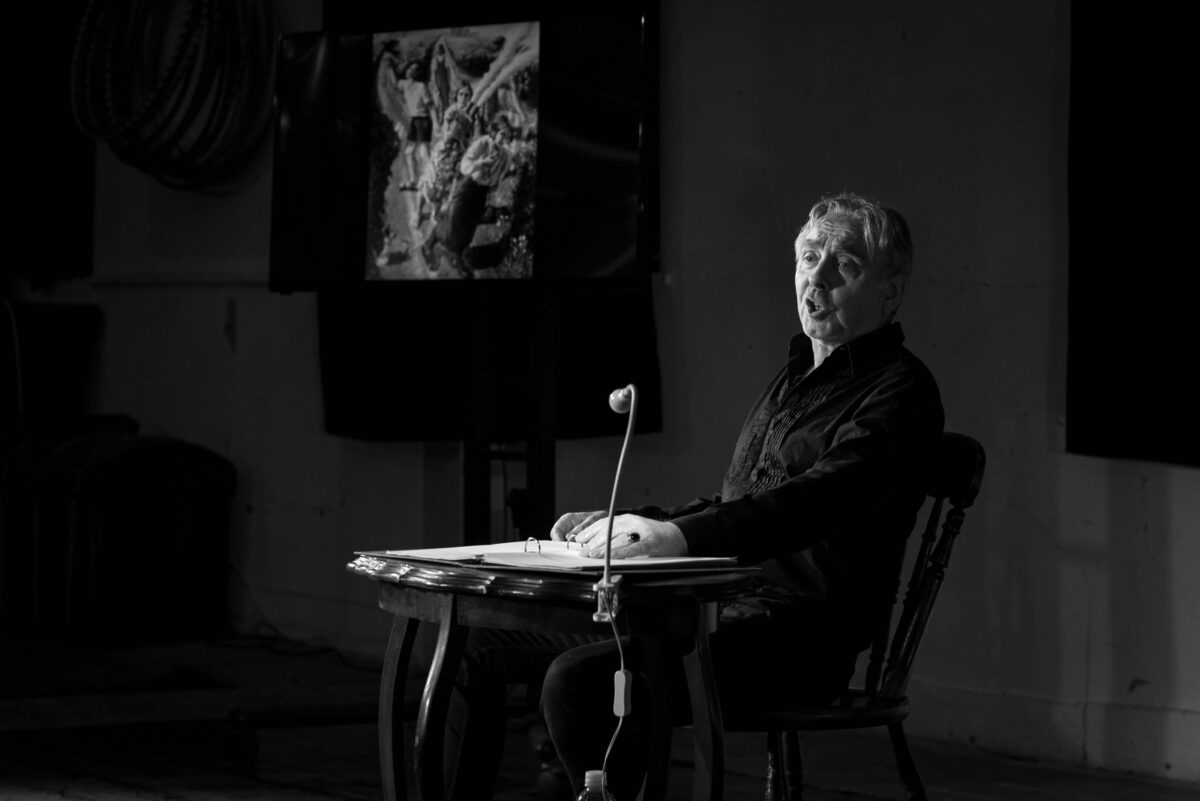
No one holds the floor of a draughty community hall stage lit by a single wash like Russel Gomer. Script in hand, moving with energy and concentration, eyes drawing you into his frightening interior world.
Gomer is one of the most talented actors of his generation who came to the fore in the Welsh theatre of the 1990s. He has had a seminal role in the development of the most significant plays in the modern Welsh canon. He can be at his best in the intensity of a one-man show. His latest incarnation, for a few nights only, is in Ian Rowlands’ new play “And I own it”… The Trouble with Buying Art. The performance on the night is underscored by an improvised jazz harp interpretation from Rhodri Davies which merges seamlessly with Gomer’s movement and controlled energy.
Both Gomer and Rowlands are on home territory on a stormy Friday night at Hopkinstown Town Hall, as guests of Citrus Arts and Rage Rage Oes Oes, who offer “exceptional experiences for everyday people” in circus, theatre and dance. It is an impressive space. The theatre is full. Legendary valleys playwright Laurence Allan has come to watch. There is expectation. You never know what you’re going to get or where you are going to go with Gomer and Rowlands.
Gomer plays the unnamed, unlikeable narrator and “first generation art-collector” who has bought a painting at an eisteddfod “in August”. The artist, also unnamed, is an enigma who, through her painting, begins to impinge on the collector’s view of himself.
Guilt
The artist as collector has troubled Rowlands for some time. His three-play sequence A Trilogy of Appropriation is riven with guilt about acquisition, ownership and ultimately colonisation. His masterpiece of monologue, A Marriage of Convenience (1996), memorably interpreted by Gareth Potter, set not too far from Hopkinstown on the day of Charles Windsor and Diana Spencer’s wedding, is torn to the seams with language, class, education and, of course, guilt. Where would the Welsh be without that?
In And I own it, the narrator has moved beyond the caprice of youth and language to the successful, educated middle-class game of buying and ultimately valuing art. There are occasional throwback lines to the superiority and up-yourself self-importance of A Marriage of Convenience, emphasising the use of his language – but crucially not his mother tongue – above the ‘thin’ tongue. The collector is a successful Welsh learner. The ‘thin’ tongue is nevertheless the medium for most of Rowlands’ engaging and embracingly international work.
The purchase of the painting brings problems for the collector in the shape of a request from the artist to borrow back the painting for an exhibition. The exhibition is extended and then tours. He agrees to the extension. He doesn’t actually have the thing, the object, the art in his possession but is buoyed by the fact he’s extending his patronage, largesse “like a fucking Guggenheim”.
Then things get a bit more complicated. He reads the obituary of the artist in the Western Mail. The artist’s husband gets in touch asking whether they can exhibit the painting at her memorial. Of course. He would be welcome to attend. He would be honoured. And one last thing – would he consider selling the painting back to the husband? The grieving husband who has just lost his young, wonderful wife to breast cancer at the age of thirty-four? Maybe now’s not quite the right time.
The matter of Wales
As a playwright of substance, Rowlands has always played with our values, using real-time engagement with his concerns about nationality and independence, the matter of Wales. This is a more personal piece but even more universal. The artist in question in this play is Sarah Snazell, one of the most illuminating talents to emerge so briefly in Wales in the late nineties.
Snazell was born in Abergavenny and studied at the Newport College of Art and then Leeds University. She settled for a time in the city, where she met her husband, while also developing the Jackson Yard Artists’ Studio, which would become part of East Street Arts and the renaissance of modern art in the city.
Snazell’s superb painting Doppelganger (1998) was the centrepiece and cover poster for a retrospective of the work acquired in twenty-five years of collecting by the Brecknock Art Trust, exhibited at Y Gaer, Brecon, in 2025. The painting was the first purchase the trust made. It was a great choice. Snazell worked slowly and exhibited rarely but won admiration quickly. She was at the beginning of a wonderful career when she died of breast cancer in 1999 at the age of thirty-four.
As the play darkens, Snazell’s husband arrives at the collector’s house with the painting, all wrapped up, finally and reluctantly to be surrendered to its rightful owner. The man with the receipt. The husband is going to ask one more time. The painting, his wife’s seminal work, the one she exhibited for her thesis and gazed at in her studio when she was battling her illness, is about to be lost. He is invited to undress her.
Rowlands continues to turn the screws on half-truths we tell ourselves about our position in the world and the meaning of it all in this embracingly honest and self-lacerating work of dramatic investigation. With Gomer at his piercing best, it should win prizes. It deserves a full production and an international tour.
Lewis Davies is a writer and publisher. His own play about buying art, Football, directed by Jeff Teare and produced by Made in Wales, was seen briefly at the Edinburgh Fringe, a long time ago.
Support our Nation today
For the price of a cup of coffee a month you can help us create an independent, not-for-profit, national news service for the people of Wales, by the people of Wales.
Get more trusted Welsh news
Choose Nation.Cymru as a preferred source in Google News to see more of our journalism.


