

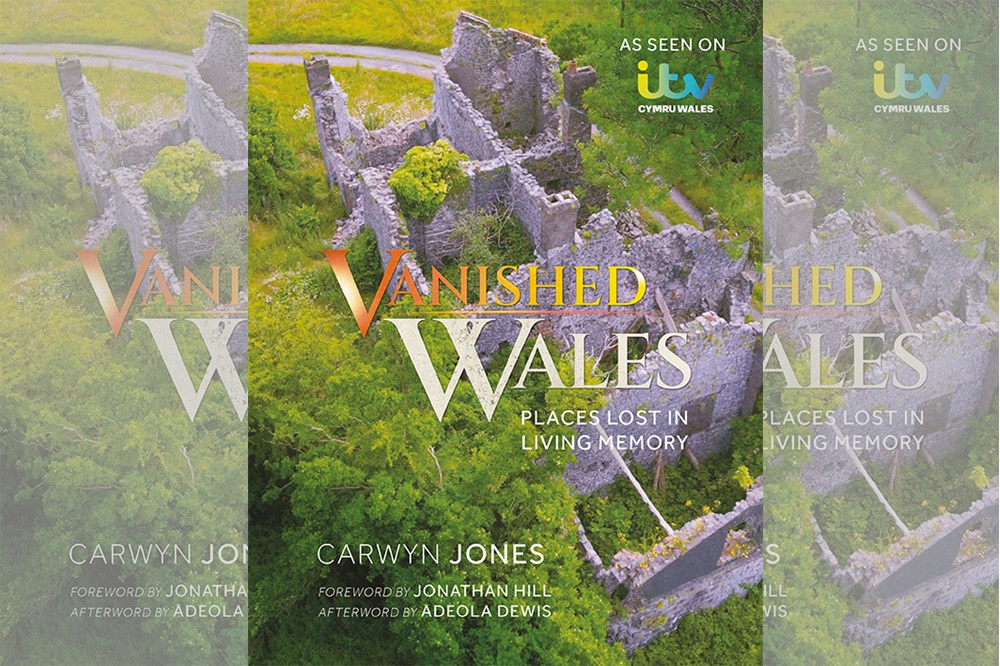
Review: Vanished Wales: places lost in living memory by Carwyn Jones
Desmond Clifford
Vanished Wales by Carwyn Jones (not the former First Minister!) is the book accompanying the ITV CymruWales television series presented by Adeola Dewis.
As the subtitle explains, it looks at “places lost in living memory”. In doing so it draws attention not only to places but to aspects of history which have slipped in public consciousness.
For the most part the book steers clear of the coal industry which has been well recorded and looms large in the collective imagination.
Manufacturing also formed an enormous part of the twentieth century’s social and economic experience in Wales and yet is often forgotten.
The Corgi Toys Mettoy Factory in Fforestfach, Swansea covered a 250,000 square feet site and in the 1970s employed an incredible 3,500 people, according to the testimony of Lyndon Davies, recruited at 16.
As a boy, I had a bag full of miniature Corgi cars which I raced incessantly around our house in epic cross-carpet car rallies.
The whole metal-bashing industry collapsed like a deck of cards in the early 1980s as plastics replaced metal, as electronics pointed to the Far East and as competition from abroad undercut Welsh labour costs.
Mustard gas
A grimmer form of manufacturing was the production of mustard gas at a top-secret site developed on 87 acres at Rhydymwyn, near Mold, obscured by an innocuous name, the Valley Works.
The secrecy held and the site avoided identification for bombing throughout the war.
A hideous 5,000 tonnes of mustard gas were stored underground. The site was diversified and used to develop “gaseous diffusion machines”, under supervision of a regiment of scientists, including 10 Nobel Laureates.
This work eventually transferred to the Manhattan Project in the United States and might, in a sense, be regarded as Wales’ contribution to the atom bomb.
Happily, the site today is a teeming nature reserve and surely an example of the repurpose triumphant over preservation.
The quixotic story of Gilbern Cars, like several chapters featured, could make a decent book all by itself.
In the 1950s two car lovers, a butcher from Church village, Giles Smith, and a former German PoW, Bernard Freise, combined in partnership to produce automobiles, the first of which was a Gilbern GT (“Gilbern”, of course, is a portmanteau of their first names).
They settled on a factory at Llantwit Fardre. Viewed from today it seems an astonishing instance of enterprise and entrepreneurship. Each car was handmade from fibreglass and buyers could purchase them fully assembled or in component parts to be put together at home.
The Gilbern was a genuinely Welsh vehicle. The business worked well on a small scale until the owners decided to sell it in 1968. The new ownership foundered and circumstances – the arrival of VAT, the oil crisis, strikes – turned against small scale car manufacturing and the indigenous Welsh automobile industry ended.
Around 1,000 Gilbern cars were made and, apparently, some 600 survive. It’s a remarkable and positive story; Welsh enterprise is too often overlooked.
Transport history features significantly in this book. We read of the Mumbles Railway; the flying boats of Pembroke Dock; Rhyl’s short-lived Vickers-Armstrong hovercraft service to Wallasey; and Crumlin viaduct, dominating Caerphilly county for a hundred years until condemned by the Beeching railway cuts.
I knew nothing of the poignant history of Groes, a village which once nestled at what is now Junction 39 of the M4 between Margam and Port Talbot. It wasn’t an ancient village, its origins were mid nineteenth century and developed as part of the estate of C. Mansel Talbot, who gave his name to the steel town, but a human reminder of the contested “price of progress”.
Severn Princess
I was especially pleased by the chapter on the Severn Princess, the small passenger ferry which plied the ancient river route across the Severn between Aust and Beachley; by a geographical quirk both are actually in England.
Bob Dylan was among the last passengers to sail on the last ferry, the Severn Princess, on his first visit to play Cardiff in 1966; the Severn Bridge opened a couple of months later and killed the river crossing forever. He played at Cardiff’s Capitol Theatre (11 May), also covered in the book (incidentally, a recording of half of the concert exists).
Pleasingly, the Severn Princess was rescued from imminent destruction and is now restored on dry land as an attraction in Chepstow.
I have personal memories linked to a couple of chapters. As a younger man I swam in Cardiff’s Empire Pool. It was built for the Empire Games of 1958 and cemented Cardiff’s position as the newly and formally designated capital of Wales.
It was demolished in 1998 to make space for the new Principality Stadium.
The King’s Hall in Aberystwyth, in distinctive pink, was a familiar landmark during my years living in the town and I was sorry when it was demolished. That corner on the Prom still feels like something’s missing.
The heritage dilemma
At the heart of all these stories is what might be called the heritage dilemma. As RS Thomas famously notes, there is no future and no present in Wales, only the past!
An unthinking heritage obsession, demanding the preservation of anything and everything, is as bad in its way as would be the opposite – blind and wholesale destruction of the country’s past.
Wales is rich in evidence of our history.
We need to protect, preserve and exercise careful stewardship – but none of us want to live in a museum. The past isn’t always better than the present and the future. As a society, we must judge and tread a careful path between preservation and present need.
This book is beautifully produced and draws on the stylish photographs generated for the TV series and extensive archive research.
The material covers the whole expanse of Wales stretching from Victoria Pier in Colwyn Bay to Lovells’ Chocolate Factory in Newport, and from the King’s Hall in Aberystwyth to the Laura Ashley factory in Carno.
The stories selected are in every case interesting and merit inclusion. I suspect there are many more comparable examples of the Wales which lies behind the first glance and a second series/ book would be very welcome. This one would make an excellent present for anyone interested in a slightly offbeat view of Wales.
Vanished Wales is published by Seren and can be purchased here and at all good bookshops.
Support our Nation today
For the price of a cup of coffee a month you can help us create an independent, not-for-profit, national news service for the people of Wales, by the people of Wales.



Gallwch gynnwys y Fro Gymraeg ymysg y mannau gollwyd hefyd.