

Review: Waterflower and the Eco-Punk DIY Spirit of Coracle Europe Fringe
Gemma June Howell
Who knew plants could be punk? From Waterflower’s riotous eco-electronica to black out poetry, film screenings and DIY Zine making, Carmarthen’s Coracle Europe Fringe is making serious noise on a shoestring.
From Thursday 22 to Monday 26 October, Carmarthen became a hotbed of experimental art, poetry, music and creative resistance as the Coracle Europe Fringe Festival returned for five days of gloriously eclectic grassroots culture.
Hosted by Write4Word, Coracle draws extraordinary talent from across the globe. Unlike so many festivals today, this isn’t solely about promotion and selling books it about cross-pollination. Artists are welcomed as equals— their art, ideas and lived experiences, a valid conversation rather than an exercise in individualism. This was my third Coracle Fringe, and without spaces like this, I’d feel utterly lost in an increasingly commercialised cultural landscape. There’s something deliciously DIY punk about it and this type of resistance feels essential right now.
When Plants Go Punk
Festival headliner: Waterflower, Latvian eco-futurist Sabine Moore creates experimental electronica using bio-data feedback from plants and fungi. But this isn’t simply making music with nature. It’s about giving nature a voice.
“I use bio-data feedback,” Sabine explains. “I see this as a living plant orchestra, where each plant brings their own unique contribution to the performance. They are individual contributors themselves.”
There’s something wholly subversive about that philosophy. In a world obsessed with extraction, exploitation and individual achievement, Waterflower proposes something altogether more radical: collaboration across species.
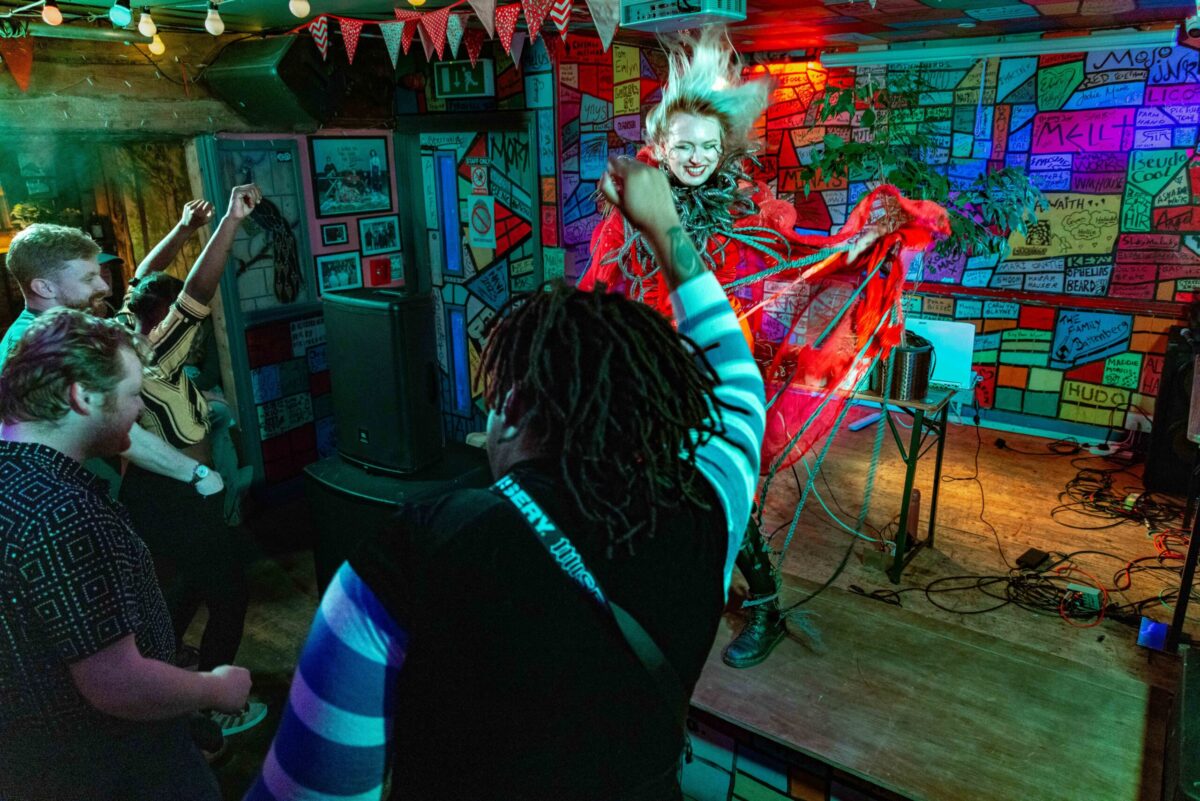
And the music? Mesmerising, emotive, banging PUNK electronica, with environmentalism at its heart. At Cwrw, the dancefloor was bumping as we danced our collective response to the spiralling turmoil of global ecological crisis. Nature colliding with electronic and D&B textures, to the beat of our feat, transforming environmental anxiety into something visceral, confrontational and unexpectedly euphoric.
But Waterflower’s work is rooted in a deeper experience; one of cultural and political repression.
“Even though there’s no immediate danger, coming from a post-Soviet environment, people are afraid of expressing anything that could be viewed as dangerous,” Sabine explains. “That tension is what drives my work, and I welcome safe public spaces to express my rage on stage, collectively together.”
That struck a particular chord with me, having facilitated Rage on the Page and contributed to Rage on the Stage earlier in the festival. Different artistic practices, perhaps, but the same desire to transform anger into collective creative expression.
It was undoubtedly one of the best performances I’ve ever seen and even the merchandise was aptly DIY: a comic book created by Sabine alongside LPs and cassette tapes, itself an embodiment of analogue, a rejection of the digital. Supporting performances from Nigerian Welsh producer Neo Ukandu, and Smokes completed an extraordinary evening.
“I felt like I was in the right place with the right people. Everyone felt like equals, and I love that about the Coracle Festival,” reflected Neo.
And therein lies the core of Coracle.
Thriving Festival, Fragile Future
Hosted in Carmarthen since 2018, Coracle has never received any significant arts funding. But this year, its partners decided to push ahead with no budget whatsoever, driven by overwhelming demand from local and international creatives.
Artists from Sweden, Nigeria, Cameroon, Ireland, the US and across Wales converged for a programme embracing queer, non-binary, anti-capitalist and climate-conscious momentum of the current landscape. Experimental, inclusive and unapologetically grassroots, festival organiser, poet and publisher Dominic Williams describes Coracle as “the infrastructure for deep and genuine global and local community engagement”, celebrating the commitment of an “international creative family.”
But beneath this extraordinary collective achievement lies a more precarious reality. Many of the artists sustaining grassroots culture are themselves struggling to make ends meet. Their generosity, passion and determination may have enabled the festival to flourish this year, but goodwill doesn’t pay the bills.
And there’s a danger in celebrating this resilience without acknowledging its cost. As the arts funding ecosystem becomes increasingly fragile in Wales, and the pressures of corporate capitalism push culture towards commercial viability and success, it’s the independent artists and grassroots communities who risk being left to wither on the vine.
Coracle is living proof of what can grow when artists collaborate rather than compete. But if we want these vital cultural spaces to survive, let alone flourish, we need to invest in the people who nurture them.
The DIY ethos deserves celebrating. Chronic underfunding doesn’t.
Black Out the Noise
My Rage on the Page blackout poetry workshop, and sister event Rage on the Stage, invited participants to black out the noise, dismantle toxic language and reclaim their power. Both events drew a good turnout at Criwdem Celf Creative Space and Cwrw, with participants pushing beyond their comfort zones against the backdrop of Swedish artist Unni Vinje’s breath-taking exhibition, which later in a dedicated talk, she took us through her creative journey from a lab milk technician to her newfound respect for cows and alternative materials.
Elsewhere, there were film screenings and innovative workshops, including DIY zine-making and Tallulah Drew’s Person in Place; a gentle invitation to reconnect with our inner child artists. She’s even handmade each of us a journal for our musings. Later that day, we enjoyed an exclusive reading from Jayde Collings’ forthcoming collection, Spiritual Cuts.
Art Belongs to Everyone
Saturday’s open mic was unforgettable: trumpet, guitar, spontaneous drumming, audience participation, singing, musical theatre numbers, spoken word and Earthbound’s soul-soothing soundscapes filled Criwdem Celf, an artist-led creative space and wholefood cooperative. I tested some new work from my forthcoming collection Hinges in a wonderfully non-judgemental space.
Sunday brought the Dinefwr Bards to Carmarthen’s old Magistrates’ Court. Industrial neglect, reclamation of the wild woman narrative, the Swansea Devil, a robot’s sonnet and a surprising, existential lament to a condom made for an afternoon both sobering and laugh-out-loud funny. Poet, Richard Temple’s line, “guilty until proven guilty” was particularly apt given the setting.
Poet, Louise Bretland-Treharne of the Dinefwr Bards described her experience:
“I was humanely supported to connect with fellow creatives, witnessing the arts as the people’s voice … actively seeing the extraordinary within a community reality.”
For Irish-American haiku poet and Farewell America author Steve Huenneke, Coracle was:
“A convivial, personally transformational, vital and valuable experience as a poet and as a human being. Horizons expand here each and every year. Long may this festival live!”
Welsh artist, Freddie Cooper, also She Elloise, whose work challenges social structures surrounding gender, wealth, bodily autonomy and ableism, was crowned this year’s Coracle Poetry Slam winner.
Reflecting on the festival, they said:
“This weekend was so amazing! Seeing thinkers, creatives, artists, and curious minds come together, that’s what it’s all about.”
Another highlight was Jasmine Violet and Tom Lewis’s town walk decolonising Carmarthen, included the sickening history of an 80ft monument, known locally as ‘Picton’s Penis’, and questions about stories are preserved and whose are erased.
A Cultural Ecosystem Worth Nurturing
We pulled it off this year. But at what cost, and for how much longer?
As funding becomes increasingly precarious, the artists keeping these grassroots communities alive are struggling to sustain themselves.
The Coracle Europe Fringe’s future shouldn’t depend on creatives sacrificing their own financial security for the collective good. I’m hopeful it will return next year but hope alone won’t keep the roots alive. Just like Waterflower’s living plant orchestra, our cultural ecosystem depends on individual contributors thriving together.
Coracle Europe Fringe is organised by Write4Word. For more info click HERE and follow on the Coracle Europe Fringe on Instagram @coraclefringe
Gemma June Howell is a writer, editor and cultural critic based in Swansea. She is the author of The Crazy Truth and works across publishing, theatre and film. Her work explores class and gender in contemporary Wales. Find more on her website HERE and follow on Instagram @howellgemma
Support our Nation today
For the price of a cup of coffee a month you can help us create an independent, not-for-profit, national news service for the people of Wales, by the people of Wales.
Get more trusted Welsh news
Choose Nation.Cymru as a preferred source in Google News to see more of our journalism.


