
The beautiful Welsh names for stars, constellations and galaxies
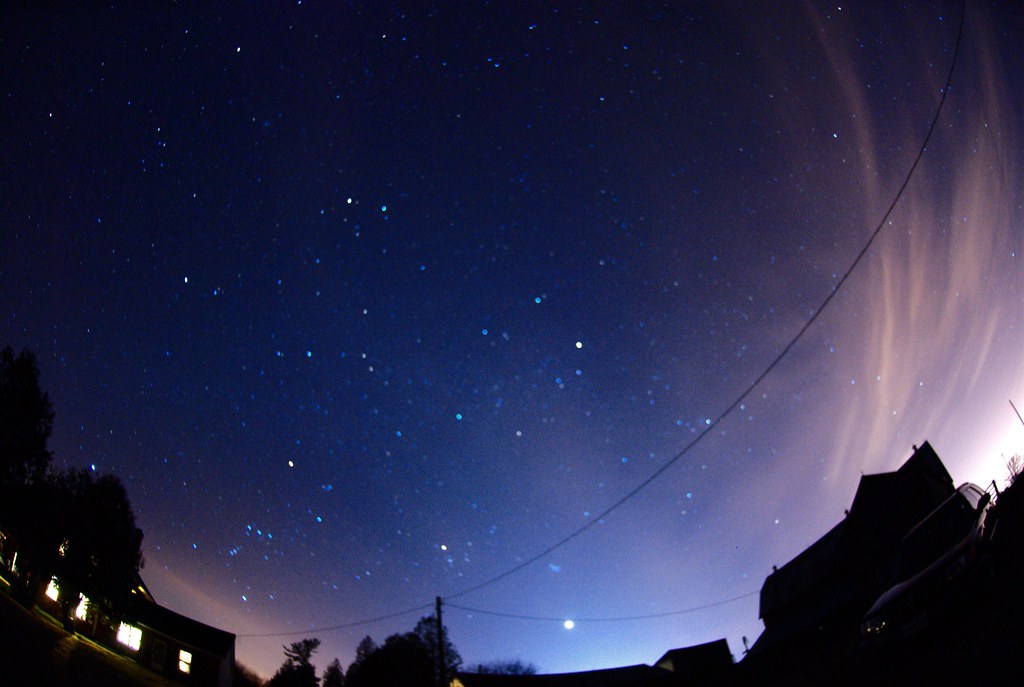
Social media’s favourite Welsh teacher has returned to share some interesting vocabulary from beyond the stars.
Stephen Rule, also known as Doctor Cymraeg, started his Twitter account in 2020 and has been helping Welsh learners through masterclasses, talks, Eisteddfod appearances and social media videos ever since.
In a video uploaded to his pages on 4 March and viewed 65,000 times, Stephen explained: “People often assume that because Welsh days of the week are named after Roman gods and space rocks, that the sky itself must belong to Greco-Romano-Norse mythology too.
“As if Celtic speakers over millennia looked up every night and thought, ‘oh, best not name anything, the Romans might eventually get annoyed’. But Welsh indeed had and still has its own names for what’s up there.”
He goes on to explain that Welsh tradition developed its own way of naming and interpreting the stars and constellations, drawing on mythology, folklore, local landmarks and everyday objects rather than the classical figures used in modern astronomy.
“The Milky Way? Caer Gwydion. Gwydion’s fortress. Gwydion being the magician hero of Welsh tradition, a figure associated with illusion, creativity and shaping the world itself. It’s also known as Llwybr Llaethog, the Milky Path, or Y Ffordd Wen, the White Road.
“Orion’s belt becomes Llathen Fair, Mary’s Staff. A Llathen is a measuring staff or a yard rod, turning the stars into a line of alignment, rather than a weapon. No hunter, just a guiding line in the stars. It’s also known as Y Tri Brenin, the three kings.
“And the Pleiades? Tŵr Tewdws, or Tewdws’s Tower. A tight cluster imagined as something constructed, not scattered. Or simply, as Saith Chwaer, the Seven Sisters.”
“The point isn’t that Welsh rejected classical astronomy,” Doctor Cymraeg concludes. “It’s that people were naming the sky long before anyone agreed whose gods owned it in the first place.”
View this post on Instagram
Traditional Welsh names for stars and constellations are thought to stem from oral traditions older than those recorded in Greek and Roman astronomy.
Around the third and second centuries BCE, this tradition, maintained by druids, connected the stars with gods and heroes hundreds of years before the stories were transcribed.
Many viewers said that despite their historic roots, Welsh words for planets and constellations are rarely taught in lessons.
“Only just learned Tŵr Tewdws very recently (there was a line in a 16c poem) and I’ve been reading Welsh for years. Funny the stuff that slips through the cracks!” A commenter said, while another made a request: “We need a longer post on this os gwelwch yn dda,”
Viewers clearly enjoyed the celestial trivia shared in the video, with one saying: “Never heard Caer Gwydion before but it’s so much cooler than Milky Way. It’s like the Welsh word for science, gwyddoniaeth, translated to Gwydion’s language. Which is so much cooler than science.”
For more information and support with learning Welsh, visit Doctor Cymraeg’s site here.
Support our Nation today
For the price of a cup of coffee a month you can help us create an independent, not-for-profit, national news service for the people of Wales, by the people of Wales.



It’s Twr Tewdws (twr = host, throng), not ‘Tŵr Tewdws’.