


Theatre Review: Martha
Molly Stubbs
When the young adult dystopian literature craze hit in the mid 2010s, I was at the height of teenage hormones, highly politicised by a newly-technological world, and primed to be swept away in stories of revolutions.
Dystopian literature and media most commonly portrays societies oppressed by totalitarian governments, mass surveillance, and enforced conformity, serving as cautionary tales about what the world might become if we fail to resist malevolent political forces.
As such, fictional dystopias deal in warnings about far-reaching issues popular at the time of their creations. 1984 has surveillance, nationalism, and class, Brave New World has eugenics, freedom, and class, The Handmaid’s Tale has religion, patriarchal power, and class.
With the digital age accelerating the activism of youth, and ideas evolving rapidly in literary spaces, you’d expect modern teen dystopias to chart new thematic territory. While YA isn’t always taken seriously, 21st century kids surely don’t share George Orwell’s preoccupation with Stalinist copycats.
And yet for all the cacotopias and anti-utopias we got in The Hunger Games’ dissection of war, The Knife of Never Letting Go’s portrayal of genocide, Uglies’ focus on beauty standards, class differences and dictators remained at the forefront. Rarely if ever did the most popular books from that dystopia craze, nor the oft-lauded giants of the genre from decades past, seriously engage with ableism and accessibility.
Breaking that trend is Martha, a Taking Flight production staged at the Sherman Theatre, written by Elise Davison and Stephanie Bailey Scott.
Future
It’s 2055, and the British government has almost succeeded in its aim of eradicating deafness. As well as deaf children being stolen from their families and forced into the hands of The Programme where they’re taught to lip-read, deaf babies are forcibly aborted, and BSL is a thing of the past. Or so the lawmakers think.
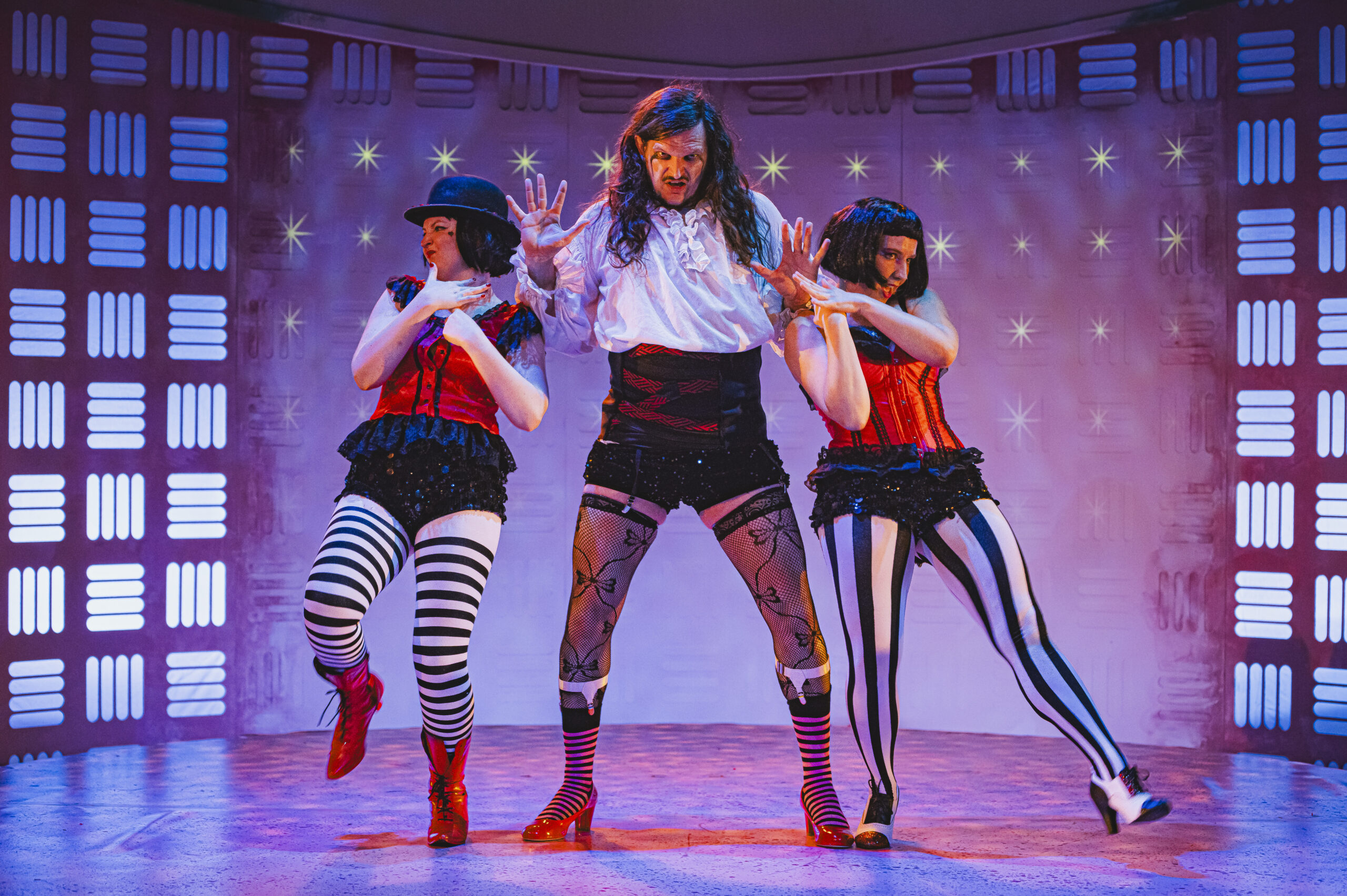
In an undisclosed location, a team of enterprising revolutionaries runs a cabaret club, Martha’s (named for Martha’s Vineyard in Massachusetts, which had a large population of people with deafness). Known for taking in those who have been placed on watchlists for their dissident views on deafness, Martha’s is a beacon for Sarah (Cherie Gordon), who is relearning her sign and turning her back on the government after a childhood of anti-deaf propaganda.
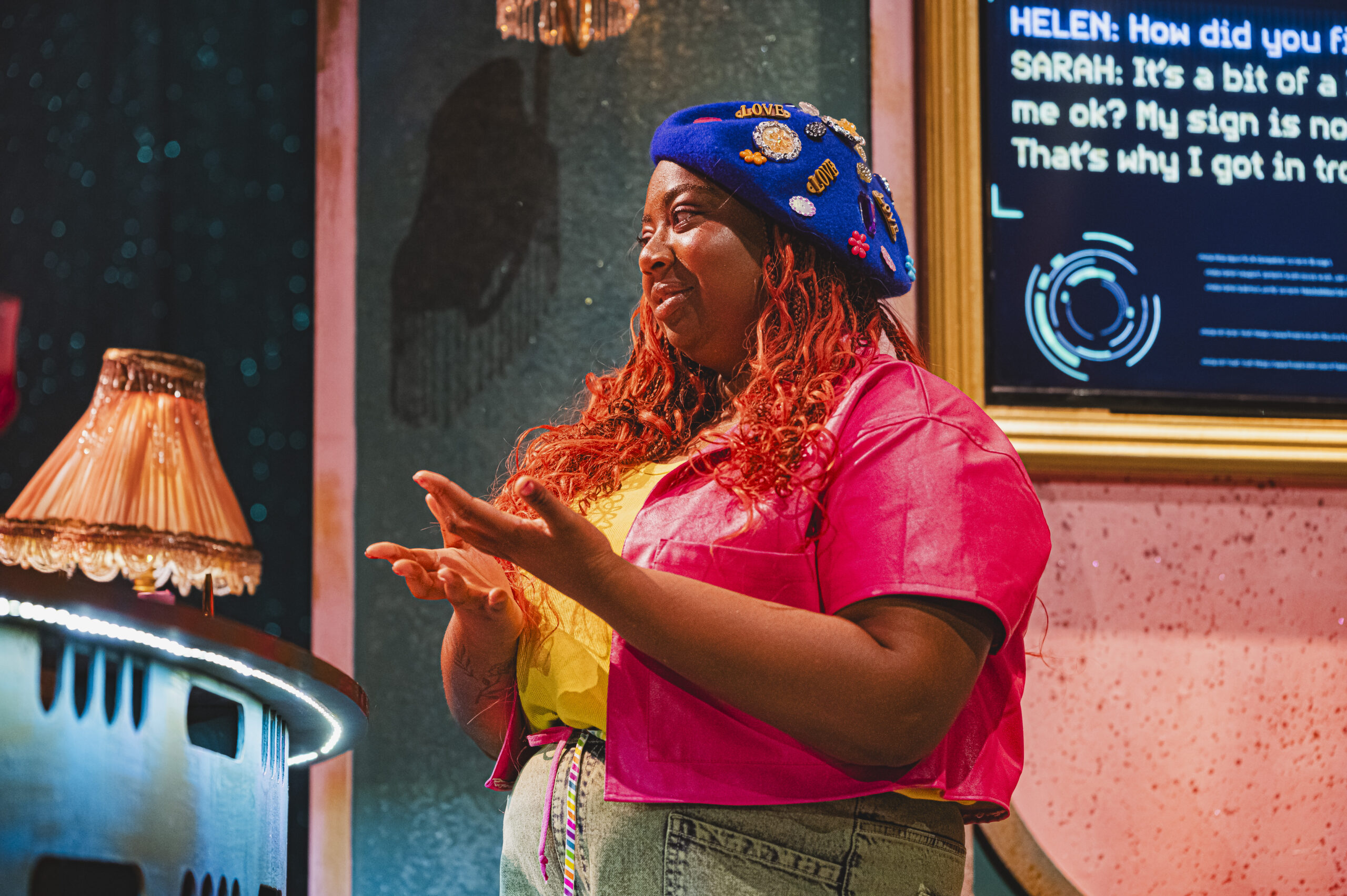
Together, Martha’s team hatch a plan to come out of the shadows and into the light, take a stand against the draconian laws of an ableist elite, and encourage people with deafness to reclaim their language and heritage.
Martha’s predominantly deaf cast delivers performances that are as bold as the script. With Bea Webster’s effervescent emoting, Duffy’s pantomimic physicality, Amy Helena’s prickly passion, and Rhiannon May’s tear-jerking softness, they ferry us through a rollercoaster of a story that never suffers from subtlety or falls into contrivance. Cherie Gordon and Eben James in particular, staying on top of their characters’ complexities, are Martha’s backbone and a joy to watch.
Accessibility
Martha is a bilingual production, performed primarily in BSL with English subtitles. The audience, majorly comprised of hearing people, needed an interpreter and accessibility measures, turning our understanding of ableism on its head. Although, this did result in a few ‘looking to the side’ moments from the performers as they worked to make sure spoken ‘translations’ were in time with signs. But I have no doubt this will become smoother the more Martha is performed.
One of the most interesting observations I made was how quickly I zoned out in scenes of solely sign. Used to listening only when people are ‘speaking’, the quiet signalled to some part of my brain that nothing was happening if no noise was being made. With this being almost instinctive, and assuming other hearing people are guilty of it too, it’s no wonder deaf stories are so often left to fade into the background. Thankfully, Martha rights this wrong.
While there is a plot unfolding with plenty of twists and turns, much of the first act is overwhelmed by a series of cabaret performances depicting deaf history. Did you know that Queen Victoria’s granddaughter, Princess Alice of Battenberg, was born deaf? Or that she hid those persecuted by Nazi forces? And did you know that Alexander Graham Bell, the telephone guy, advocated oralism to the detriment of thousands of deaf people? I didn’t.
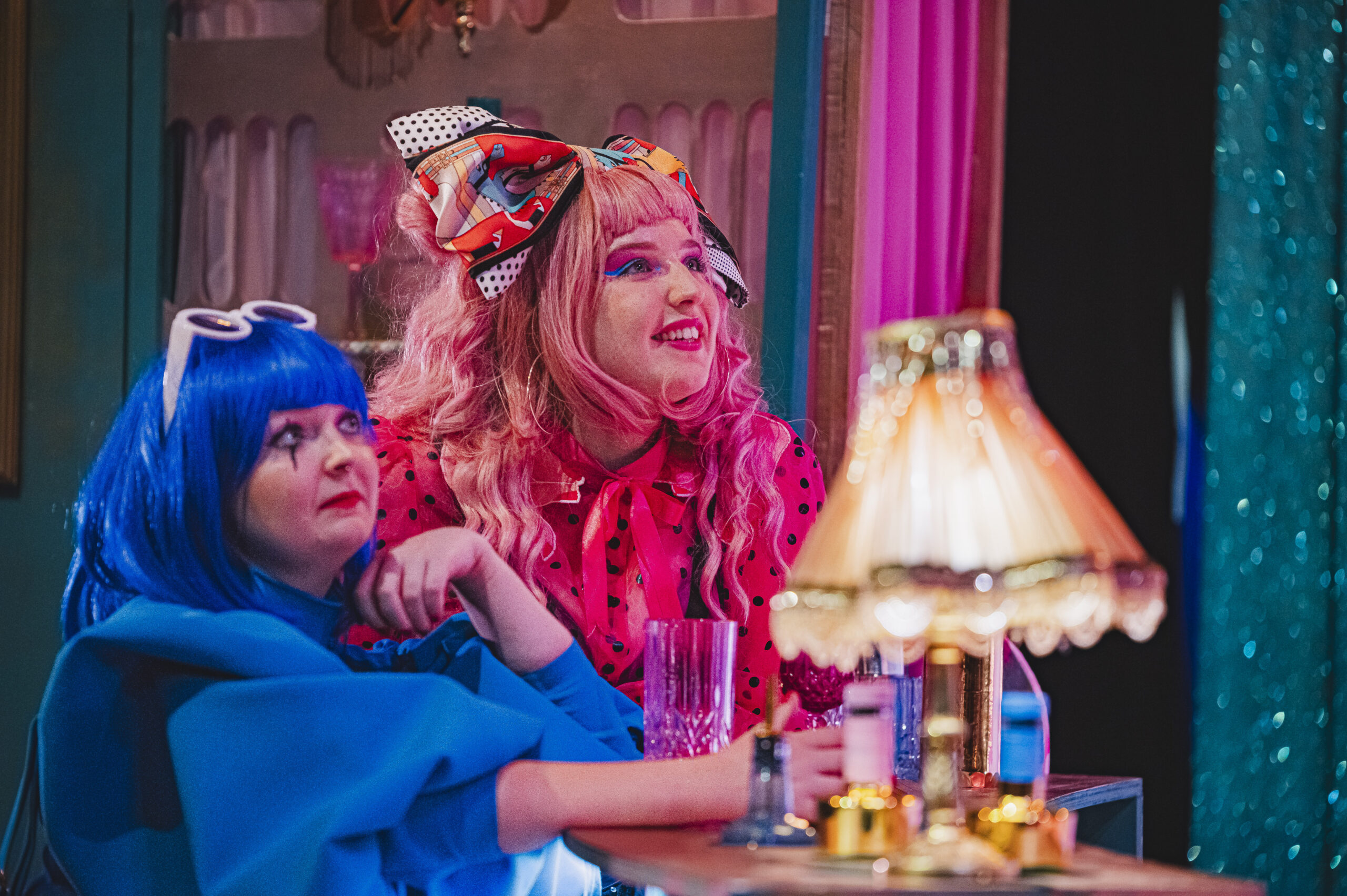
Assisting with, nay, creating entirely its sense of Vaudevillian immersion in both the setting and story is Martha’s styling. From an art-deco set to silky, vintage costumes to a pocket mirror that doubles as a messaging device, the design is unparalleled. If Martha is not made unique in its genre by its choice of topic, then it is made so by every element of its aesthetics.
There is no other way to describe this show aside from stunning.
But the line between immersion and gimmick is a fine one. Stopped at the door to the auditorium because I didn’t know the ‘password’, a hand gesture that I presume was given out in the foyer beforehand, I felt like a prize plonker and did begin to worry if audience participation was going to be a running theme. Fortunately, following that hiccup, I was left alone to relax into Martha’s world.
Prescribed path
For the generation who grew up with dystopian novels, or anyone who possesses a vague understanding of history, the path these plots follow borders on common knowledge. Protagonists are radicalised, and either an uprising or heartbreaking acceptance is prescribed.
Yet, Martha, unique as it is in choice of focus, maintains its originality even as it reaches rebellion. Rather than running to the Houses of Parliament with pitchforks and torches, our team does what they do best, and puts on a burlesque performance to stick it to The Man.
Staying true to its tenor and putting deaf people unavoidably front and centre, the show’s final moments convinced me that more of our protests would be successful if we all wore stockings and slinked out of nightgowns at the pivotal moment.

However, I do think Martha’s story suffers from trying to do too much in too little time. There’s a reason most dystopias occupy hundreds of pages, and there is so much potential contained within its central premise that Martha is bursting at the seams. As a result, there are story beats that don’t feel quite so fleshed out, and I’m sure if one looked hard enough they could find plot holes — though I’m less sure what the point would be in doing so.
Having said that, Martha, for all its campy forcefulness and vivid flavour, makes its audience read between the lines to get a glimpse of the deaf experience outside of fiction. A symptom of its dystopian setting, yes, but precisely the aim. A world in which uteruses are scanned for imperfection, the removal of a language, the enforced integration of the ‘other’? Perhaps Martha isn’t so much a dystopia at all.
Martha ran at Sherman Theatre from 13 – 21 Jun 2025, and will be performed at Pontio, Bangor on the 25 and 26 June. For more information and to book tickets, visit their site here.
Support our Nation today
For the price of a cup of coffee a month you can help us create an independent, not-for-profit, national news service for the people of Wales, by the people of Wales.


