


Vueling VY1240: Some holiday thoughts and a poem
Tony Curtis
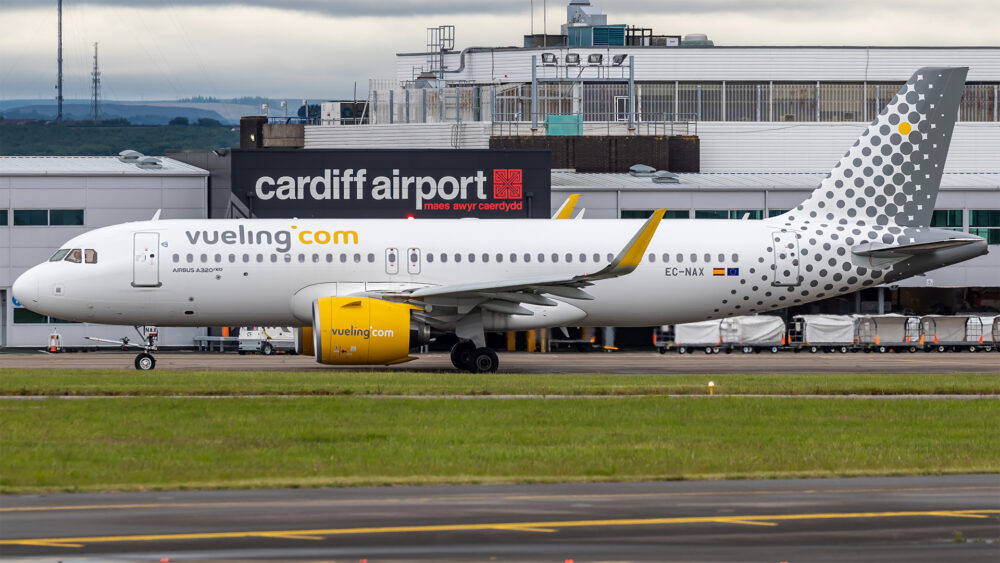
Cardiff International Airport is about two minutes’ bird-strike flight from our house in the Vale, but we are as likely to drive across the Bridge and catch a cheaper flight from Bristol; there are more flights, more destinations and cheaper deals.
But it doesn’t feel right. Rhoose is our airport and we should fight to keep it going.
There are currently only two Spanish mainland destinations: Malaga and Alicante. Malaga has been our choice for the last three trips to Spain; it’s a fine, modernised city with good museums, including the Museo Picasso, his birth place and the Museo Carmen Thyssen.
A pedestrianised city centre means you may shop until you drop; all the international big names are there.
But Alicante, that bucket and spade dropping off place, has been recommended by friends and so Flight VY1240 it is. They promise art and, of course good food. Also, we can go by train to Murcia and Valencia, which we do.
In truth, the art was not outstanding, but our reasonably-priced flat was well placed and pretty well new.
Our away-break one-night hotel in Valencia was very good and a few yards from the Ceramics Museum there; it’s grandly titled Museo Nacional de Cerámica y de las Arts Suntuarias González Martí.
Alerted by Michael Portillo’s TV guide to his family’s roots in the city, we covered a lot of ground in the time we had, including brunch at the Market’s tapas counter, fuelled by the Michelin chef, Ricard Camarena, superb, but still affordable.
As for Alicante: there’s the looming Castillo de Santa Barbara, a modern harbour and promenade. Not quite Nice, but pleasant enough.
From the castle you have a panoramic view, from the mountains to the north of the city to the crowded beach parasols.
The trip from the airport is short and not unpleasant. The airport: the ticket CWL to ALC does not indicate that the airport in Alicante is “Alicante-Elche Miguel Hernández”. Originally, “El Altet”, then “Aeropuerto de Alicante-Elche”, from 1969, it was steadily developing into a major hub, with some eighteen million passengers annually now.
Cardiff last year had fewer than a million passengers.
Perhaps a change of name would help Cardiff? What about the “Dylan Thomas Airport”? Or passing through the “Gareth Edwards Lounge”? Liverpool has “John Lennon”; so perhaps Tom or Shirley for Cardiff?
Well, how many people land in Alicante without checking the name? I hadn’t. To my shame. For Miguel Hernández was a rural poet who got caught up in the Civil War and died a prisoner of the fascist regime of General Franco in 1942.
Incarcerated in a succession of prisons, he died of untreated tuberculosis in Alicante. He was thirty-one. There’s a curved metal slab with his name on in front of the Palacio de Justicia, a museum in his home town of Orihuela and a series of murals in San Isidro.
Also, there is a memorial on the site of the Nationalists’ prisoner camp, now a bare field in Albertera, placed in 1995.
Deep division
The airport’s name was changed in 2021, to mark the 110th anniversary of the poet’s birth. And that is remarkable; the remembrance of the Spanish Civil War is contested and an ongoing root of deep divisions in Spain, so the re-naming is a clear act of defiance.
Flying into Alicante, one is going to the final place of Republican resistance in that war. Though one may spend days in the sun and the museums and restaurants unaware of that. It is only this year that tours of war-sites and of the bomb-shelters are being advertised. There were over ninety bomb shelters in the city.
There is a small museum – the Centro de Interpretacion sobre los Refugios Antiaereos, which opens from this Spring, too late for us. But, as I discovered, it’s not too hard to spot many of the shelters; all numbered and most of them concreted, with steel doors.
I feel bad about coming to these issues so late in my life and career.
Reading Dannie Abse’s Ash on a Young Man’s Sleeve and writing critiques of that great poet’s work, of course I had followed through on the associations of the scene where the young boy is taken to the memorial service for a fallen International Brigade volunteer, “Jimmy Ford”, who had died at the battle of Brunete.
He was, in fact, Sammy Morris from Ammanford. “The Fifteenth Brigade, ragtime idealists, advance; but Jimmy Ford lay horizontal, akimbo, on the dusty road near the tobacco fields, the vision of a white, deserted farmhouse leaking out of his surprised eyes.”
Much later, my friend and mentor Dannie had mentioned the influence of Miguel Hernandez, but I had not followed up on that.
There is a selected poems still available from Bloodaxe Books. Apparently, well translated and, certainly, generous in its scope; Hernandez lived a short life.
As a writer he was relatively untutored, but lauded, a sort of Spanish John Clare. The War put him on the right side of history and he gave poetry readings and wrote a play to support the Republican cause.
He was well-reviewed and could have expected a literary career. However, the Nationalists caught up with him; he was badly beaten and at one point he was condemned to death.
Other writers campaigned for a reprieve and he could have stayed on the run, but he returned to Orihuela, his family, capture and, inevitably, death in the prison hospital in Alicante.
I am an open window, waiting
as life goes darkly by.
Yet there is a streak of sunlight in battle
which always leaves the shadow vanquished.
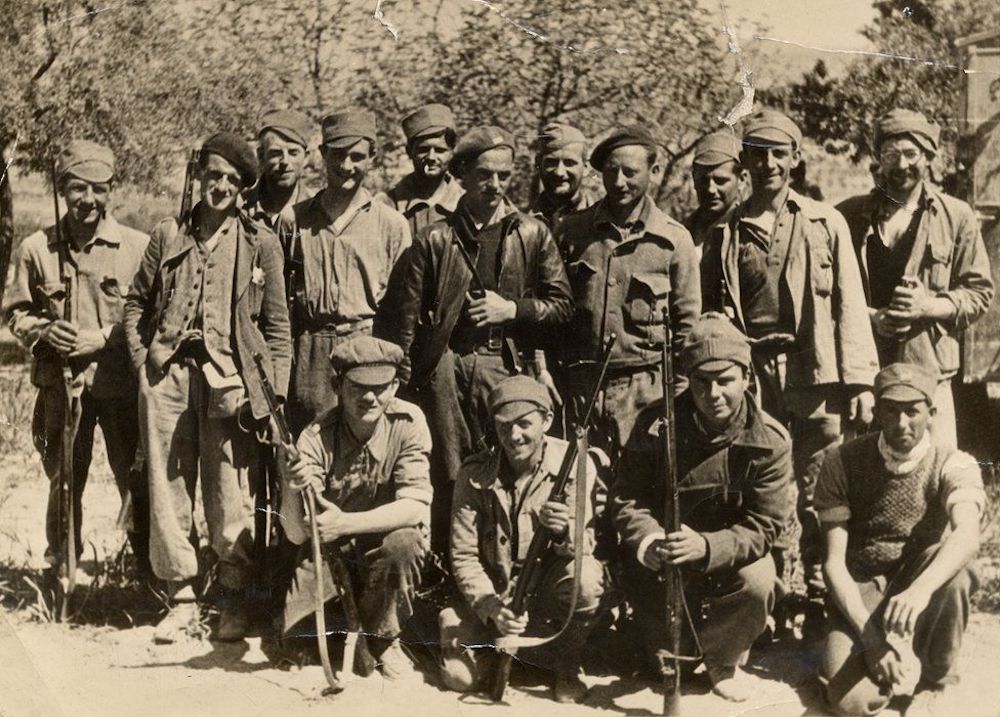
The late Hywel Francis did extensive research into the role of south Wales miners in the International Brigade; some 200 volunteered and served; 35 died. His father had been an active supporter of the cause in the coalfield.
It was no easy task to make it to Spain – clandestine train journeys as “tourists” to Paris and then being smuggled down south to the border.
Francis’s Miners against Fascism: Wales and the Spanish Civil War (Lawrence and Wishart, 2012) is the standard reference text. And the poet John Ormond’s BBC Wales documentary series Colliers’ Crusade, first broadcast in 1979, has important footage and interviews.
The narrative is there if we but look for it.
There are first-hand accounts by Edwin Greening, From Aberdare to Albacete and From the Rhondda to the Ebro, by Alun Menai Williams, both published by Warren & Pell.
In 2022 First Minister Mark Drakeford unveiled a plaque on the Pierhead Building in Cardiff Bay; It commemorates Captain Archibald Dickson from Roath, who bravely rescued some two thousand souls from the Alicante shore.
International Brigade Cymru
A delegation from Alicante attended. And the International Brigade Cymru – (ibcymru is on Facebook) keeps the memory of those from Wales who served. Each summer they have a commemorative event at the Alexandra Gardens in central Cardiff.
This year is the 90th anniversary of the start of the war and on Sunday, June 28th at 11.am. there will be a gathering at the memorial. I keep meaning to go: this year I will.
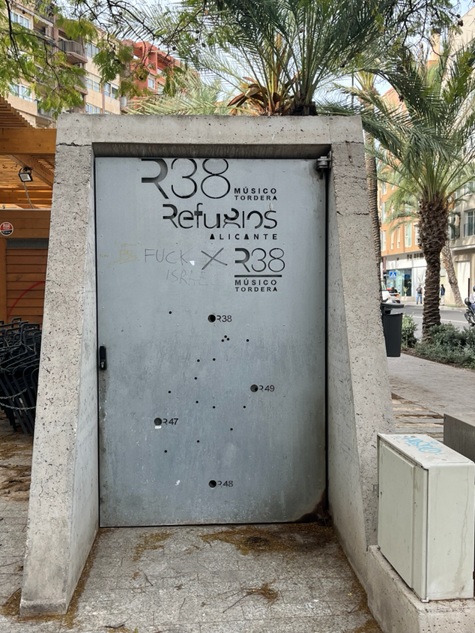
Alicante: Shelter R38
Between our apartment and the busy roads that cross
beneath us is a triangular little park with children’s swings,
benches, mothers and prams, old men, the Refugios38 entrance,
and a coffee cart that has breakfast pastries.
It is an oasis in the city’s hustle and traffic –
between Poeta Carmelo Calvo and Benito Pérez Galdos.
This is a short walk from the Central Market,
where in 1938, one May morning such as this,
the Aviazione Legionaria bombed the shoppers.
The market clock is kept at 11.20 to commemorate the act.
The Italians flew over Monte Tossal and with no sirens warning
nearly four hundred women and children were killed.
Alicante was the final post of the shrunken and defeated Republican cause.
In the bay where now the moneyed yachts are moored
the last comrades watched for ships that never came.
Except Captain Dickson’s The Stanbrook, dangerously crammed,
which got through the blockade to Algeria, to Oran
where the French would not let them land.
Those who remained, fifteen thousand men,
huddled in the sun, laid down their rifles in the sand
and prepared for what they knew would come.
Some committed suicide rather than face Franco’s hatred.
Two Anarchists vowed
to shoot each other in the head.
They fell as one. Then the strafing began.
The survivors were marched to a camp in Albatera,
where they were beaten and selected for execution.
Franco ploughed it up after it had served its purpose.
There’s a recent memorial of sorts – two posts
with barbed wire strung between them and a plaque.
No directions are given: a contested history is hidden.
And on the last morning of our holiday, the air warms,
the Mercardo Central is bustling, the traffic speeds past our park,
where children are pushed on the swings
or fall asleep in the shade of the palms.
Captain Dickson, from Cardiff, has a bust on the harbour walk.
The steel door of R38 is graffitied Fuck Israel.
Support our Nation today
For the price of a cup of coffee a month you can help us create an independent, not-for-profit, national news service for the people of Wales, by the people of Wales.
Get more trusted Welsh news
Choose Nation.Cymru as a preferred source in Google News to see more of our journalism.



Málaga is also a great base for exploring southern Spain by train with Seville, Córdoba and Granada in easy reach. And unlike Alicante there’s a station in the airport itself.
Good article. Captain Dickson is remembered in Alicante. The civil war was horrible. I tried reading the Ghosts of Spain the writer brings the horrors to life it but because of that is a difficult read.