


Welsh mausoleum named among the top ten endangered buildings
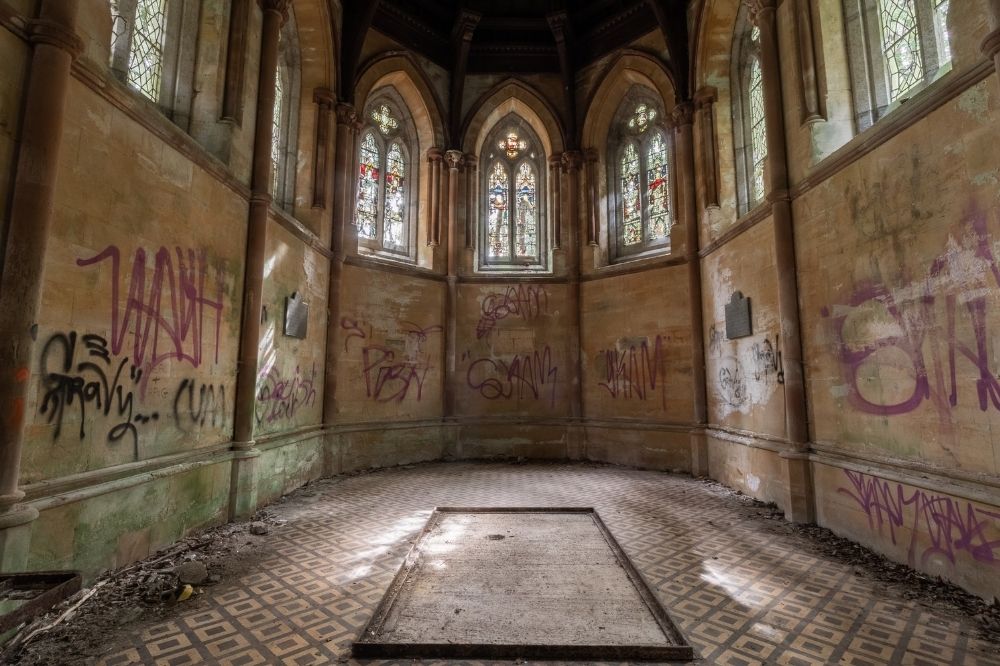
A crumbling woodland mausoleum near the Wales Coast Path has been named among the top ten endangered buildings.
The Faenol Mausoleum appears at first glance to be a romantic folly. In fact, it is a substantial and architecturally significant funerary building, now in a state of visible decay and at risk of further deterioration.
The building has been included on this year’s Top Ten Endangered Buildings List 2026 by the Victorian Society, the sole charity campaigning for Victorian and Edwardian built heritage across England and Wales. It is the only Welsh building included in this year’s list.
The list is based on public nominations from across England and Wales, and the buildings selected represent industrial, religious, domestic, and civic architecture from across the nation with unique historic and architectural significance and value. Nominated buildings must be dated between 1837 and 1914.
Listed as a rare and important Welsh example of its type, the mausoleum stands within an octagonal enclosure surrounded by iron railings. Cadw notes its “grandeur of design”, but years of neglect have taken their toll. The building has suffered vandalism, with graffiti and damage to its stained glass, and its condition continues to decline.
The mausoleum was constructed in the late 19th century for the Assheton-Smith family, owners of the vast Faenol Estate, which once extended to some 36,000 acres. The family’s wealth was closely tied to the Dinorwig slate quarry – by 1882 responsible for the majority of Britain’s slate production – and the estate played a central role in the local landscape and economy.
Designed by Henry Kennedy, a leading architect in north-west Wales, the mausoleum reflects his extensive ecclesiastical work across the region. The building incorporates French Gothic elements, including a bell tower, and features a striking interior with a hammerbeam roof. Decorative carving was carried out by Robert Evans of Menai Bridge, and the stained glass is believed to be by James Powell & Sons.
Burial place
The mausoleum was intended as the burial place of a powerful local dynasty, and its history is closely bound up with the family it commemorates. Members of the Assheton-Smith family were interred here, including Captain Robert George Duff, whose body was brought from the Isle of Wight in 1890. George William Duff Assheton-Smith, who inherited the estate as a boy, was buried here in 1904 following a large and elaborate funeral procession, attended by tenants, quarry workers and household staff.
His widow, Laura, was later laid to rest in the mausoleum in 1940, followed by their daughter Enid in 1959. As a child, Enid had marked another moment of local history when she cut the first sod for the construction of the Snowdon Mountain Railway; one of its early locomotives was named after her.
Despite this rich history, the mausoleum now stands isolated. The wider Faenol estate has been divided and repurposed, with parts hosting major cultural events including Bryn Terfel’s Faenol Festival, the National Eisteddfod, and Radio 1’s Big Weekend. Yet the mausoleum, under separate ownership, has been left to deteriorate, disconnected from the renewed life of the surrounding landscape.
With a well-used national trail passing close by, the mausoleum has clear potential to be appreciated once again as part of the historic environment. The Victorian Society is calling for action to address its condition and secure a future in which it can be conserved and, where appropriate, made accessible.
Extraordinary find
Griff Rhys Jones, Victorian Society President, said: “What an extraordinary find and one that anyone walking the nearby great coastal path of Wales would be overjoyed to stumble on and explore and rest a while. This is such a familiar story. The tangle of ownership needs to be cut aside by a latter-day perfect gentle knight, so this sleeping beauty, this unique monument, can come back to life.”
James Hughes, Director of the Victorian Society, said: “This is a rare and evocative building that forms part of the historic fabric of the wider landscape. Its current condition is a direct result of fragmented ownership and a lack of co-ordinated care. With the right
The Victorian Society’s Top 10 Endangered Buildings 2026:
- Hackney Borough Disinfecting Station, London. Grade II, Gordon and Gunton, 1901
- Tees Transporter Bridge, Stockton-on-Tees/Middlesbrough. Grade II*, Engineer: G.C. Imbault, constructed by Sir William Arrol and Co Ltd, 1911
- New Market Hall, Bridgnorth. Grade II, Robert Griffiths of Quatford, 1855 -1859
- Former Strand Railway Station and Railway Men’s Club, Barrow in Furness. Grade II, E. G. Paley, 1863
- Faenol (Vaynol) Mausoleum, Pentir, Nr Bangor. Grade II, Henry Kennedy of Bangor, late 1870s.
- Oakes School, Huddersfield. Grade II, Charles Fowler, 1873; extended by Ben Stocks, 1885
- Parndon Hall, Harlow. Grade II, Possibly Joseph Clarke, 1867
- St Michael’s RC Cemetery Chapel, Sheffield. Grade II, Charles Hadfield, 1898
- Derby School of Art, Derby. Grade II*, F.W. Waller, 1876 with additions 1899
- Former Library and Mechanics Institute, Devonport. Grade II, A, Norman, 1843-44
Support our Nation today
For the price of a cup of coffee a month you can help us create an independent, not-for-profit, national news service for the people of Wales, by the people of Wales.
Get more trusted Welsh news
Choose Nation.Cymru as a preferred source in Google News to see more of our journalism.



