


Welsh publisher brings classic novel back in print
Stephen Price
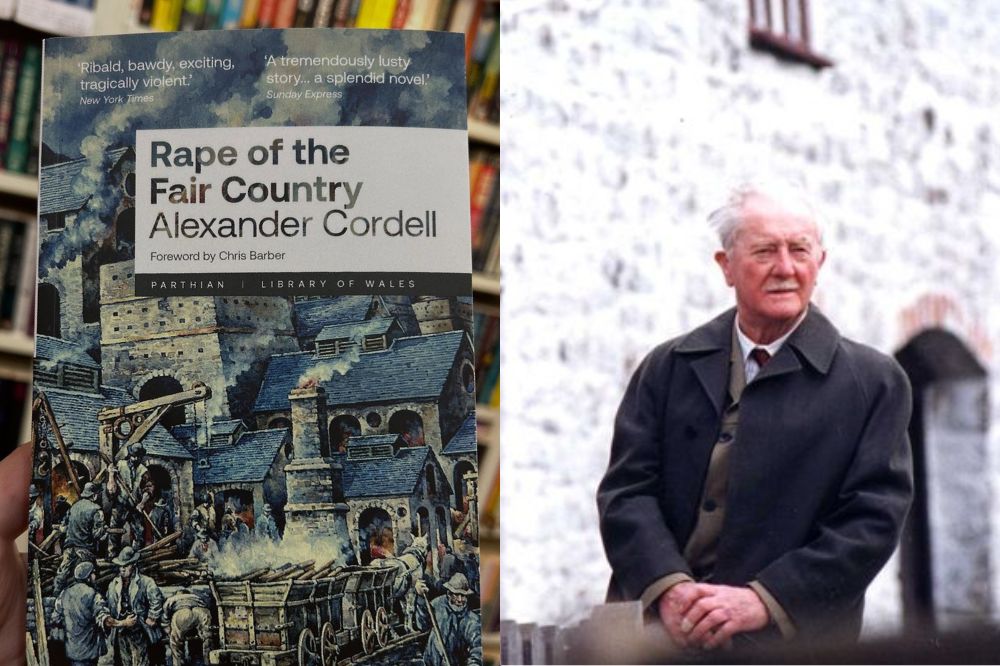
After being out of print for a number of years, Alexander Cordell’s timeless novel, Rape of the Fair Country is set to return to book shelves once again after being reprinted by Welsh publishing house, Parthian.
Set in the valleys of the Welsh iron country, this turbulent, unforgettable novel begins the saga of the Mortymer family. A family of hard men and beautiful women, all forced into a bitter struggle with their harsh environment, as they slave and starve for the cruel English ironmasters.
But adversity could never still the free spirit of Wales, or quiet its soaring voice, and the Mortymers fight and sing and make love even as the iron foundries ravish their homeland and cripple their people.
The Mortymer’s struggle has become emblematic of a nation’s history and struggle, it is a unique story of the people of Wales.
First published in 1959, Alexander Cordell’s Rape of the Fair Country has become an icon of Welsh literature.
Over 2 million copies of Rape of the Fair Country have been sold worldwide since first publication, with the New York Times describing it as: ‘Ribald, bawdy, exciting, tragically violent’ and The Sunday Express calling it: ‘A tremendously lusty story… a splendid novel’.
Carolyn Hitt, from the Western Mail wrote: “Cordell’s historical novels reflect the radical politics of the Chartist movement, the hardship of the workers and their families and the spirit that bonded Welsh industrial communities in times of adversity”
Chris Barber, who knew him well, shared: “He was one of the most influential writers of his generation and his books helped put the Industrial Revolution into a context that ordinary people could understand.
“He undoubtedly deserves widespread recognition for his literary achievements.”
Cordell
Alexander Cordell (1914 – 1997) was a prolific novelist and author of thirty works which include the Mortymer trilogy: Rape of the Fair Country, Hosts of Rebecca and Song of the Earth.
He was born George Alexander Graber in Colombo, Sri Lanka, the son of a soldier. Much of his youth was spent in the Far East, particularly China, to which he would return to in later fiction.
He joined the British Army in 1932 aged eighteen, reaching the rank of major in the Royal Engineers before demobilisation in 1946 saw him pursue a second career as a quantity surveyor.
He settled with his wife and young daughter in Abergavenny, and his first novel was published in 1954 but attracted little attention. It was the publication of Rape of the Fair Country in 1959 which went on to become an international best-seller which enabled him to sustain a career as a writer of fiction.
He would return several times, over a long career, to the stories of his adopted country’s industrial past and has become one of the best-loved and most read of modern Welsh novelists.
“I wrote the book at white heat, scarcely altering a chapter,” he explained. “In between spells of writing I studied at the University of Wales, Aberystwyth and befriended every available librarian. I suddenly discovered that hand in hand with the tale of the mountain town went the last bloody revolution in Britain, the Chartist Rebellion, when men like John Frost a hundred years before their time, fought and suffered for the Six Point Charter – five of which we enjoy today in freedom.”
As Brian John writes: “Conducting interviews with local Blaenavon residents in the 1950s, he talked to people who had been born in the 1870s and were thus able to relate the iron-making stories of their forefathers.
As their narratives unfolded in conversations in The Rolling Mill pub, Cordell’s imagination took flight. In his introduction to Rape of the Fair Country, he describes how the “old people’s tales of Blaenavon breathed life” into the book.
The adding of Rape of the Fair Country to the Library of Wales series has a personal connection to publisher Richard Davies.
He shared: “I was first recommended the book by my History teacher, Mrs Presdee, Dwr-Y-Felin Comprehensive, Neath, 1982.
“I was fourteen and in class A2, being taught the turgid and remote industrial revolution of Wales – iron, coal, the valleys. Alexander Cordell’s novel made it all come alive and it was about us. It was the first time I read about my own people, the Welsh in fiction. It was a revelation.
“I raced through the trilogy, The Hosts of Rebecca, rural Carmarthenshire, then Song of the Earth, wonderfully set on the canals of the Neath valley. I was entranced.
“It is an honour to bring this much-loved book back into print.”
Rape of the Fair Country is available direct from Parthian or from all good book stores from 1 November.
Support our Nation today
For the price of a cup of coffee a month you can help us create an independent, not-for-profit, national news service for the people of Wales, by the people of Wales.
Get more trusted Welsh news
Choose Nation.Cymru as a preferred source in Google News to see more of our journalism.



I read this recently and found it dated
Yes, it is set between 1826 and 1839!
Two films i would love to see made and both of which i think would put Wales on the map , is about the life and times of Owain Glyndwr and a film based upon this novel.
I really wish someone would take it up .
Hi Mark,
I just read your comments. I read a 6-part television series of the book which I sent to Chris Barber who read them and was very enthusiastic. Unfortunately, we still haven’t found a producer to take it on. If you are interested in reading the script, let me know. You can contact me via: [email protected]
It was reading Cordell’s work that brought the history of Cymru to life for me, both in its beauty and its ugliness. Visiting Crawshay’s tomb in Vaynor churchyard, with its epitaph “God forgive me” hammered home the awareness of how Cymru has been exploited for centuries.