


Where Hokusai meets Cader Idris
Julie Brominicks
I’m in Tywyn, where the parched marsh is scratchy with heat. A warm breeze rustles the phragmites, Cader Idris hoves into view and now a cormorant flies across Afon Dysynni, like a Japanese print come to life.
Cheap as noodles back in the Edo Period, woodblock prints were sold in bookshops throughout Japan. Subjects included sumo wrestlers, kabuki actors, and most famously, the landscapes currently on show at the Whitworth Gallery, Manchester, in an exhibition called ‘Beneath the Great Wave: Hokusai and Hiroshige.’
Such work continues to influence artists like Ian Phillips, who I find in his studio above Millie and Sid’s coffee bar, with a dazzling view of the marsh.
Ian, who has biked in, whizzes around pulling out prints and blocks and books, talking excitedly, his bright energy not what I expected from the creator of such meditative scenes.
“I’ve just been teaching,” he explains, “so you’ve caught me in chatty mode. It’ll take a few days to recharge. When I’m engrossed in cutting or printing I tend not to want to be disturbed. I’ll come in, eat chocolate and potter about.”
Ian studied illustration at Leicester Polytechnic then worked as an artist in London, but it was a little book he picked up before graduating that shaped his destiny: ‘Hiroshige’s Road’ or ‘53 Stations of the Tōkaidō.’
“It’s prints and poetry, brothels and stalls, there’s all sorts going on,” says Ian, who eventually transitioned from illustration to printmaking, in which he is largely self-taught. At first his drawings weren’t right. “There was no action, or the print was empty. Now I draw for print.”
In 2001, Ian moved to Cymru and found his source material — Eryri, the Pembrokeshire Coast, Afon Dyfi.
His current series ‘Cadair Idris’ is why I’m here, having just written about the mountain, though neither I nor Andrew Green, (author of ‘Cader Idris and the Artists’) discovered Ian’s project in time to include it in our books.
“I’ve probably missed all kinds of opportunities!” laughs Ian, who supplements income from print sales and his wife Sian’s greeting-card business, by teaching printmaking workshops.
So. Cader Idris. “I’m of the belief that a map should be scribbled on” he says. While mine is a mess of pencilled pink routes, Ian’s is overlain with a scarlet compass rose radiating from the summit. Both Hiroshige and Hokusai depicted scenes of Mount Fuji. ‘Cadair Idris’ is a kind of homage.
“I thought I should do something about Cader Idris, but there was so much information it was overwhelming. So to give myself the compass rose as a restricted idea is actually a weird kind of freedom. Simplifying it and within that you can be creative.”
2017
Back in 2017, Ian divided the year into sixteen equal parts and related each to a cardinal point, starting with North on Winter Solstice. South was Summer Solstice, and the rest fall between.
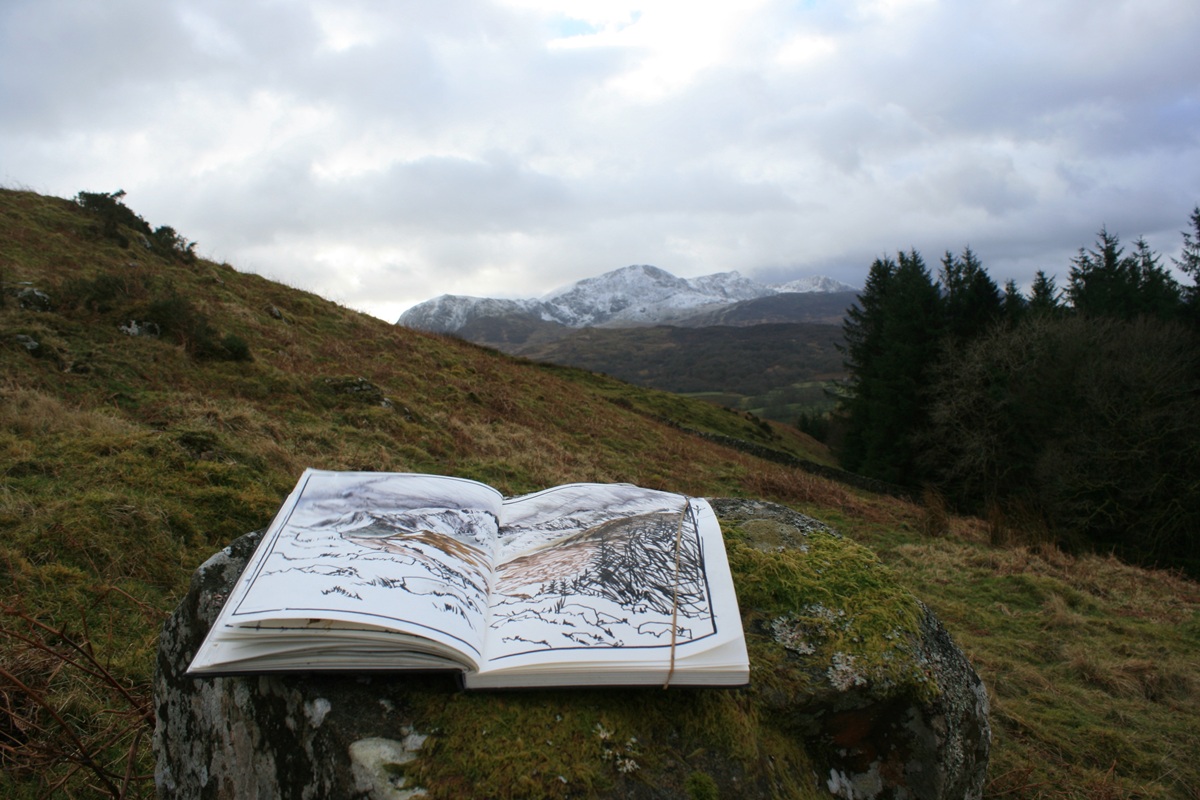
On each allotted day, Ian identified a footpath somewhere on the line. “Then I’m wandering around trying to get a view looking back to the mountain. I wanted variety and progression around the year, all different weather. A big thing for me is a sense of light. That Japanese thing. What time of day, what season.”
Ian’s sketchbooks combine image and neat notes such as ‘heron lifts off’ or ‘warm winter green’. “I make little drawings and once I’m warmed up I do a big one” he says. They confidently fill the page.
Turning them into prints is studio work. “First I scan the drawing and enlarge it to print size. Then I trace and re-draw it onto tissue-paper with a Chinese brush and ink, because I don’t want to lose the painterly texture of the strokes. Then I paste the tissue-paper face down onto the block, and cut through it into the wood to remove the blank bits.”
Every print requires several blocks, depending on colours and details. He clatters the Shina plywood blocks onto the table — curious inky 3D landscapes in their own right. “When you start, there is a period when a printmaker falls in love with the blocks. I get really lost in the carving.”
Then it’s inking up the blocks, and printing. Ian might use two or three layers of colour in really thin ink. “So this is kind of how a Japanese print is done. Lots of blocks, lots of prints. What I like about printmaking is it combines art and craft. I use a combination of traditional materials; Chinese ink, Japanese tracing-paper and cutting tools, and ‘western’ printmaking papers and oil-based printing inks.”
Startling
He lays ‘Llanelltyd; North’ on the table. On screen or behind glass, the bold lines, colours and composition are arresting, but close up, the detail and texture is startling. My eyes are drawn first to the inky black ripples, then the dancing white dashes, before I see the spellbinding clouds — as if they have only just formed.
“This first print is half-lino and half-wood. The clouds have been inked onto rollers. But I didn’t feel like I had it quite right. So now I’m working on a new process with two other printmakers, Judith Westcott and Wuon Gean Ho. We’re using woodblock in an experimental way.”
He introduces ‘Cerrig Nimbwl; North North East’, for comparison. “So these are wood clouds.” The subtlety is so skilful the clouds resemble ink-wash until scrutiny reveals the grain. Ian encourages me to run my fingers over the print to feel the pattern in the ink.
“I forgot to show you!” he adds, indicating two red hanko stamps in the corner. One bears his name, the other is a kanji meaning ‘Raven Peak.’
“When I was drawing, there was always a raven. I’d see them flying in the distance and they’d turn in the air and come to check me out. One time they tumbled right over.” Ah yes. I know these ravens.
Ian sells (and sells out of) the prints as he makes them, but luckily for us, on completion, he hopes to exhibit the Cadair Idris series in its entirety. Keep your eye on his website for news. https://reliefprint.myshopify.com/
Support our Nation today
For the price of a cup of coffee a month you can help us create an independent, not-for-profit, national news service for the people of Wales, by the people of Wales.
Get more trusted Welsh news
Choose Nation.Cymru as a preferred source in Google News to see more of our journalism.


