

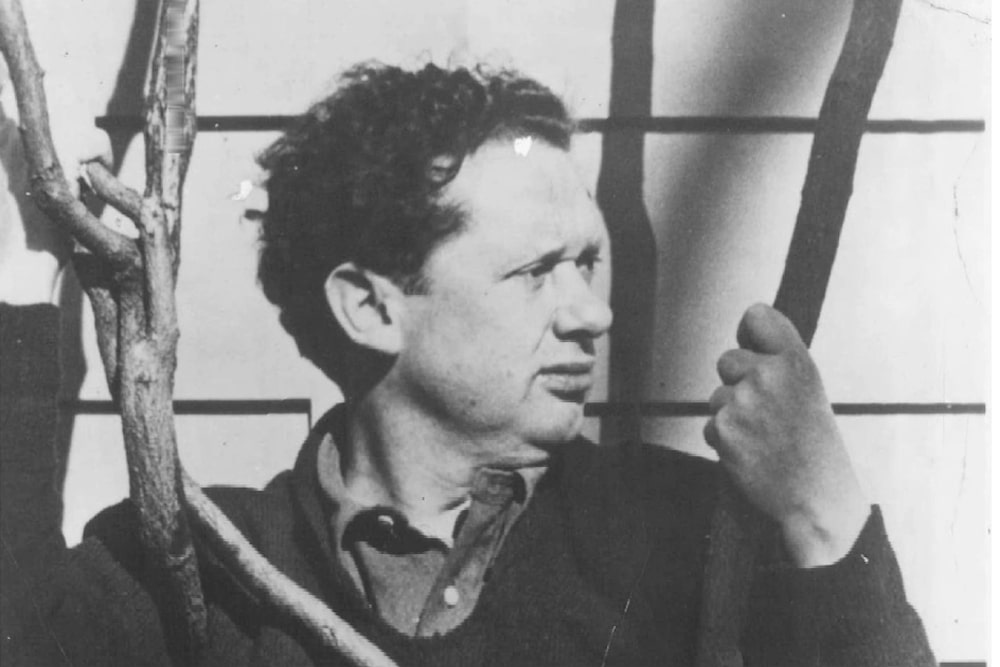
Writer claims Dylan Thomas ‘repeatedly stole from others’
Gosia Buzzanca
Welsh literary icon Dylan Thomas has been accused of plagiarising the work of other poets.
American writer and publicist Allesandro Gallenzi says Thomas had ‘repeatedly stole from others’. Mr Gallenzi has laid out his claims in an article recently published in the Times Literary Supplement.
Whilst working on a book collecting unseen work from the beloved Welsh bard, Allesandro Gallezi discovered that a young Thomas appeared to have plagiarised “several of the poems he published under his name in the Swansea Grammar School Magazine.”
Gallenzi reports that Thomas “had not simply drawn inspiration from other texts, imitated or parodied them, as he later claimed: he had stolen the work of other authors wholesale, at times changing the title or a few words, perhaps to dodge detection.”
Gallenzi, founder of Alma Books, described his difficulties with some of the earlier published poems of Dylan Thomas.
He writes: “I realized that only a few of his various poems for student magazines had been republished, in scattered periodicals and collections; as for the rest, though the titles were known, the texts were impossible to source.
“I was both surprised and intrigued, and set about tracking them down for inclusion in our volume, which is to be the first-ever fully complete edition of Thomas’s poems – but not even the largest libraries and archives of England and Wales were able to assist me.
“As a last resort, I contacted Geoff Haden, the genial curator of the Dylan Thomas Birthplace, whom I had met in April 2017, and he replied to say that he had one of only two known complete sets of the Swansea Grammar School Magazine, which had been owned by the poet’s father, D. J. Thomas.”
Following a visit to Thomas’s birthplace, Gallenzi was excited to get to work on editing and annotating poet’s works created during his younger years. However, soon enough his editor alerted him to concerns with the texts.

In December of 1926 Thomas published “His Repertoire”, a ballad about a boy named Vincent Brown. This turned out to be an almost direct copy of a poem published in 1909 by Archibald J. A. Wilson called “The Only Piece He Knew”.
Gallenzi continues “The young thief got away with it and, emboldened, raised the stakes of his deceit.
“With remarkable audacity, he hoodwinked the editors of that story paper into publishing, under the name ‘Dylan Marlais’, ‘The Second Best’, a rather conventional poem by Helen Elrington that had appeared in the same magazine more than fifteen years previously, and in January 1927 he secured the publication, in the Western Mail, of ‘His Requiem’, in fact a work by Lillian Gard, also taken from the Boy’s Own Paper.”
It is believed that Thomas’s plagiarism continued for another four years.
He was first caught in 1929, when a plagiarized submission – entitled ‘Sometimes’, later discovered to be the work of the American poet Thomas S. Jones – was intercepted by McInerny, who later in life generously attributed the uncanny correspondence between the poems to “total, unconscious recall”.
The poet’s recent biographers, “have been reluctant to entertain the possibility that Thomas’s magpie-like appropriation of the work of others was more extensive,” writes Gallenzi.
Constantine FitzGibbon, author of “The Life of Dylan Thomas” recalls in his book that “the poet once said to Randall Swingler, as well as to others: ‘One day they’ll find me out.’ ‘They’ perhaps meaning the critics; the clever, educated literati.”
“But one cannot now help wonder whether Dylan Thomas meant something else,” Allesandro Gallenzi concludes in his piece.
Support our Nation today
For the price of a cup of coffee a month you can help us create an independent, not-for-profit, national news service for the people of Wales, by the people of Wales.



I suspect everyone steals ideas from everyone after all they have to have their inspiration from somewhere.
So fake it til you make it.
We are referring to early works by a very young Dylan? None of his very best can be accused of this, though? What the best of Dylan can be accused of is the same accepted truth among all writers: we are all influenced by some or other. This some or other is usually a more accomplished poet or writer as we are allowing the self to be influenced and in time, if we reach the podium of accomplishment ourselves, we’d have found our voice. We are talking about school magazine published works, right? Many years ago, when I was first… Read more »