


A Celtic Troika?
Lila Haines
Celtic Conundrums/1
First Minister Rhun ap Iorwerth told an NUJ conference on the state of the media in Wales recently that he would prefer to live in a Wales where journalists ask too many questions rather than too few.
Taking him at his word, I’d like to consider the ‘Celtic Summit’ in Cardiff on 14 September.
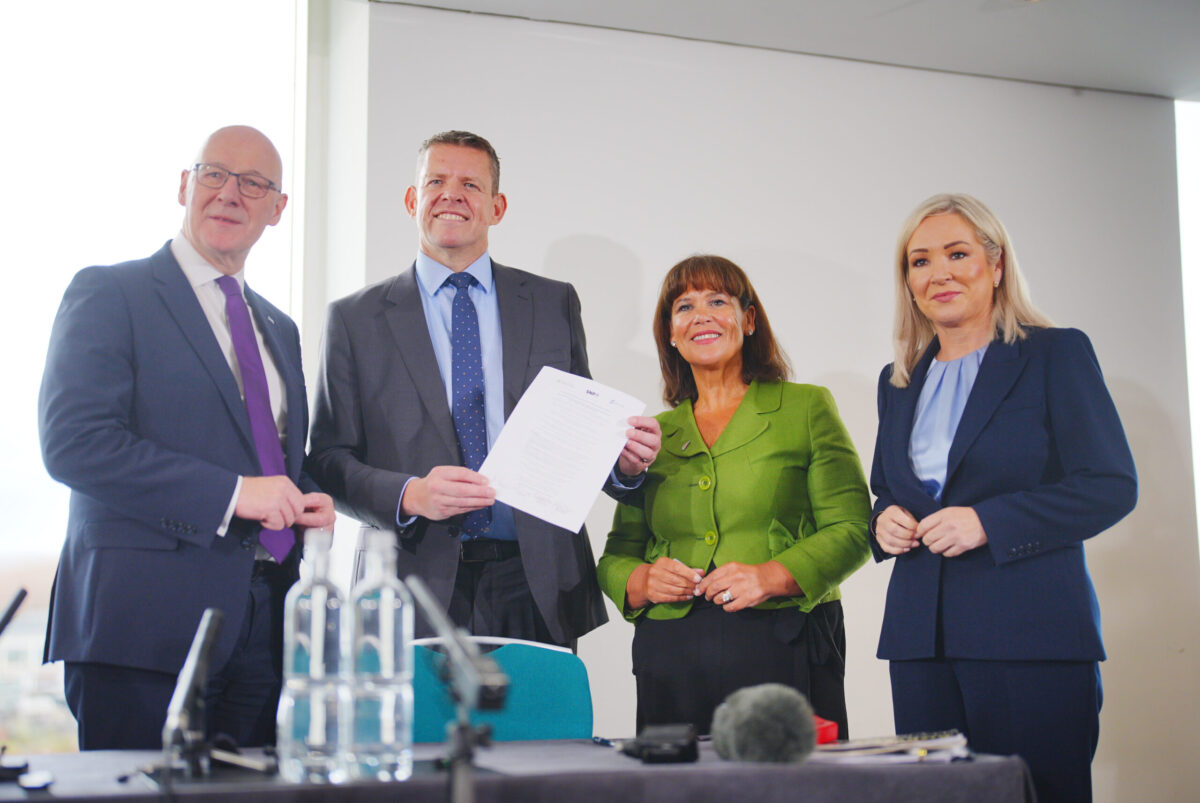
In a day of two parts, leaders of Plaid Cymru, the SNP and Sinn Féin signed a memorandum of understanding about cooperation between their parties.
And the First Ministers of Wales and Scotland signed ‘The Cardiff Agreement – Cytundeb Caerdydd’, establishing a framework for closer cooperation between their two Governments on ‘matters of shared interest’ – while noting that this would not replace their ‘broader commitment to positive intergovernmental relations across the United Kingdom’.
The resulting headlines about a Celtic alliance mostly disregarded the major differences between Wales, Scotland and Northern Ireland, and may have alienated some of Plaid’s newer voters and potentially harmed Cymru’s relationship with the Government of the Republic of Ireland.
Why now?
It was inevitable that the SNP’s return to government (though with six fewer seats) would spark a fresh push for a second referendum on Scottish independence, especially as the Scottish Greens (15 seats) also support the right to call such a referendum.
While Plaid’s breakthrough into government in Wales shifted the political dynamic to a degree we can only guess at yet, Rhun ap Iorwerth has consistently said he will not be seeking a Welsh referendum during his first term in office.
But he very much wants enhanced powers for Wales as well as reform of the formula used to allocate funding to Wales – what strain would that put on relations with Scotland when the Edinburgh Government already enjoys a much better deal?
Sinn Féin presumably welcomes any profile-enhancing headlines as they face into the May 2027 Assembly and local authority elections in Northern Ireland, and demand an early referendum about the Irish border.
Outliers
Northern Ireland and Sinn Féin are the outliers in the ‘Celtic’ threesome, geographically and in terms of history and political cultures.
After forecasting that unification would happen ‘within five years … 10 years … in year X …’ SF leader Mary Lou McDonald has escalated demands for a border poll, for which there is provision in the 1998 Belfast/Good Friday Agreement that ended the bloody 30-year-long ‘Troubles’.
Schedule 1(ii) of the 1998 Belfast/Good Friday Agreement states that the Secretary of State for Northern Ireland shall call a border poll ‘if at any time it appears likely to him that a majority of those voting would express a wish that Northern Ireland should cease to be part of the United Kingdom and form part of a united Ireland’.
Whatever criteria might be used to identify such a moment, none so far – not election results, not the consistent findings of opinion polls, not social change analysis – suggests that the conditions are close to being met or that a border poll would deliver the result SF presumably wants.
Politically, and for the purposes of a border poll, the NI population is approximately 40% unionist, 40% nationalist and 20% ‘Other’ – with a growing proportion of Catholics indicating that they do not necessarily want constitutional change.
A realistic radical?
Rhun ap Iorwerth could barely put a foot wrong in his early months as First Minister of Wales. Showing every sign of being realistic about the current state of Welsh public opinion, he consistently stressed that he wouldn’t push independence in his first term in office.
His first international engagement was an official visit to Dublin where he met President Catherine Connelly, Taoiseach Mícheál Martin TD and the Minister for Foreign Affairs and Trade, Helen McEntee TD.
The visit was a resounding success, according to all involved. Both sides reaffirmed their commitment to the Ireland-Wales Shared Statement 2030, a framework for partnership between the two governments (signed on behalf of Wales in 2025 by the previous First Minister).
Rhun ap Iorwerth told Irish media that his Plaid Cymru government wanted a ‘stronger relationship than ever’ with Ireland.
“Ráiméis”
Then came the 14 September event in Cardiff with the SNP and Sinn Féin – and the reaction of Ireland’s Taoiseach, Mícheál Martin TD, makes me wonder what advice, if any, the First Minister received regarding the possible impact on relations with the Dublin Government.
Responding in Irish to a media question about the Cardiff summit, the Taoiseach dismissed as “ráiméis” (nonsensical talk) Sinn Féin’s calls to pressurise the British government into an early referendum on Irish unity, adding that it could actually set back reunification.
The Taoiseach’s reaction may be understandable for several reasons, not excluding how often SF leader Mary Lou McDonald has accused him of ‘doing nothing’ about unity.
Is €2 billion ‘nothing’?
In addition to its block grant from the UK Treasury, Northern Ireland benefits from Dublin Government funding for cross-border projects as well as from EU resources and post-Brexit trade privileges.
The Shared Island Initiative established by Taoiseach Mícheál Martin put €2 billion on the table for projects that bring the island and its peoples together through cross-border collaboration in areas such as key infrastructure projects, climate action, tourism, culture and research.
The Dublin-Belfast rail link upgrade has doubled services between the two cities, and the Narrow Water Bridge is under construction across Carlingford Lough.
But some schemes are stalled for lack of a contribution from the NI Executive (in which SF holds the finance and economy portfolios) and, to date, the Executive has failed to set a budget for the current financial year.
The optics of it all
In Cardiff the ‘Celtic Summit’ provided striking optics. It doubtless excited some in Wales but may have startled others who are less politically engaged or, indeed, as some in my community told me, raised fears that the Plaid leader was rushing too far, too soon for many citizens.
Pointing out the complexities beyond the headlines, Professor Laura McAllister told The Guardian that “the aims and the timelines for independence as sought by each of these first ministers is fundamentally different, as of course is the constitutional framework in each country.”
Prof McAllister added that, if there is to be serious discussion about reshaping UK relationships, “there has to be a presence for England at the table” – another aspect of the constitutional conundrum requiring cool heads and much questioning not only by and of UK Prime Minister Burnham but also on the part of all those seeking change.
Wales, Scotland and Northern Ireland are each at different stages in their constitutional story, but it’s also important to remember that Northern Ireland is still a post-conflict society despite much progress since the 1998 Belfast/Good Friday Agreement.
In the next instalment, I’ll look at some real-life stories about change.
Lila Haines is a Wales-based Irish author whose publications include ‘Radicals & Realists: Political Parties in Ireland’ (Welsh Academic Press, 2022). She is currently working on an analysis of the ‘Celtic fringe’ phenomenon.
Support our Nation today
For the price of a cup of coffee a month you can help us create an independent, not-for-profit, national news service for the people of Wales, by the people of Wales.
Get more trusted Welsh news
Choose Nation.Cymru as a preferred source in Google News to see more of our journalism.



The meeting of the 3 first ministers on September 14th certainly rattled unionists. This reaction demonstrates the need for their parties (and others) to develop a positive vision of a post-UK British Isles that does not leave England or unionists across these islands feeling diminished or on the road to Ruritania. The postscript to the article states that the author “is currently working on an analysis of the ‘Celtic fringe’ phenomenon”. I hope that’s to debunk that dismal, pervading narrative from the 19th century of the “Celts” being driven into the mountains and bogs by waves of Germanic incomers to… Read more »