

A federal Europe of nations: Is a new world emerging that will engulf Europe?
Mathieu Guihard, President of the Breton Party / Strollad Breizh
Russia’s military aggression against Ukraine, a sovereign and independent country, from February 24, 2022, was a wake-up call for us Europeans.
This brutal return of war to our continent reminded us that the old reflexes of a past we thought buried could resurface when the imperialist logic of nation-states prevailed.
The election of Donald Trump to the presidency of the United States, the world’s leading economic and military power, on November 5, 2024, was another sign.
Each time, the French media and political world failed to see it coming.
Weak
A sign of what? That the world is harsh and merciless, and that the European Union, located on a small continent, is prosperous but slow and indecisive.
That it is weak and inconsistent in the face of the giants that are organising themselves and the confrontations that lie ahead. A Union that is unable to reinvent itself, nor to enchant.
These two recent signs remind us of the need to build, more than ever, a Europe-power that can hold its own against the world’s major political and military players: the Russian Federation and the United States, but also China, India, Brazil… in fact, all the BRICS, the major emerging states that are joining forces to dethrone the West, and which held a spectacular meeting in Kazan, Tatarstan (Russia), on October 22.
In the 21st century, the world is moving forward at high speed, and we’re making the most of it.
In terms of research, innovation (biotechnology, artificial intelligence, etc.), defense and trade, we Europeans are already dangerously outstripped by the giants and future giants.
Our old Western European welfare states have become incapable of ensuring the prosperity and well-being of our peoples.
Are we going to become an open-air museum, to be visited with condescension or pity by the new masters of the world, like visiting a bedridden old relative? Will Europe be swallowed up, like the legendary City of Ys?
More than one Europe
Let’s be clear: there is more than one Europe.
This worrying European engulfment is due above all to the great nation-states of Western Europe: Germany, the United Kingdom, Belgium, Spain, to a certain extent the Netherlands and Italy, and above all France, entrenched in its Jacobinism and its certainties, the real sick man of Europe (1).
This is less true of Western European countries comparable in size to Brittany, such as the Republic of Ireland, Denmark, Portugal, Switzerland and Norway, which are more flexible and virtuous in economic and budgetary terms.
Nor is this true of the countries of Central and Eastern Europe, which have been under Soviet domination and have recovered forever from socialism and imperialism, and whose freedom and prosperity are the fruit of a cherished independence won only 25 or 30 years ago, generally without violence.
All in all, Europe harbours tremendous potential, but it is above all its large states that have become inadequate, especially those that dominate the European Union.
Nothing is lost, therefore, if Europe has the ambition to rediscover its destiny as an economic, commercial, scientific, industrial and cultural power. This giant destiny can only be achieved in a federal Europe of nations, as we shall see.
(1) Yann Fouéré, in his classic “L’Europe aux cent drapeaux” (Europe of the 100 flags, written in 1968!) already predicted the failure of the Jacobin “Europe of the 30 States”, the nation-states that stand in the way of Europe’s future (p21).
Beware – there are two Europes
First of all, we need to ask ourselves: what do we mean by a federal Europe? The French public is largely ignorant of the term, which has been virtually banished from the Parisian media-political world.
Federalism has been a dirty word in France since the Terror (*)… Yet French European federalists do exist: they can be found among the Macronists, the Greens and the French Socialist Party. French sovereigntists (LFI, RN, Reconquête, PCF, LR, etc.) castigate them. This is the only dividing line we’ve been served up for 40 years.
During the 2024 European election campaign, Bernard Guetta, the outgoing Renew (Macronist) MEP, published a book with the evocative and provocative title “The European Nation”.
Bernard Guetta calls himself a European federalist, and opposes French sovereignists as much as Russian and American imperialism.
In the course of his dispensable and rather narcissistic account of his European peregrinations to convince often dubious Lithuanians, Swedes, Poles and Romanians, the idea of a federal Europe takes shape. But is it really federal?
Federal Europe, really ?
Bernard Guetta’s diagnosis of the current dysfunctions of a sclerotic European Union is accurate.
In 60 years, we’ve built the European Union, step by step. But we’re still in the middle of the road.
Our institutions are hybrid and incomprehensible. We haven’t had the courage to see European integration through to the end, and we’ve ended up with a technocratic “thing” that’s as slow as a mammoth, guided in reality by the member states who are its real mahouts.
All major decisions are taken by the governments of the member states, a fact never mentioned in France. Even the fine principles of Europe cannot stand up to the rule of the nation-states.
Just look at the European Union’s total lack of reaction when Madrid seriously violated the human rights and fundamental freedoms of European texts during the self-determination referendum prevented by Madrid in Catalonia in 2017.
The member states validated it, and the European institutions said nothing.
Revealing. But Bernard Guetta doesn’t mention this in his book, preferring to evoke distant peoples in struggle, or Polish conservatives… A true Raphaël Glucksmann (**).
There is a nation and a nation-State.
So yes, Bernard Guetta criticizes the crushing weight of the member states, wants the European Parliament to have more power and deplores the Council’s power over it.
And so he wants to erect the “European nation”. Except that Europe is not a nation, and Europeans are not a people, and that’s his mistake. A very French mistake.
A state is only viable and healthy if it is the fruit of a nation. In reality, Guetta wants to erect the nation-state of Europe. He is reproducing the mortifying historical process of France, a predatory state that preceded a French nation still pathologically searching for its national identity 1,000 years later.
The Europe of the pro-European French bears a striking resemblance… to a France seeking a new empire, colonizing its own continent.
A Jacobin Europe that would engender revolutions at home and wars abroad, doomed to self-destruction to the misfortune of its inhabitants. We know all this.
European federalism or French Jacobinism?
Bernard Guetta is just another French Jacobin. What’s more, he spares no effort in “selling” France to his European interlocutors.
With Trump’s American disengagement from Europe from 2017 to 2021, he triumphs and presents France as the “defender of Europe” (p22).
Except that when Europe is attacked in 2022, when it comes to taking action, it’s France that sends the least military equipment to the Ukrainians, and that talks the longest with Vladimir Putin, no matter how long the table…
What kind of Europe is this? A Europe submissive to the dream of domination of the French nation-state, all too happy to regain its former lustre by substituting soft American domination with French imperialism straight out of the 19th century.
Let’s face it, the countries of Central Europe have clearly understood the French game against a people’s Europe, which, as always in history, will result in imperialist France coming to terms with the imperialists. But we won’t do it to them (***).
A French obsession
And yet Bernard Guetta struggles on like a cock sure of his indispensability.
He laments that his European partners do not share his love of French-style planning (p.61). He sees himself as an avant-garde elite showing the way to the peoples of Europe (p. 84).
Yet it is revealing that he contrasts federalism and nationalism (p.111), even though the two are perfectly compatible within the European framework.
What’s more, he dismisses nations and regions alike as useless junk (p. 102).
He’s adamant about bringing the Ukraine into the EU, while farmers in Brittany and France are surely equally useless old fashions, to be sacrificed “in the name of democracy and freedom”.
In short, Guetta is a banal French statist who wants to apply French imperialism on a European scale, building a blue-white-and-red Europe, Europe the Jacobin way.
His “European nation” is in reality the nation-state Europe, and in this he is like all French European “federalists”.
Back in the 2000s, didn’t Dominique Strauss-Kahn call for the erection of a Europe “from the Sahara to the North Pole”? Dreams of grandeur, always… A deadly mania born of the French Revolution, which ends in totalitarian disaster.
No, thank you!
At the end of the day, nothing differentiates French European “federalists” from French sovereignists.
Here’s how nostalgic Eric Zemmour spoke on RTL on September 10, 2018: “The French genius is to remake the Roman Empire. That is, to unite all the European populations, once unified under the Roman Empire, and take them under its wing. France is the new Roman Empire!”
“What’s the difference? They’re two sides of the same coin, French imperialism masquerading as humanism. Yann Fouéré, in his classic “Europe of the 100 flags”, had already identified them back in 1968, castigating in turn “the Europe of nation-states advocated by De Gaulle, (and) the single Europe of citizens dreamed of by the extremists of ‘nation-Europe’”. (p.38)
A truly federal Europe !
In this essential work, Yann Fouéré associates the European nation-state with hyper-taxation, control of information, control of the masses… implemented by businessmen and senior civil servants (p.64).
Sound familiar? Yann Fouéré’s lucid and relentlessly modern commentary is a must-read. He predicts that if Europe’s nation-states persist, they will lead to European dictatorship and World War III, after having led to the first two. Premonitory?
But then, are we condemned to banish all utopia, all dreams of a prosperous and harmonious European future?
The great Breton politician Aristide Briand, winner of the 1926 Nobel Peace Prize, wanted to build a United States of Europe, and Breton activists of the 1930s like Morvan Marchal defended the idea of European federalism. Utopians, to be sure.
For the time was ripe for empires and their universalism, which led to ever more destructive wars.
Today, in a world where the human condition is at the heart of globalisation and technology, the idea of a truly federal Europe has never been more relevant or necessary.
This is the Europe of 100 nations, the Europe of the peoples of the great European family.
(*) “The Terror” is a period of the French Revolution beginning in 1793 which has shaped the French political life since then.
(**) This Socialist European MEP from Paris is known for regularly denouncing human rights violations around the world.
(***) Bernard Guetta is “wounded by such accusations” (p.42). Yet he is also aware of France’s unflattering image in the eyes of its European partners: “It was France that was the most dangerous in their eyes,” he laments on p. 47. He comes back to this several times, and fails to understand the “false trial” that his partners are making of France, suspected of “double-dealing” with Putin (pp.117 and 131).
Our future is national and federal
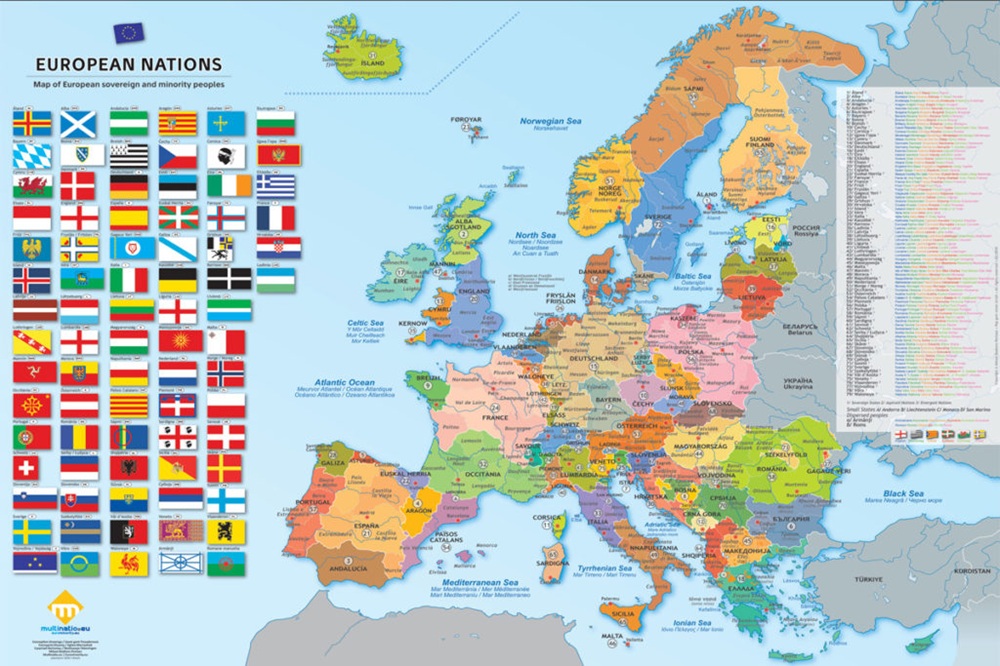
Europe’s ethnic diversity is an immense strength. Our continent is home to some one hundred peoples, and is the cradle of several major civilisations: Celtic, Greco-Latin, Germanic and Slavic.
This diversity must be preserved and nurtured, for it is a source of creativity and a stimulus to human progress, for example in the artistic and scientific fields.
The whole of European history proves that small groups have been the most fruitful, not large, levelling, centralised empires.
It’s worth noting that miscegenation, if defended as a systemic societal project as it is by French European “federalists” and left-wing sovereigntists (LFI, PCF), and even sometimes right-wing sovereigntists, would be the opposite of this diversity and would lead to the annihilation of European peoples.
The counterpart of the totalitarian nation-state-Europe described in part 2, in short. Yann Fouéré warns us that miscegenation “accelerates the atomisation of man and his uprooting” (in “Europe the 100 flags” p.176).
Let’s be clear: this in no way means that people of mixed race should be vilified – that would be disgraceful. What we’re talking about here is a political project for the global and widespread “métissage” of European societies.
Yes, Europe is unique, remarkable and precious. Its geography is rich, its history fascinating. But it is no longer truly powerful.
The world is moving fast, and Europeans are not, either inside or outside the European Union. The European Union, in particular, is hybrid and unfinished, blocked by the stranglehold of its member nation-states.
Nations are essential in Europe
The expression “federal Europe of nations” is a given.
But why speak of “nations” when we’re talking about a federal Europe? Because the nation is the human framework for the development of a people and the application of a political project at its service.
It is the result of centuries of human history, and is an ethnic and cultural reality essential to the equilibrium of the men and women who make it up.
It’s in our nature as human beings to need a sense of belonging and identity. So, federalist AND nationalist.
In fact, some of the great names of the 20th century were both, from Gandhi to Vaclav Havel, and the same is true of contemporary pan-Africanists.
Conversely, the so-called “Europe of the nations” of French sovereigntists is in reality the Europe of the nation-states of the 19th century, artificial and self-destructive by nature.
Yann Fouéré describes nation-states as “an accident of history” doomed to disappear (p.109). This kind of Europe would lead us straight into World War 3, which Vladimir Putin is currently brandishing as a threat to Europe in his speeches. QED.
Federal Europe is the future
In many countries or “continent-countries” where federalism is already in force, diplomacy and defence are two areas systematically devolved to the federal level.
In the Federal Europe of Nations, this will also be the case.
The other areas can be exercised at local, regional, national or European federal level, depending on the field in question and applying the tried and tested principle of subsidiarity.
Federal organisation will thus radically eliminate the disadvantages of political fragmentation.
A federal Europe of nations will prevent war between European nations, and protect against external aggression. It is the guarantee of lasting prosperity, and the most successful model of democracy and fundamental freedoms.
There will be around a hundred member nations of roughly equivalent size and power, preventing any imperialist temptations.
The Breton people (5 million strong, with a solid economy) are a good example of this standard European size and power.
These nations will have to accept the withdrawal of part of their sovereignty.
France will have to share, even if its old pride suffers…
Progressive federalisation
Over the course of this century, there will be no shortage of projects to drive forward a prosperous and powerful Federal Europe of Nations: European campuses of excellence, a federal police force, a blue ocean pact, the emergence of forward-looking industries… to name but a few.
This federal Europe of the peoples could be built progressively in several “cores” made up of peoples establishing simple partnerships at first, other peoples building an economic union with a single currency and without fiscal or social dumping as at present, and a central core of the most willing and ready nations truly integrated into a federal state.
Of course, there will be a president to represent Europe, alongside the heads of the European states, and a European federal parliament.
This will undoubtedly take place in several stages, the ultimate goal being the reunion of all 100 European nations in a Europe “united in diversity”, to quote the beautiful motto of the European Union.
Of course, the nations of Europe could themselves be organized internally on a federal basis. This is perfectly suited to our country, Brittany, and to our national state of mind.
Let us leave the final word to the poet Robert Mallet: “Good ideas have no age, they only have a future”. If we want it, the 21st century will be the century of the union of the peoples of Europe. War-raok Europa!
Support our Nation today
For the price of a cup of coffee a month you can help us create an independent, not-for-profit, national news service for the people of Wales, by the people of Wales.



“In terms of research, innovation (biotechnology, artificial intelligence, etc.)… we Europeans are already dangerously outstripped by the giants and future giants.” Only got to look at the patenting system from bright idea through to an issued patent to see a broken system, dysfunctional and not much of a job creator (for Wales/UK). For example, take a wee look at Wales’ principal university and see a pathetic patent filing rate. A Nobel Prize winner who co-invented a biotechnology that is used in countless laboratories, academic and commercial, across the globe – and under Cardiff University’s watch a patent was NOT FILED.
Do you have all the details of the last point as that sounds horrendous? Albeit unsurprising.
I think the previous poster is talking about the work of Sir Martyn Evans.I don’t know much about it, but, from my very limited understanding, what the poster above mentioned is essentially correct. Sir Martyn spent years conducting research at Cardiff University, earning himself a Nobel Prize in the process, made numerous biotech breakthroughs. Despite there being several patentable inventions, techniques and technologies, the “Technology Transfer Office” at Cardiff University failed in their basic purpose to protect the IP of Cardiff University.
The above article is when you let a political theorist cook for a few years. I’ve never read such barely substantiated hogwash since Trump’s latest tweet. It’s just complete fantasy and wishful thinking on so many levels that it completely misunderstands the people of Europe, it’s history and it’s ‘tendencies’. We’ve been largely spoiled by ‘peace’ in Europe over the last 80 or so years. It begins with the Federal map of Europe, which I had to laugh at. It would tear Europe apart and it would descend into complete war in under ten years. Hang on while I go… Read more »
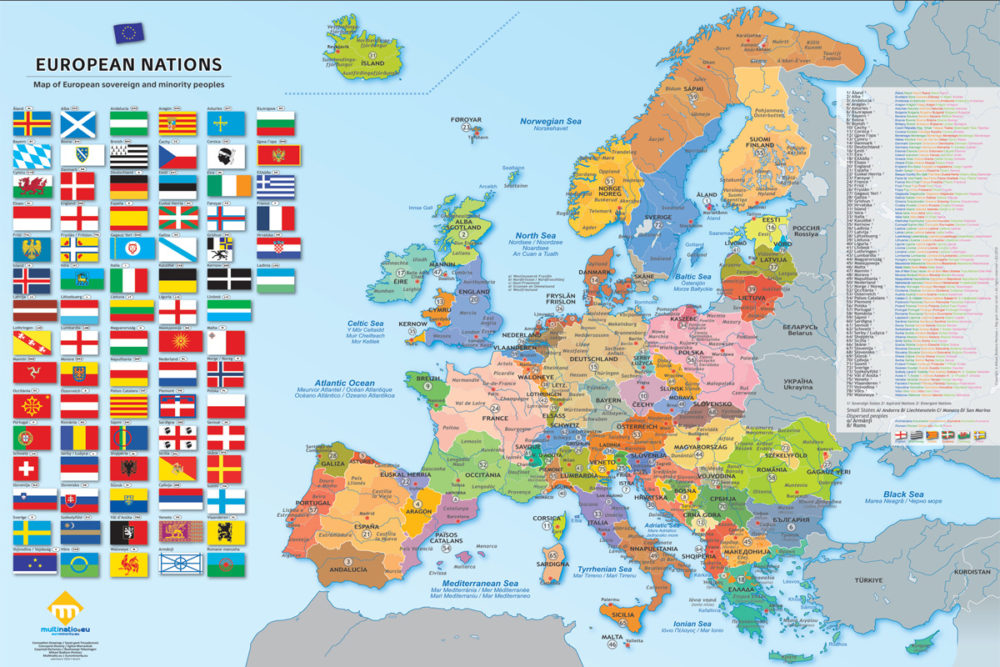
I agree with your notion, even a brief mention of EU backed creation of independent Silesia or Kashubia would certainly lead to swift polexit. Most of the regions highlighted on this map as “nations” have non existent separatist movements and most of people living in them indentity as their respective state nationals. Eg. Silesia and Occitania, in these 2, considering borders on a proposed map, over 90% of citizens would be Polish and French nationals who do not want to be a part of forcefully created sudo National entity.
What a self-satisfied prig you are, Smae. MInd you don’t let facts foul your fiery polemic. I don’t think the model proposed in the meme is likely to be realized, but to claim that it is in any way like the Roman or Chinese Empires is risible.
“What a self-satisfied prig you are,”
It takes one to know one, apparently.
Largely agree with the gist, the Angevin empire, Austro-hungarian and several others also achieved spectacular prosperity above peers, the original article is creating a blatantly false narrative. However, going back further than the Romans is difficult it’s unlikely 2/3rds of Europe ever identified as “Celtic” or “Germanic” much less enjoyed centralised administration they’re just broad brush simplifications based upon the limitations of reporting at the time.
Europe as an ‘idea’ is already passe. Europe as a geography is the reality.
Wonderful map, trugarez deoc’h Mathieu.
I never expected to read in progressive media such as nation.cymru an attack on so-called ‘miscegenation’, a term only used these days by far-right white nationalists. This is not excused by the clumsy attempt to row back a couple of paragraphs later by saying mixed-race people should not be vilified.
The author of this article still bears the particularly French intellectual habit of posing ‘grandes idées’; that whilst criticising an earlier manifestation, introduces yet another one. What is ‘Europe’?
What could be successful, is a modern version of the EEC, and a European Defence Organisation, (NATO, without America). Our multiple languages, cultures and histories mean that the notion of a Federation is doomed.
So how has quadralingual Switzerland survived all these centuries? Is it doomed?
The map proclames the rights of many different identities and imagined countries, but then puts all of Northern Ireland, a country that actualy exists now, into Ireland. A country that half of the population of Northern Ireland do not want to be part of. Regardles of which side you support in the Northern Ireland debate this decission by the map makers highlights the folly in a map like this. Recognising the danger of simple Nationalisam of all types and an acceptance of mor complicated multi level identities would be more useful.
The “100 Flags” shouldn’t mark bloodlines—they should mark watersheds. Mathieu Guihard is right that the 19th-century Nation-State is obsolete. It is too large to solve local problems and too fragmented to solve planetary ones. However, defining the ‘new nations’ by ethnicity or language alone is a trap. That path leads to balkanization and endless debates about who belongs. A more durable model for a federal Europe is Bioregionalism. Instead of drawing borders around ‘Bretons’ or ‘Welsh,’ we draw them around the actual life-support systems of the continent: the watersheds, the forest canopies, and the agricultural basins. A Bioregional Europe gives… Read more »
The problem with that idea is that people don’t think in terms of maps. it’s the same mindset that imposed on the continent of Africa a construct of ‘countries’ that failed to recognise tribal and cultural integrity.
Wrong map! You make Bulgaria and Greece smaller in favour of the communists invented nation… It’s not going to happen like this…
Good to see the nations of Mercia, Wessex, Northumbria and the rest of the Heptarchy represented. Their temporary alliance has probably outstayed its welcome.
What about Ukraine and NATO over through of the Elected Government of Ukraine and the Civil War with the Donbass from 2014 till the Russians went in and stopped Ukraine from murdering 14000 to 17000 thousand people in the Donbass areas was that not aggression worth mentioning is it Russia bad NATO good wake the f up and tell the truth
You believe a million Russian casualties was all for a humanitarian cause to save 14,000?
A federal Europe, once espoused by the “extreme right” such as Mosley, along with support for Palestine over Israel. Now ideas identifying firmly as leftism. This world is a funny old place.
Yann Fouéré was a collaborator with the Nazi occupation of France, convicted in absentia in 1946.
Overturned by the French courts in 1955.
By 1955, France had ‘rehabilitated’ many of those who had collaborated with the Nazi occupation. That does not change the facts. In Fouéré’s case, the court refused to restore the property confiscated at the time of his conviction. The journal ‘La Bretagne’ that Fouéré edited with the approval of the Nazi occupiers published anti-semitic articles. As late as 1962, he defended the role of Breton militias who had fought alongside the German army and the SS against the French Resistance. The attacks on ‘miscegenation’ and ‘métissage’ in this article show that the Breton Party must be considered part of the… Read more »