


A giant amongst men: Remembering Terry Yorath

Following the sad announcement that Terry Yorath has passed away, Iwan Williams looks back at the life of a Cymru legend.
Terry Yorath was born in Grangetown, Cardiff, in 1950. Showing early talent as a rugby scrum half, the story goes that Terry watched his brother play for Cardiff boys against Rhondda boys in football.
Cardiff were one short, and so Terry borrowed a pair of boots, gave a wonderful performance, and subsequently won four Welsh Schoolboy caps. After rejecting Cardiff (some loss!) and the Bristol clubs, he joined Leeds United as a 17 year old, and made his Leeds debut against Burnley in 1967.
However, as a central midfielder he would have to be patient, with club legends Billy Bremner and Johnny Giles ahead of him in the pecking order set out by Don Revie. He only played 14 league games in his first five years with Leeds, and then established himself as a regular from 1972 onwards.
Terry won the League Championship in 1973/74, and became the first Welshman to play in a European Cup final, a 2-0 defeat to Bayern Munich in 1975. He had previously played in the 1973 European Cup Winners Cup final, a 1-0 defeat to AC Milan. With Jimmy Armfield succeeding Revie, Terry moved on to Coventry City in 1976, and later joined Tottenham in 1979.
Terry Yorath scoring for Leeds against Coventry in 1975
He ventured abroad in 1981, spending a year with the Vancouver Whitecaps, before returning to England to play for Bradford City between 1982 and 1985. He was player and assistant coach with Bradford, which helped him become player-manager at Swansea City in 1986.
That said, he only made one appearance for the Swans, before focusing on his managerial duties. In total, Terry played 343 club games (141 for Leeds), scoring 16 goals.
As a player, Terry was a tough, no-nonsense, hard-as-nails midfielder. In an age where tackles counted, Terry was uncompromising and made his presence known. His Cymru career began early in 1969, with a tough debut in Rome against Italy, a 4-1 defeat.
Over the course of twelve years and under the management of Dave Bowen, Mike Smith and Mike England, Terry won 59 Cymru caps, and 42 of those as captain. He was a crucial part of the Cymru team of the seventies, a leader in a talented side that included Joey Jones, Brian Flynn, John Toshack, John Mahoney and Leighton James. Sadly, in recent years we’ve lost Leighton, Joey and now Terry from that fearless team.
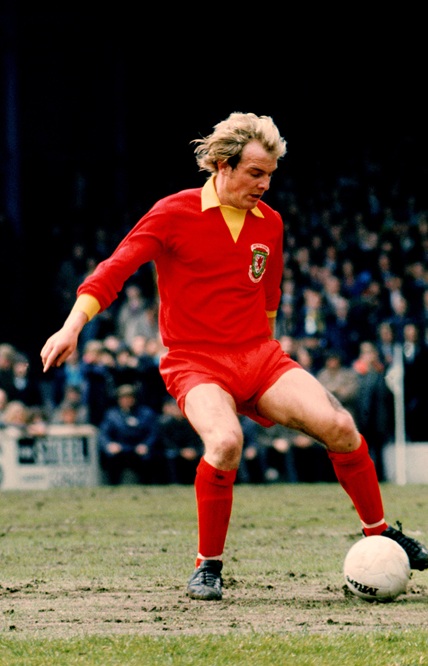
Like so many others, Terry was so close to playing in a finals tournament. Cymru were Euro 1976 quarter finalists, however the finals tournament was confined to four teams. To reach the finals, Cymru played Yugoslavia over two legs. They lost the first leg 2-0 in Zagreb in April 1976.
The second leg in Ninian Park in May 1976 remains a painful chapter for so many. Cymru drew 1-1 in a brutal game, with referee Rudi Glöckner (from behind the Iron Curtain) biased towards the Yugoslavs.
Terry missed a penalty (the first attempt in his career), but at least stepped up to take it when the occasion got to others. “There was nobody else, so I had a go” was Terry’s recollection.
Cymru were very close to qualifying for the 1978 World Cup, when they were in a small, winner-takes-all group with Scotland and Czechoslovakia. After beating Czechoslovakia 3-0 in Wrexham, it was all down to a huge night against Scotland in Liverpool in October 1977, with the FAW prioritising gate receipts over home advantage.
In a packed Anfield (mostly filled with the Tartan Army), Scotland won 2-0, including a 78th minute penalty won by Joe Jordan’s infamous handball claim. Another ‘so near yet so far’ moment in Welsh football history.
Interestingly, Joe Jordan was godfather to Terry’s daughter, Gabby, and despite the anger shown towards Jordan, Terry didn’t “blame him for what he did – not at all”.
There were happier times in the Cymru shirt, including the 2-1 win against Hungary in Budapest in 1975, the 3-0 win over Scotland in Cardiff in 1979, and the iconic 4-1 win over England in Wrexham in 1980. The 1-0 win against England in Wembley in May 1977 was another highlight.
The English FA had refused to play Hen Wlad Fy Nhadauand insisted in only playing God Save The Queen.
The proudest of Welshmen (it’s not difficult to imagine Terry standing next to Owain Glyndŵr on a battlefield) and in an act of clear defiance, Terry and John Mahoney ensured that the Cymru team didn’t move before the game started, and “Yorath’s side only moved once their point was made” as mentioned in Phil Stead’s Red Dragons. Terry scored two Cymru goals, against Luxembourg in 1975 and the Republic of Ireland in 1981. Had it not been for his move to Vancouver, then Terry could possibly have won more Cymru caps.
Following his playing days, Terry excelled as a manager. He spent three years with the Swans between 1986 and 1989, and achieved promotion from Division Four to Three in 1987/88.
Terry was also appointed Cymru manager in 1988, and combined his international management duties with club duties at the Swans, and then with Bradford City in 1989/90, returning to the Swans in 1990/91. That he somehow combined club and country duties and managed incredible wins, such as the 3-1 win over Belgium in Cardiff in October 1990, is nothing short of remarkable.
He was full time Cymru manager for the iconic results of the early nineties: the 1-0 win over world champions West Germany in June 1991 in Cardiff, and the 1-0 friendly win over Brazil in September 1991 in Cardiff.
As Cymru manager, Terry will be best remembered for the 1994 World Cup qualifying campaign. After a poor start, a 5-1 away defeat to Romania and 2-0 away defeat to Belgium in 1992, Cymru recovered and beat the Belgians in Cardiff 2-0, including that Ryan Giggs free kick. This was followed by a 1-1 in Ostrava against the Czech and Slovak Representatives (RCS), comfortable wins against the Faroe Islands and Cyprus, and a 2-2 thriller against the RCS in Cardiff.
It was all set up for 17th November 1993. With the top two qualifying, the situation was clear: beat Romania in Cardiff and Cymru were going to the World Cup in the US. The buzz around Cymru football in the early nineties was incredible.
Long in the shadow of Welsh rugby, those dazzling, electric nights in the Cardiff Arms Park were phenomenal. This was Cymru’s time. Everyone loved Terry, players, staff and fans. With a side including the talents of Neville Southall, Kevin Ratcliffe, Dean Saunders, Mark Hughes, Ian Rush and the emergence of gifted youngsters Gary Speed and Ryan Giggs, this was the time to get over the line and finally make it to a first finals tournament since 1958.
Much has been written about that night. Hagi’s shot squirming under Southall, Paul Bodin’s penalty and Raducioiu’s late winner. The dream of an American summer and playing on the world platform was over, and the 2-1 defeat to Romania remains one of the darkest chapters in Welsh football history.
On Christmas Eve 1993 (what timing!), Terry was informed by the FAW that his contract would not be renewed, along with his assistant Peter Shreeves. After taking Cymru to the edge of qualifying, Terry had asked for a reasonable salary increase. The FAW refused, Terry lowered his request, and was told to reapply for the job by FAW Secretary Alun Evans.
The response from everyone, players and fans, was disgust, frustration and disbelief. Had this happened in the age of social media and 24/7 media coverage, then the contempt shown towards Evans and the FAW would have been tenfold. Terry’s honest admission was “I was indeed hurting. Deep inside, I did feel bitter because nobody could give me a reason why my contract wasn’t being renewed”.
The decision not to renew Terry’s contract was a pivotal crossroads in Welsh football history. It led to John Toshack’s very brief period as Cymru manager, then Mike Smith before the disastrous appointment of Bobby Gould in 1995. Results worsened, enthusiasm and passion waned and led to an incredibly challenging period for Welsh football.
There’s a parallel world where Cymru qualify for the 1994 World Cup, Terry enjoys a decade and more as a successful Cymru manager, with Welsh football thriving on and off the pitch. As it turned out, Terry joined Cardiff City in 1994/95, managed Lebanon between 1995 and 1997, and had brief managerial spells with Sheffield Wednesday (2001/2) and Margate (2008/9). What could have been.
There were numerous setbacks, crushing disappointments and heartbreaks as a player and manager. But none of them compare with the tragedies that Terry experienced off the pitch. On 11th May 1985, Terry was present when a fire ripped through Bradford’s Valley Parade stadium. As an assistant coach, Terry ran onto the pitch to help evacuate people, and received minor injuries in the rescue attempts. 56 people died as a result of the fire, and that horrific, harrowing experience stayed with Terry.
Personal tragedy
Terry’s personal tragedy happened on 25th May 1992. Five days on from the 5-1 Romania defeat, “My whole world collapsed when our son Daniel, died in my arms while we were playing football together in the back garden of our home in Leeds. He was just 15 years old”. Daniel died from hypertrophic cardiomyopathy, and the impact of watching his son die would stay with Terry for the rest of his days.
No one would have blamed him from stepping back from his Cymru role, but continuing as manager in the most difficult of circumstances showed Terry’s resilience.
The Romania game in Cardiff in November 1993 will be remembered for the result, but it was also the night that Cymru fan John Hill from Merthyr lost his life. A flare was set off following the final whistle and raced sideways across the stadium. It hit John Hill, and killed him. As an 11 year old prepared for a night of celebration, I was around 10-15 rows below.
That awful night has been captured in Leon Barton’s excellent 2023 article, where I said “It was awful – I remember his head jerking back, then the panic. I think his son was with him, distraught, the stewards at a loss what to do. Think about that night every November. The journey back home with my Dad and two others was incredibly sad and quiet.”
Terry’s reflections were “I couldn’t take it in. It was the Bradford fire all over again if on a smaller scale. How could a man go and watch a football match and not come home afterwards? I know the Romania game meant a hell of a lot to everybody but after someone had died, the result paled into insignificance.”
Whilst the Ukraine game and qualifying for the 2022 World Cup gave some closure, that dark, painful night in Cardiff remains with me and so many others to this day, and it undoubtedly stayed with Terry too. That Terry leaves us in the year that Cymru strive to reach another World Cup in the US carries with it some irony.
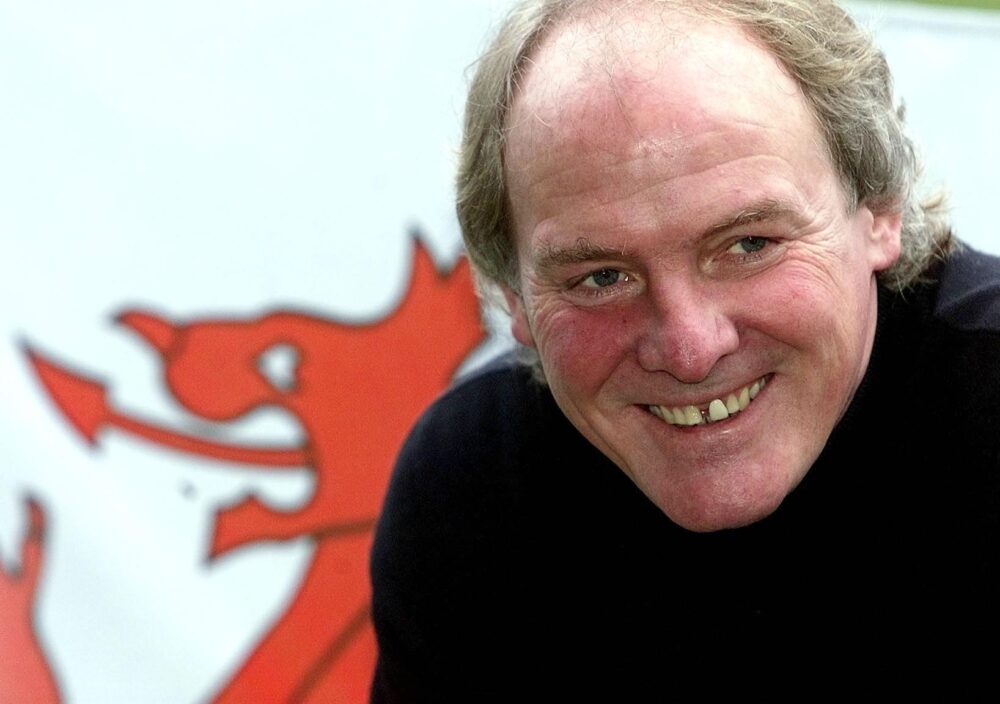
His autobiography, ‘Hard Man, Hard Knocks’, was published in 2004 and is a very honest and difficult read.
On the Bradford fire, Terry said “My overriding concern after the fire was trying to get my head round what had happened: 56 people had died just watching a football match.
“How could their families ever come to terms with the fact that their loved ones had gone to see a game and would never be coming home? It was terrible”. Following the Romania game, “I was sitting on a stairwell crying. The whole evening had been horrible. We’d lost a game and a man had lost his life. This was the third death to have affected me in a little under two years. First, Alan Davies (who played for Terry’s Cymru side in the late eighties) had committed suicide, then Daniel had died and now John Hill had been killed at a football match. Could things get any worse?”
On Daniel’s death, Terry said “Life has gone on but I haven’t moved on. I’ve never been able to get over Daniel’s death – and I never will”.
The tragedies that Terry witnessed and experienced would test anyone, and sadly Terry turned to alcohol in his later years to deal with the pain and grief. He admitted a drink driving charge in 2004, when he badly injured a young woman. Daniel’s death, in his own words, was his “recurring nightmare”.
A true Cymro. On the pitch, he feared no one. Captain, leader, warrior, manager, he was a giant amongst men, and made an invaluable contribution to Welsh football over decades. He was loved by so many, and we’ll forever be grateful for his achievements and contribution. Thoughts with his daughter Gabby Logan, his other children, family and friends. Diolch Terry.
With thanks to Phil Stead (Red Dragons: The story of Welsh Football) and Leon Barton (The agony and tragedy of Wales v Romania – 30 years on) for their research and publications
Support our Nation today
For the price of a cup of coffee a month you can help us create an independent, not-for-profit, national news service for the people of Wales, by the people of Wales.

