


A letter from Whitchurch
Nigel Lewis
Welcome from Whitchurch, Yr Eglwys Newydd.
Even the translation doesn’t make sense. But then, old Whitchurch was always an anachronism. A village which was never part of its bigger neighbour. A parish constrained by a river, wild heathland, the start of the uplands, and an uneasy relationship with the townsfolk to the south; some might say proper ‘bandit country.’
It was very rural back then, mainly Welsh-speaking, with farmers, tin-workers, iron-foundry-men (and women), the odd collier, cloth-weavers and canal bargees, all jostling together.
God-fearing, hardworking, heavy drinking; what could possibly go wrong!
Chris and I have lived in Whitchurch for over fifty years now, and we’re beginning to be accepted – we do get some raised eyebrows now and then from ‘proper’ Whitchurch folk who remain unsure about ‘incomers’. We’re doing our best though.
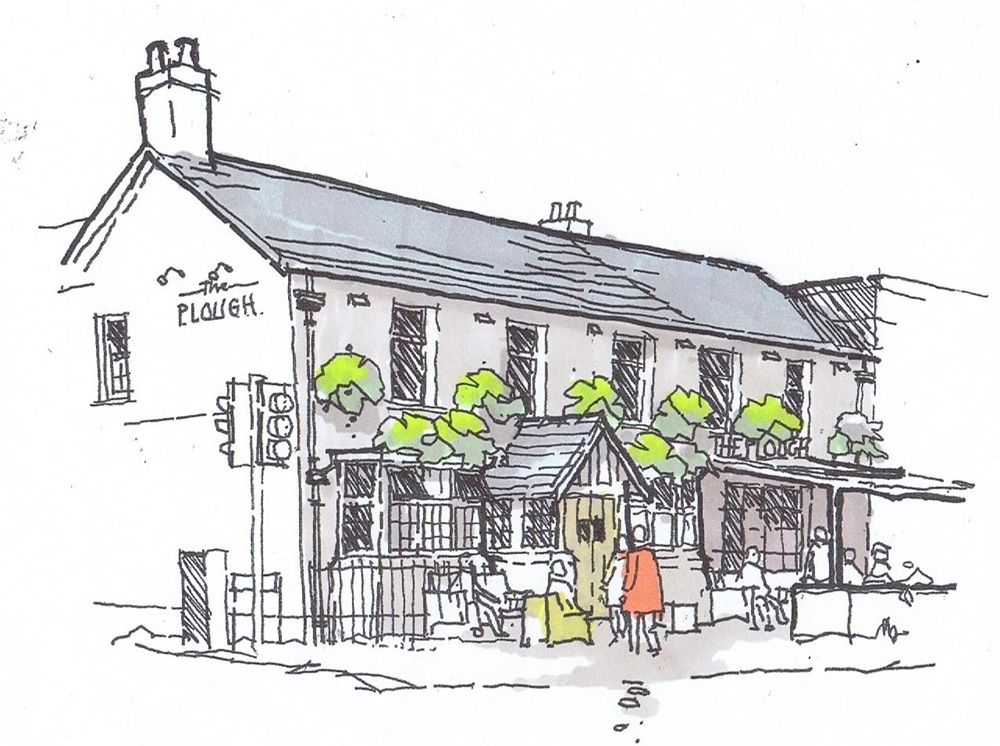
Today, the nearly-two-hundred-year-old Plough is probably the geographical centre of both the village and the old parish, set on the traffic lights. You might have seen it, and enjoyed a pint there.
In times past, there were ancient Celtic ancestors – the Silures, then Roman settlers, native Welsh tribes and Norman invaders. Add to that Viking visitors and Anglo-Saxon interlopers and, in the last hundred-years-or-so, a huge influx of newcomers. The parish population in 1801 was just 686, now it’s over forty thousand.
It seems that the folk of Whitchurch were always up for a fight. If not the Romans, the Normans, the neighbours – in fact anyone else who might be up for it!
Even before Cardiff was ever thought about, Whitchurch was an old chapelry in the diocese of Llandaff. It was always the place ‘over-the-river’, a place to be avoided, but tolerated enough to allow the dead to be buried in the Cathedral graveyard. At least until 1616, when we were allowed to have our own.
You might ask where is Whitchurch? There are at least another two in Wales and another six in England. Our Whitchurch is just a mile-or-so north of the Capital, but still fiercely separate. Even though the parish was subsumed by Cardiff in the late 1960s, everyone still refers to ‘the Village’. It’s Whitchurch Village, Rhiwbina Village, Tongwynlais or Llandaff North – although Llandaff North was Primrose Hill until 1904 when the name was changed; who’d do that?
We don’t have a ‘welcoming’ sign, and if you’re travelling north-south or east-west, you’d miss us quite easily. Perhaps we ought to think about getting one or two!
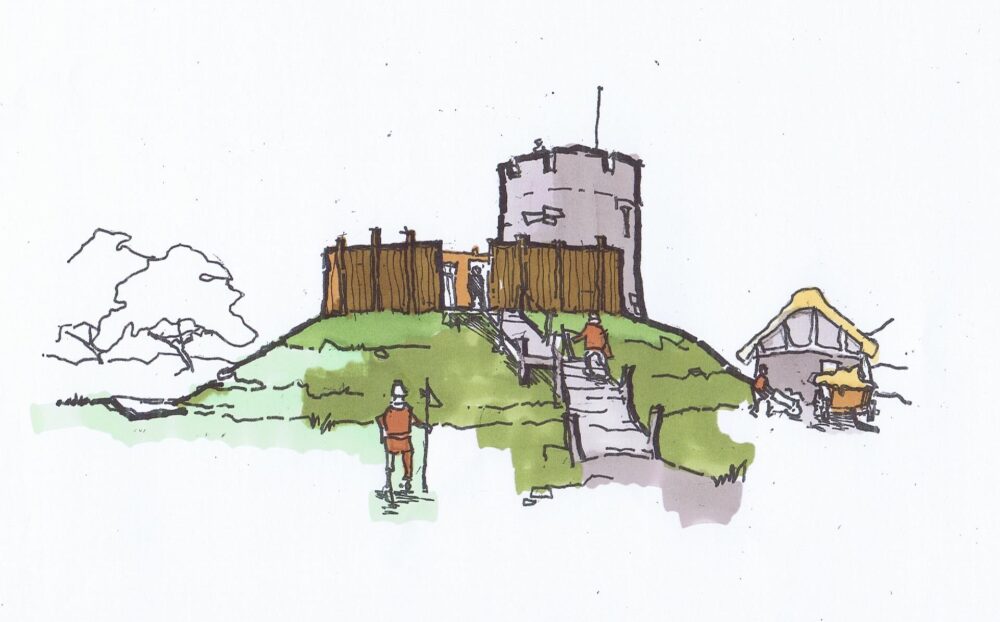
We’ve got lots of history, but it’s hard to discover. We used to have a castle – a motte and bailey – but that was finally demolished in 1965 to build flats! We don’t know what it looked like, but the sketch gives a flavour.
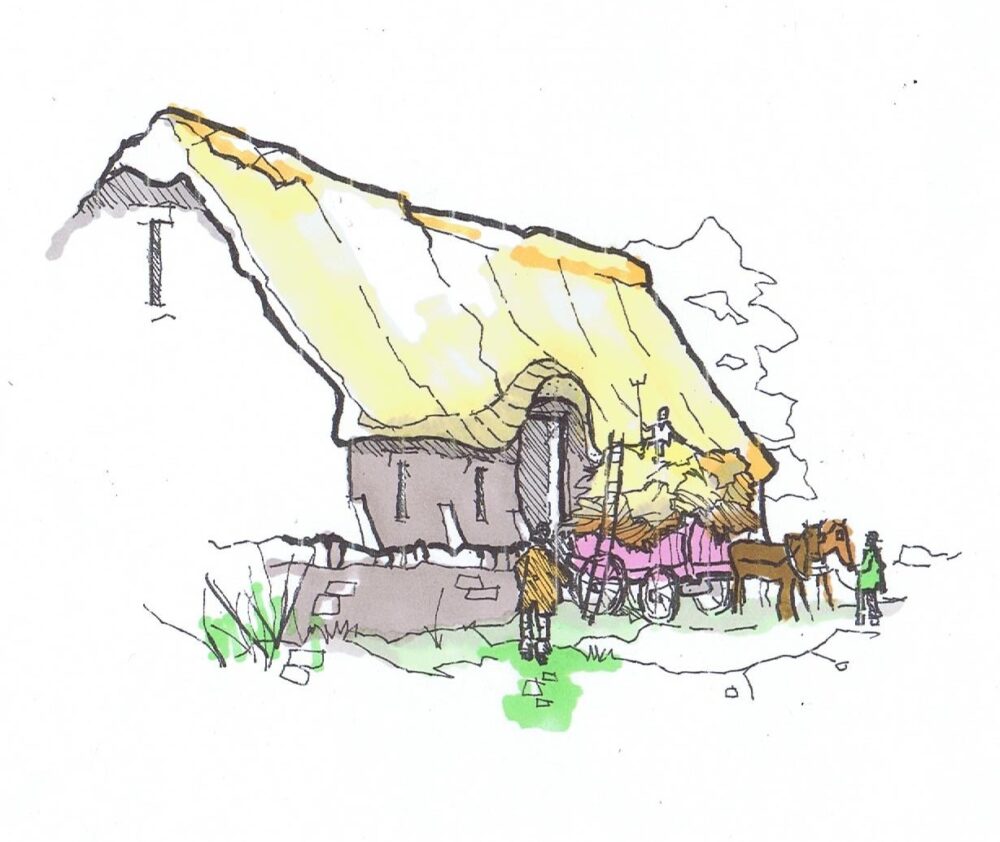
We had an ancient church – but that was left to fall into dereliction and demolished in 1904. And we had an ancient thatched tithe barn – that caught fire in 1900 and was simply ‘lost’. Perhaps the sketch will help?
You can see that we’ve had our share of philistines to go with all the others, as well!
The ‘authorities’ did their best to eradicate the Welsh language in the late nineteenth/early twentieth century – and almost succeeded. But it’s now a joy to wander through the village to hear young children chattering away to their parents in Welsh. We’ve got both a Welsh-language primary school and high school, and a couple of Welsh-language chapel congregations. So many of the signs and posters are bilingual.
The old parish was huge, stretching from the River Taff in the west to the Great Heath in the east. From the strongholds of the Wenallt and Thornhill in the north to the ill-defined southern boundary which followed a meandering stream.
Carved up
This huge area is now carved-up by an old canal, railway lines, the A470 running north and the M4 running east-west – the motorway effectively slicing-off Tongwynlais.
There’s so little known about the history of our parish. There are a few books on the subject, but they are almost ancient themselves, and long out of print
But we’re beginning to reclaim the past. There are folk who still remember things. Whether it’s distant memories of a grandfather who once worked at the tin-works at Melingriffith, the discovery of unlikely heroes of the parish, or stories of ghosts and ghastly deeds of the past.
Groups of community enthusiasts meet regularly to share and record these precious memories. It’s early days, but the story’s getting known and shared. Last month, we had visitors from Surrey – twenty-four of them on a coach from a smart Arts and Crafts Foundation – visiting the Garden Village in Rhiwbina. They loved the place, the curated tour, particularly the story of Nick Boing, the 22-stone pet sheep who loved cuddling-up on the sofa, and who’s commemorated in the local park!
Whitchurch Hospital
The Surrey group didn’t have time to visit Whitchurch Hospital; our Grade-II listed ‘lunatic asylum’ in its landscaped grounds. Built by Cardiff Corporation over a hundred years ago, in Whitchurch because the stigma of having an asylum in town was just too much.
For the past ten years or so it’s been empty and now ‘surplus to requirements.’ It’s slowly deteriorating with rain getting in and casual vandalism. A melancholic ghost, until ‘the authorities’ decide what to do with it
We’re well worth a visit, if you can find us.
Maybe I can share some more of our story another time?
Support our Nation today
For the price of a cup of coffee a month you can help us create an independent, not-for-profit, national news service for the people of Wales, by the people of Wales.



Nice one, Mr Nigel Lewis…I used to live in Whitchurch with my parents…at 60 Park Road…yes, I stayed at the Hospital early 90s…twas a great place…nice at Christmas time…Whitchurch was magical in the late 80s…I think I drank at most of the pubs…can remember the village, all shops…used to catch the buses into town and back….thanks for reminding me..!
I would recommend anything written by Edgar Chappell, Especially Old Whitchurch from 1945. A local historian, councillor and supporter of a Welsh Parliament….
I did wonder for a moment if this wasn’t going to be an article on a visit to our close neighbour over the border in Shropshire, but that’s Yr Eglwys Wen. I’ve never been to the Whitchurch on the outskirts of Cardiff, no real reason to although maybe I might pop in. I have been to Rhiwbina though, my girlfriend took me there once on an aside from a visit to Cardiff because she thought I’d find it interesting.