


A north-south coach service – or reopen the railway?
Professor Stuart Cole CBE, Emeritus Professor of Transport Economics and Policy, Prifysgol de Cymru / University of South Wales
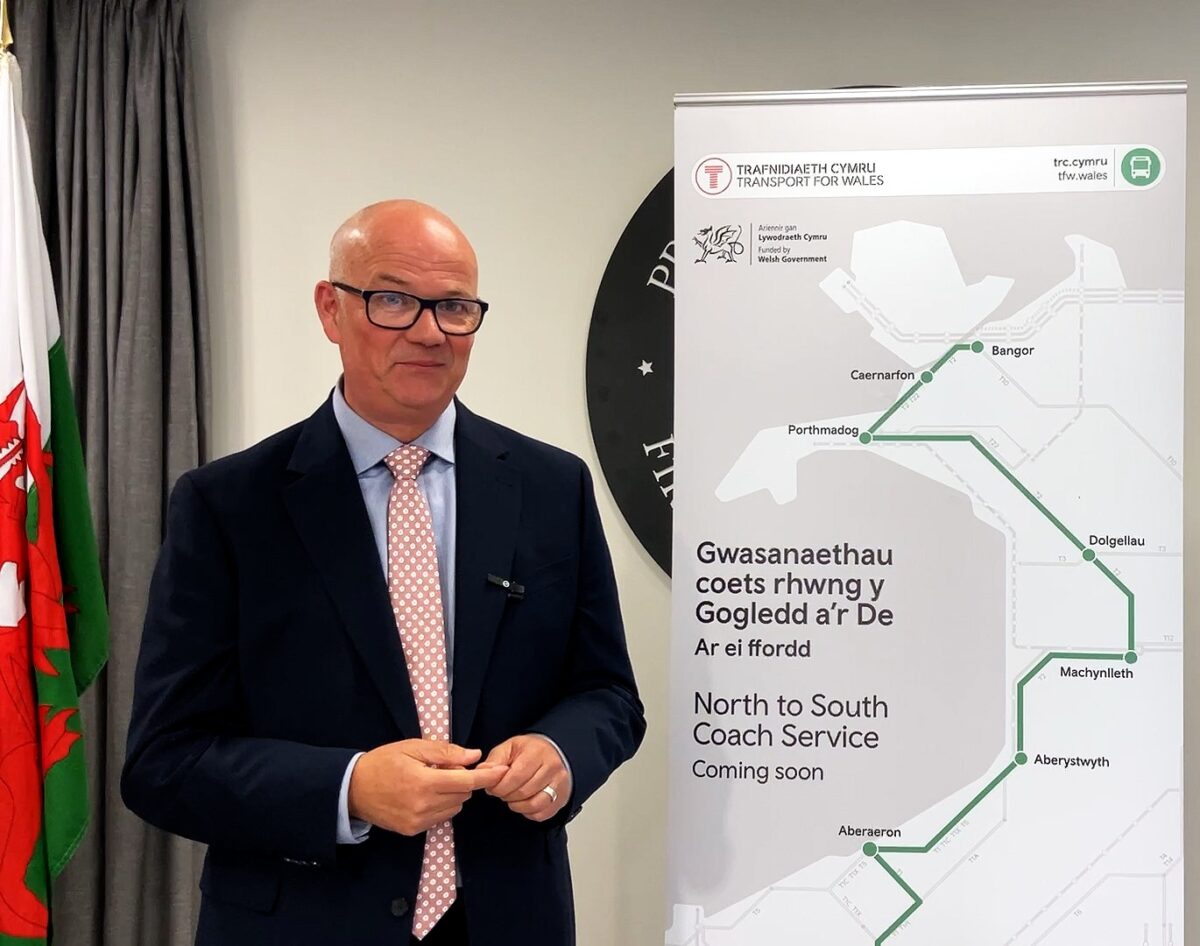
The new Plaid Cymru government has committed to introducing a long-distance coach service between Bangor and Carmarthen alongside TrawsCymru’s existing bus operations.
The commitment formed part of the party’s First 100 Days programme to improve north-south public transport and serve parts of Canolbarth (mid Wales) that have been without a railway for nearly 60 years.
However, the government must adopt a part-commercial, part-socially necessary approach to the service. As it differs from the existing TrawsCymru network, a separate brand incorporating “Cymru” in its title might also be worth considering.
Market for the service
Marketing any new business, including a coach service, is based on the four Ps – product, place, price and promotion.
Pre-market testing, as with all new passenger services, begins by deciding the route to be operated, the places to be served and the interchange points with connecting services.
This long-distance service must meet the needs of local residents while also attracting students, other passengers seeking quicker and cheaper journeys within Wales, and tourists wishing to enjoy the spectacular rural scenery along the route.
There is a market for this service on both demand and public policy grounds. However, Transport Minister Mark Hooper will no doubt face criticism from the usual suspects about there being “hardly any passengers” while demand builds. TfW can, however, point to the steady growth in TrawsCymru patronage since 2012.
Although provided by TfW, this is intended to operate as a commercial coach service, similar to those offered by long-distance coach operators, railway companies and airlines. None offers free travel, despite, for example, the railways being state-controlled, and the Welsh Government has correctly indicated that concessionary passes will not be valid in order to avoid drawing passengers away from existing TrawsCymru services.
As a commercial coach service, it is likely to use market segmentation and differential pricing. Discounts should, of course, be available for regular travellers, similar to UK railcards, coach passes and air miles, as well as for other market segments such as off-peak passengers.
When ministers initially refused to accept concessionary passes on the TrawsCymru T9 Cardiff Airport service, they faced a strong public backlash and ultimately reversed the decision.
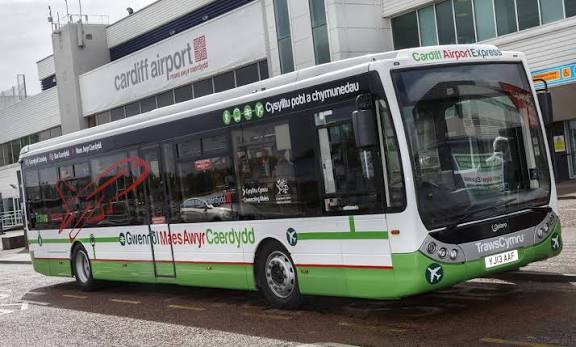
However, that was a bus service and therefore fell within the Welsh Government’s concessionary bus travel policy.
Passengers using local stopping services will continue to be served by the TrawsCymru T1 and T2 routes, where concessionary passes remain valid.
Travellers will also compare fares with other modes of transport, particularly the perceived lower cost of travelling by car and rail fares, which are likely to be considerably higher.
Once the market has been established, the service will require effective promotion, including online real-time passenger information. An estimated £2 million has been included in the 2026-27 supplementary budget to operate and promote the new service.
Demand
Demand for this service is unlikely to make it commercially viable on its own. Even with relatively high fares, price and cross-elasticity effects could encourage travellers to remain in their cars or continue using existing bus services, reducing revenue below commercially viable levels.
For the service to be both affordable and accessible, while also achieving wider objectives such as reducing car use and supporting environmental goals, ongoing revenue support will almost certainly be required. Had there been a genuinely profitable market, sophisticated demand forecasting models using population data, competitor pricing and tourism trends to optimise services would almost certainly have identified the opportunity long ago. Companies such as National Express or FlixBus would already be operating such a route.
Journey time, frequency and reliability
Journey time, rather than distance, is now one of the main factors influencing travel choices.
The predicted journey time between Bangor and Carmarthen using the new route is four hours and 30 minutes. Comparable journey times are:
TrawsCymru T1C: 5 hours 45 minutes
Train (via Cardiff): 6 hours 8 minutes
Car: 3 hours 30 minutes
Many other intermediate journeys across mid Wales will also become significantly quicker using the new coach service.
Reliability and punctuality should also benefit from the experience gained operating the existing TrawsCymru network.
A two-hourly frequency represents an attractive offer for passengers and is more frequent than many comparable long-distance coach services.
The service and route
A coach service of this type was first proposed in 2010, when this columnist was asked by the then Welsh Assembly Government to analyse bus services in rural Wales and identify potential improvements. During that work, this columnist created the TrawsCymru brand and led the team that established the initial six-route TrawsCymru network two years later, alongside the Bwcabus (now Fflecsi) demand-responsive feeder service.
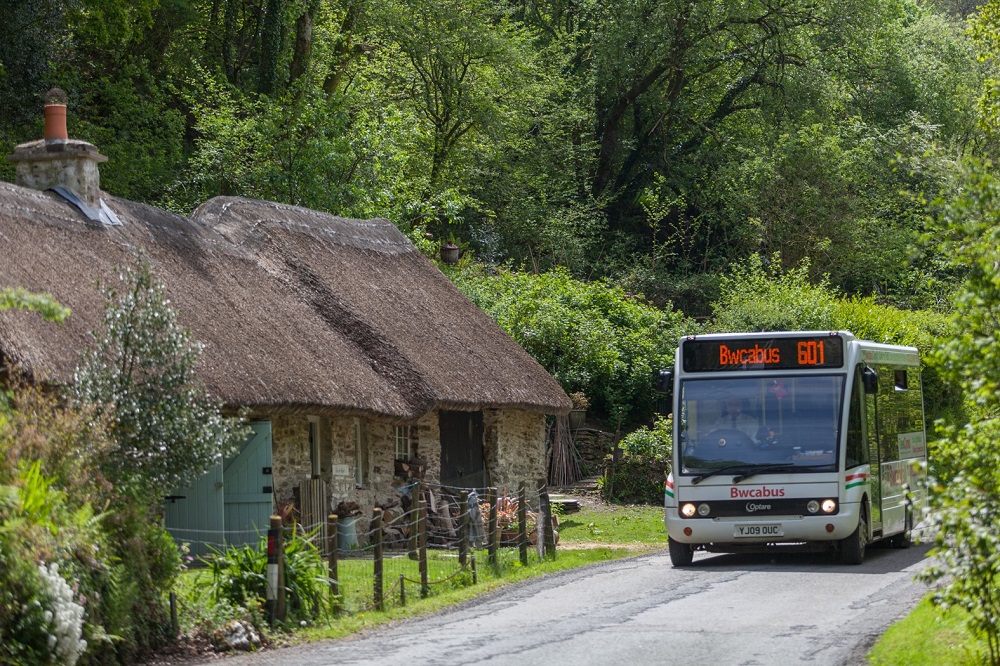
The TrawsCymru Express was conceived as a long-distance, limited-stop coach network operating less frequently than the bus network, but offering considerably shorter end-to-end journey times by serving only principal centres and key transport interchanges.
The new service is planned to call at Bangor railway station, Caernarfon, Dolgellau, Machynlleth, Aberystwyth University and the town’s bus and railway interchange, Aberaeron bus station, Llandysul and Carmarthen railway station.
As part of the procurement process, TfW will have specified the operational requirements when inviting tenders from potential operators. These could include options such as extending some journeys to Holyhead to serve ferry foot passengers. Detailed commercial negotiations will inevitably take place between TfW and the companies bidding to operate the service.
Vehicle details
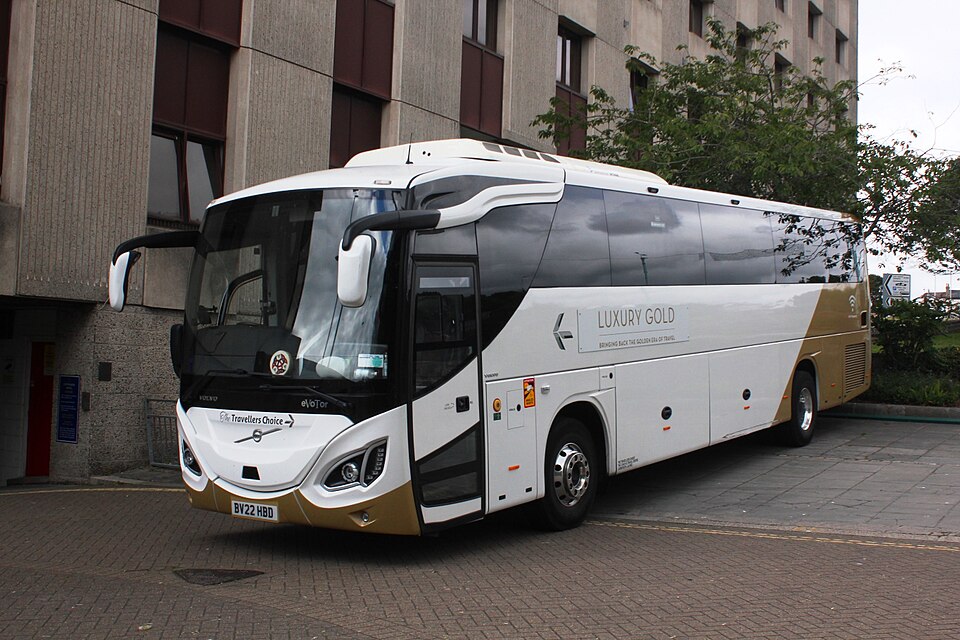
Plans for the new service are already well advanced, with the vehicles having been specified in detail. Welsh Government has procured eight high-quality Volvo/MCV eVoTor coaches, each costing, by my estimate, up to £300,000. The coaches are built in Egypt on the successful Volvo B8R chassis, with bodywork and interiors manufactured by MCV.
The coaches will offer a range of on-board facilities, including toilets – the lack of which has been a frequent criticism of TrawsCymru buses – together with four-seat tables, which proved popular on the original TrawsCymru services, reclining seats, increased seat pitch and full accessibility for disabled passengers.
As this column has often argued, the shop window for bus and coach services is the humble bus shelter. Too often it is little more than a basic shelter. If this new express service is to project the same high-quality image as its vehicles, it also needs high-quality waiting facilities, as has been achieved across much of the TrawsCymru network.
In place of rail
Support our Nation today
For the price of a cup of coffee a month you can help us create an independent, not-for-profit, national news service for the people of Wales, by the people of Wales.
Get more trusted Welsh news
Choose Nation.Cymru as a preferred source in Google News to see more of our journalism.



Flixbus have a good app to pre book and choose coach seats, including the option for solo travellers to pay a bit more and have both seats to themselves.
This is just one route, others could be considered, for example Wrexham to Carmarthen via Newtown, Llandrindod Wells or Rhayader, Builth Wells and Llandovery.
While it is important to grow demand one way to do this from say Aberystwyth is to offer through tickets to Swansea, Cardiff (other places are available) using TfWs trains or other bus services. Back in the early 1980s there was a Trawscambria coach that did the Aberystwyth Cardiff route that as a student I used frequently.
As regards bus shelters at least have seats and not a inclined bench that gives no relief.
Good news: Through fares are already available – you can book Aberystwyth to Cardiff using the T1 bus and a train on a single through rail ticket, for example.
I’m hoping it’s not charged at ‘rail fare equivalent’ pricing per mile for the entire journey, as that would be quite the swizz for what is, while a step in the right direction, ultimately a poorer mode of transport.
The integrated pricing for the electric buses already plying this route are very good value. On the TfW app today it’s £4 to travel the 2h18m from Carmarthen to Aberystwyth, or £2.65 with a senior railcard.
That’s quite staggeringly cheap. The JurnyOn app TFW offer for rail ticket discounts is good too.
On the scale of things, a choice between a coach service and reopening a rail line to connect north and south seems minor compared to the recent infrastructure built in England—and it is, given the hundreds of billions spent east of Offa’s Dyke and the relative pittance spent in Wales. However, Plaid Cymru should not be attacked for lacking aspiration or ideas. The real issue is that they lack the power and the levers needed to utilise our natural resources to fund infrastructure ourselves. At present, the Welsh Government has limited borrowing powers—£1 billion, to be exact. For decades, Whitehall,… Read more »
Regarding your last but one para Y Cymro, if our new Plaid government performs well there’ll be more of a likelihood that people will vote Plaid in General Elections. Logically the better they do in Wales the better we’ll be served in Westminster.
With just four MP’s at the moment they can be almost ignored. What if we had eight or ten or twelve. With a good performance in Cardiff you’d imagine Plaid could take quite a few of Labour’s twenty two and the Conservatives fourteen seats.
Yes, logically, you would think that. It is plainly evident that UK Labour regard Wales a region not a country; in fact, they openly insult us to our face. They patronise us, regard us as an appendage of England, doubt our ability as a people, use poverty and division as a weapon. Wales should take a leaf out of the SNP’s book. When they sent all those MPs to Westminster in 2015, it shook Labour and the Conservatives to their rotten core. There was a strong SNP government at Holyrood and 56 MPs championing Scotland at Westminster. Wales, on the… Read more »
The ‘too small’ argument is trivial to comprehensively debunk with a simple rhetorical question posed to the naysayer: “Where would you rather live, Liechtenstein or India?”
The aim should be to reconnect Carmarthen to Aberystwyth by rail and Dolgellau to Ruabon/Wrexham. Using modern infrastructure this should be effective. There are precedents like in Scotland where Melrose has been reconnected to Edinburgh.
It would be great to see a Carmarthen to Abergavenny service. It takes too long by bus at present with 2 changes. It could stop at Llandeilo, Llandovery, Trecastle, Brecon, and Crickhowell.
There’s a direct train, taking 2.5 hours.
Start with the charging network, which is poor.
Not being one of “the pay-day Welsh” and someone who uses public transport as a necessity rather than a statement (TfW HQ in Pontypridd stands over a gated car park), critical considerations are timetabling, reliability, connections, price and comfort (air con and toilets). Let’s hope the contract with the coach operator delivers for taxpayers and passengers. Professor Cole writes about the railway not being viable for 40+ years (population growth?). It’s not dismissed, it’s retained as an “aspiration”. The purpose of government is finding ways of delivering on aspirations and our universities to support those endeavours.
I’m sure that pretty much to a project, every rail reopening programme in the UK over the last decade or so has vastly outstripped forecasted use. Each will have drafted in their own ‘experts’ at the initial juncture to make the case, who would have made said forecasts. I think it’s time a lot less stock was put in what they come out with.
Folks talk about induced demand for new roads but totally ignore it on public transport projects.
What about the social good? Market demand isn’t the barometer for everything.