


Beyond the polls: How Wales voted in the 2026 Senedd election
Jessica Blair, Director Electoral Reform Society Wales
On Thursday 7th May, Wales headed to the polls for the Senedd election. This was an election that delivered seismic change for Wales; seeing Welsh Labour lose their position as largest party in the Senedd for the first time ever, and putting Plaid Cymru in government, with Reform UK Wales as the official opposition.
The new Senedd has 43 Plaid Cymru MSs, 34 Reform MSs, nine Labour MSs, seven Conservative MSs, two Green MSs and one Lib Dem Member.
How did the new voting system fare?
Beyond the headline results, we saw a new voting system used for the election, with all 96 Members of the Senedd elected via the Closed List electoral system for the first time.
Under this system parties put up lists of candidates in each of the 16 new constituencies across Wales. Voters were able to endorse a party’s list of candidates or vote for an independent.
From its inception in 1999 to 2021, 60 members sat in Cardiff Bay, elected using an Additional Member (AMS) System, which saw 40 seats elected using First Past the Post (FPTP) and topped up with 20 regional list seats elected under Closed Lists.
The new system to elect a larger Senedd was intended to be a more proportional one, and manage the 96 Members on an equal mandate ending the practice of having a combination of constituency and regional MSs.
To establish whether this system was more proportional than the previous one, a score can be calculated, which is referred to as a DV score.
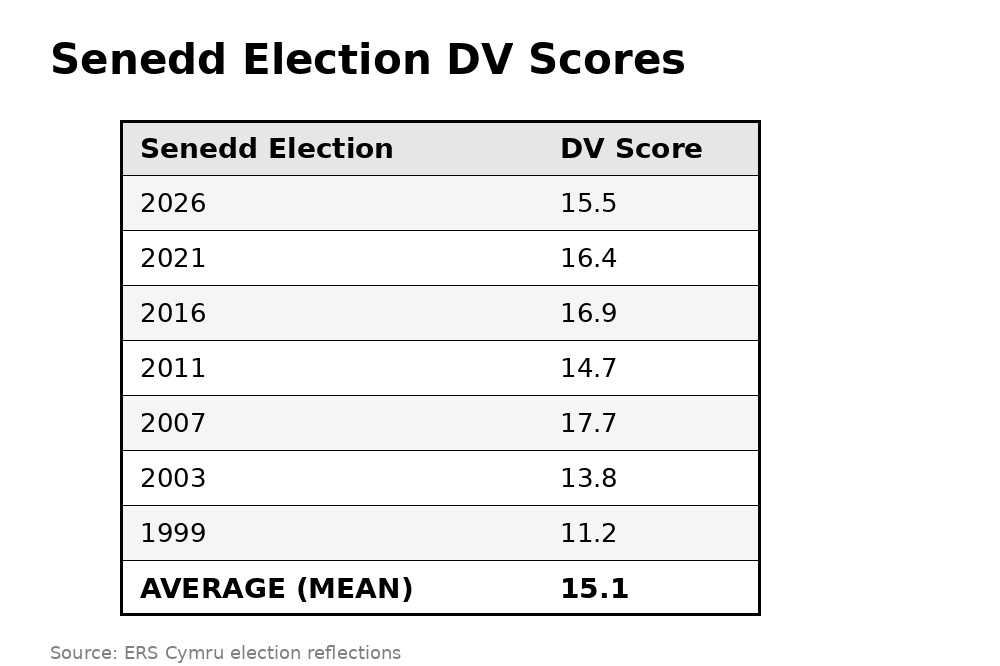
Essentially, the lower the score the more proportional an election. For the 2026 Senedd election the DV score (using the Loosemore-Hanby DV method) is 15.5, which puts it around average for the DV score for the previous Senedd election’s list votes compared with seats in the previous Senedds. This means that in 2026 the Closed List system behaved much in the same way as it has done in previous Senedd elections on this measure.
Comparing this with a UK General Election in Wales demonstrates how much more proportional this system is than the Westminster system. The Welsh results at the UK General Election had a DV score of 47.4 and over a similar timeframe have an average of 29.3.
Interestingly, the over-representation of the largest party is the lowest in any Senedd election to date (9.4 points). This compares to an average of 13.7 points across the first 6 Senedd elections and is the first time this figure has been under 10 points.
That isn’t to say that everyone is happy with this system. ERS has always been critical of its lack of voter choice and the fact that voters are unable to directly elect an individual from a party list.
An alternative system, the Single Transferable Vote, was the one recommended by both a panel of experts and a previous Senedd committee yet wasn’t put in place for this election. A review mechanism could now be used to tweak or change the Closed List system ahead of the 2030 elections, but it is currently too early to say whether MSs will vote to establish this or have the mandate to affect any changes.
How does this measure up with English local elections?
Compared with some of the other elections held last Thursday the Senedd election was much better able to manage the fragmentation we are seeing across the UK. With local elections in England held under FPTP on the same day we have a direct comparison for how different voting systems handle voters’ wishes.
Thursday’s council elections in England produced a string of disproportional results. In South Cambridgeshire the Liberal Democrats won 95.6% of seats on 41.6% of the vote, while in Wandsworth the Conservatives garnered the most seats despite winning fewer votes than Labour.
There are also examples; of where parties who won a similar percentage of the vote to Plaid Cymru in the Senedd election (35.4%) have benefited hugely under FPTP, such as Havering where Reform UK won 70.9% of the seats on 36.3% of the vote. Across a number of councils, large swathes of voters – over a third in some cases – ending up with no representation at all.
Within this context the proportional representation systems that we have seen used in Wales and Scotland (which used AMS for its election last week) have held up much better.
While the Welsh system could be improved, particularly in terms of giving voters a direct link with their representatives, it has been able to deliver a much more proportional result than those we’ve seen in England.
A look ahead
While the dust hasn’t even begun to settle on the Senedd election, voters will be back to the ballot box in just a year’s time for the Welsh local authority elections.
While we’ve had PR for the Senedd, those elections will still be held under FPTP and may cause parties much more of a headache if we see anything like the disproportionality we have just seen in England’s local elections.
If parties want to look to avoid replicating the problems we’ve seen in England, then time is of the essence to ensure FPTP becomes a thing of the past in Wales.
Support our Nation today
For the price of a cup of coffee a month you can help us create an independent, not-for-profit, national news service for the people of Wales, by the people of Wales.
Get more trusted Welsh news
Choose Nation.Cymru as a preferred source in Google News to see more of our journalism.


