

Beyond the stage: How Owain & Henry brings the power of the Welsh national anthem to life
Amelia Jones
A nation’s identity can outlive its greatest battles, a message at the heart of Owain & Henry, where the power of song takes on a meaning far beyond the stage.
More than 600 years after Owain Glyndŵr led a rebellion against the English Crown in the fight for Welsh independence, his story continues to resonate with questions of identity, belonging and what it means to be Welsh.
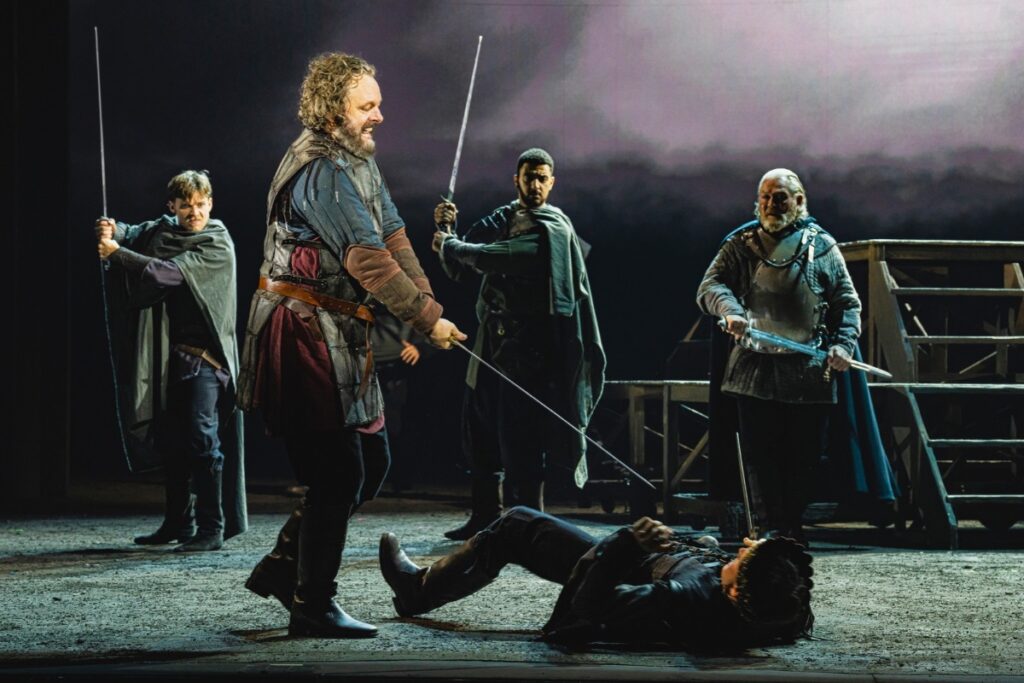
It is this defining chapter of our history that comes to life in Owain & Henry, the ambitious production at Cardiff’s Wales Millennium Centre. Written by Gary Owen and co-directed by Steffan Donnelly and Michael Sheen, who also stars as Owain Glyndŵr, the play explores a struggle that was about far more than territory or political power.
But amid the drama, conflict and political machinations, one of the production’s most memorable moments comes not through a battle or a declaration of independence, but through the power of song.
Set against the backdrop of the Welsh rebellion, the play brings together some of the key figures of the period, exploring the clash between Glyndŵr’s ambitions for an independent Wales and the English monarchy’s determination to maintain its authority.
Alongside Glyndŵr and Henry IV, we see Prince Hal, the future Henry V, played by Ned Costello. The play presents a story of shifting loyalties, political ambition and the struggle for power, but also of two nations whose histories, identities and sense of belonging are deeply intertwined.
However, it is a moment that comes towards the end of the play, when the tide has turned against Glyndŵr and the dream of an independent Wales is slipping away, that really puts this play into perspective.
Prince Hal launches into Jerusalem, with a beer in hand, singing with a swaggering, grotesque relish, spitting and spluttering the words as he delivers the song. It is deliberately provocative: an ugly, taunting celebration of English triumph at a moment when the Welsh cause has been crushed.

The audience made their feelings known, with boos ringing out as Hal continues. An uncomfortable, confrontational moment, and all the more effective for it.
The song, so closely associated with English identity, becomes a weapon of sorts, as if it is rubbing defeat in the faces of those who have lost.
Then, the opening notes of Hen Wlad Fy Nhadau ring out and the cast begin to make their way through the audience, parting the crowd as they move towards the stage.
There is something utterly spine-tingling about hearing the Welsh national anthem sung in this way. As the voices gather and swell, the theatre seems to become one collective voice.
It is a deeply moving, almost tear-jerking moment. One that transforms the atmosphere from confrontation and defiance into something full of pride, belonging and emotion.
For a few moments, you are not simply watching a play about Welsh history, you are immersed in it.
The backdrop
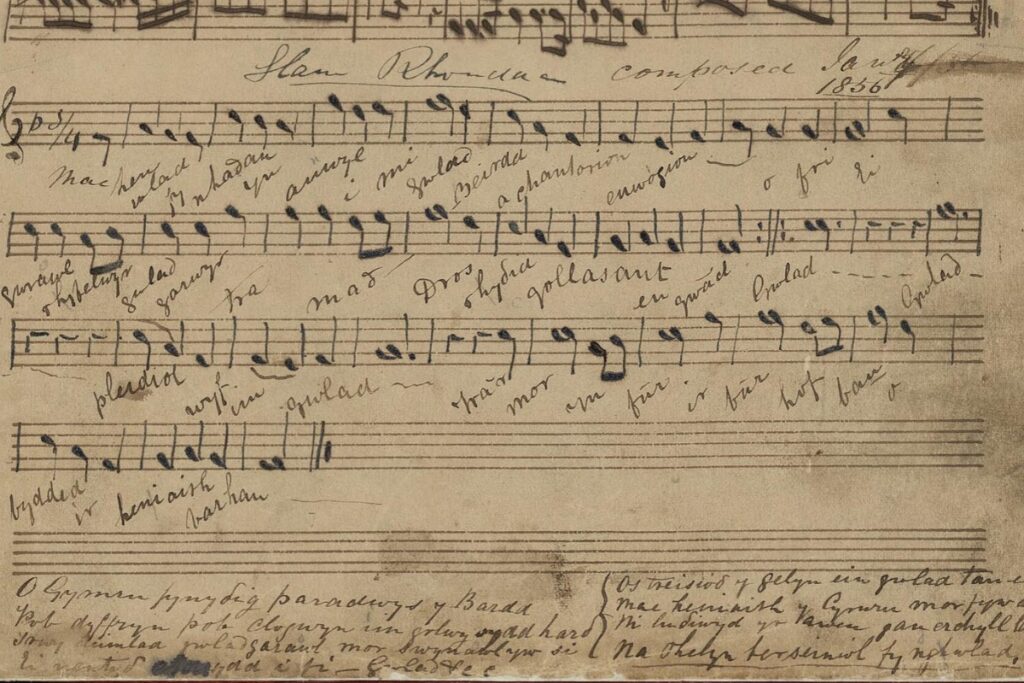
The anthem, which was originally titled Glan Rhondda (Banks of the Rhondda) was composed by James James (Iago Ap Ieuan, 1833-1902), a harpist who often played in the inns of Pontypridd, one day in 1856 as he was walking along the river bank in his hometown.
On returning home he sang it to his father, Evan James (Ieuan Ap Iago, 1809-1878), asking him to write some words for it. By the following day Evan had completed three verses.
Just a week after it was composed, it was performed publicly for the first time by Elizabeth John, a young singer from Pontypridd, at Tabor Chapel in Maesteg. From there, its popularity gradually spread, first through the surrounding communities and then further afield across Wales.
The earliest surviving version can be found in a handwritten collection of music compiled by James James, now held at the National Library of Wales in Aberystwyth. The manuscript brings together compositions dating from 1849 to 1863, with Glan Rhondda among its contents.
A significant turning point came at the 1858 Llangollen Eisteddfod, where the melody attracted wider attention. Two years later, musician and publisher John Owen, better known by his bardic name Owain Alaw, included it in his collection Gems of Welsh Melody. It was through this publication that the song acquired the title Hen Wlad Fy Nhadau, the name by which it would become known throughout Wales.
Its popularity continued to grow, with performances at major cultural gatherings and eisteddfodau helping establish its place in Welsh life. By the time it was sung at the Bangor Eisteddfod in 1874 by celebrated vocalist Robert Rees, it was already becoming a familiar and much-loved expression of Welsh pride.
Rather than being officially appointed as the country’s national anthem, Hen Wlad Fy Nhadau earned that status through the people who continued to sing it.
The story of Hen Wlad Fy Nhadau is, in many ways, a story of how a song can become something much bigger than the notes and words that make it up. It was not handed down by a government or given its significance by royal decree; its meaning grew through the people who sang it, generation after generation.
The play presents the anthem in its purest form, performed with the power and pride for which it was written. Its voices rise above and eventually drown out Hal’s mocking rendition of Jerusalem, as a wave of Welsh pride and national identity fills the theatre.
Hal eventually stops. Turning to Glyndŵr in fits of laughter, he taunts him for taking such pride in a song, but Glyndŵr’s response is defiant.
He proclaims that through this song Welsh pride and identity will live on, even if their fight for independence is lost.
The power of this play is almost indescribable. Its twists and turns leave you laughing, roaring with emotion and reflecting long after the curtain falls.
But that moment cements it as a powerful reminder that national pride is not defined by who is in power. It is something much deeper than that, it is a feeling that sits deep in your chest, stirred by the first note of an anthem for the ages.
Support our Nation today
For the price of a cup of coffee a month you can help us create an independent, not-for-profit, national news service for the people of Wales, by the people of Wales.
Get more trusted Welsh news
Choose Nation.Cymru as a preferred source in Google News to see more of our journalism.


