

Birthday Wishes from Whitchurch
Nigel Lewis, a member of AWEN, Arts-Whitchurch-Eglwys-Newydd
It’s always nice to celebrate something special – particularly when there seems to be so much bad news around
Anyway, Happy Birthday Whitchurch, you’re nine hundred years old this year!
The village – just north of Cardiff – is probably older, but it’s hard to confirm dates from so long ago
We know that the village is at least nine hundred, as there’s a legal document signed by the king himself, confirming its existence
Back in 1126 – this was sixty years after the Norman Invasion and thirty-six years after Robert Fitzhamon and his Norman knights rode into town
He’d set up camp in the ruined castle in the middle of Cardiff and began to divvy-up the land he’d acquired, sharing it out amongst his followers
Whitchurch on the east bank of the River Taff and opposite Llandaff Cathedral was an early prize – or so he thought!
Bishop Urban was bishop at the time; he was the first Norman bishop of Llandaff, and was from a Welsh clerical family – his baptismal name in Welsh was Gwrgan, and we’ve got a street in the village named after him (although there’s a local Welsh prince who’d strongly dispute this)
Gwrgan/Urban was unconvinced by the Norman claim to lands just across the river – after all, the tithes were an important source of income to whoever had the best claim
It all came to a head when Robert, the Norman Lord of Glamorgan took his claim to the king in 1126, at the regular court at Woodstock (now Blenheim in East Oxfordshire), fiercely opposed by bishop Gwrgan/Urban.
Ownership
According to the ‘Book of Llandaff’ – which still exists – King Henry I, with King David of Scotland, the Archbishop of Canterbury, several other bishops, and a hatful of leading barons agreed to the ownership of the contested lands in the favour of Gwrgan/Urban
It was stated: ‘The Chapel of Stuntaf (a really old name for the village) and the tithe of the township which the Earl gives to the said chapel, in order that a priest by means of the tithe may be maintained’
There was a condition though!
Provided that the parishioners on Christmas Day, Easter and Pentecost visit the Mother Church at Llandaff, and that the bodies of those who die in the said village be taken to the Mother Church for burial’
This last rule applied for the best part of the next five hundred years, and meant funeral parties wading across the river at Melingriffith, carrying the deceased! The churchyard in Whitchurch wasn’t dedicated until 1616, avoiding the processional ordeal
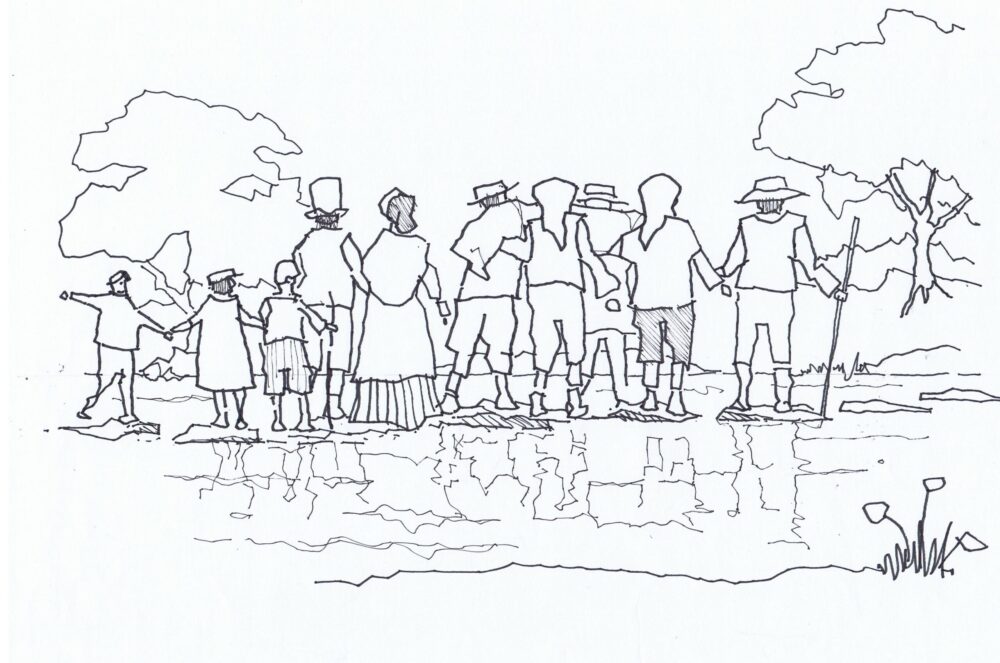
The sketch shows a funeral procession ‘carefully navigating’ the ford in those early days
We have a festival each summer on the Whitchurch Common, and this year, AWEN our local community group, are hoping to celebrate our nine-hundredth birthday – hopefully with a cake – and maybe a timeline showing all the important events that have happened in the village since
Watch out for the invitation
Penblwydd Hapus y Eglwys Newydd!
Support our Nation today
For the price of a cup of coffee a month you can help us create an independent, not-for-profit, national news service for the people of Wales, by the people of Wales.


