
Can Lumo’s new train service shake up travel between Carmarthen and London?
Professor Stuart Cole CBE, Emeritus Professor of Transport Economics and Policy, Prifysgol De Cymru / University of South Wales.
Passenger railways in Wales are currently operated either by private companies such as Avanti West Coast or Great Western Railway (GWR) under franchises awarded by England’s Department for Transport (DfT) or by Transport for Wales Rail (TfW), which is owned by the Welsh Government.
Great Western Railway will transfer into public ownership at 2am on 13 December 2026. Operations will pass from FirstGroup’s First Greater Western Limited to Greater Western Railway Limited under the UK Government’s public ownership programme.
Avanti West Coast is due to follow in March 2027. Passengers will see little immediate change in service frequency and facilities, though the UK Government is promising greater things in the longer term.
However, other changes are afoot with the arrival of an ‘open-access’ passenger train service expected in summer 2028 (and please, no remarks about late-running trains) between Carmarthen and London Paddington.
Reasons for open (track) access passenger rail services
‘Open (track) access’ was created to enable private sector companies to provide train services that the government franchising system could not or was not prepared to provide. They operate without a government franchise, take the full commercial risk and apply directly to Network Rail for train path access. As with nationalised train companies, any open-access service must be approved by the Office of Rail and Road (ORR), which considers whether the resulting service will:
- provide passenger benefits arising from the competition
- not result in network capacity constraints
- have no discernible impact on government-funded franchises or more recently government-owned companies
- complement rather than undermine the wider rail operation.
In effect, to be successful, any open-access proposal to the ORR will have to show it is neither cherry-picking routes nor aiming to be primarily extractive.
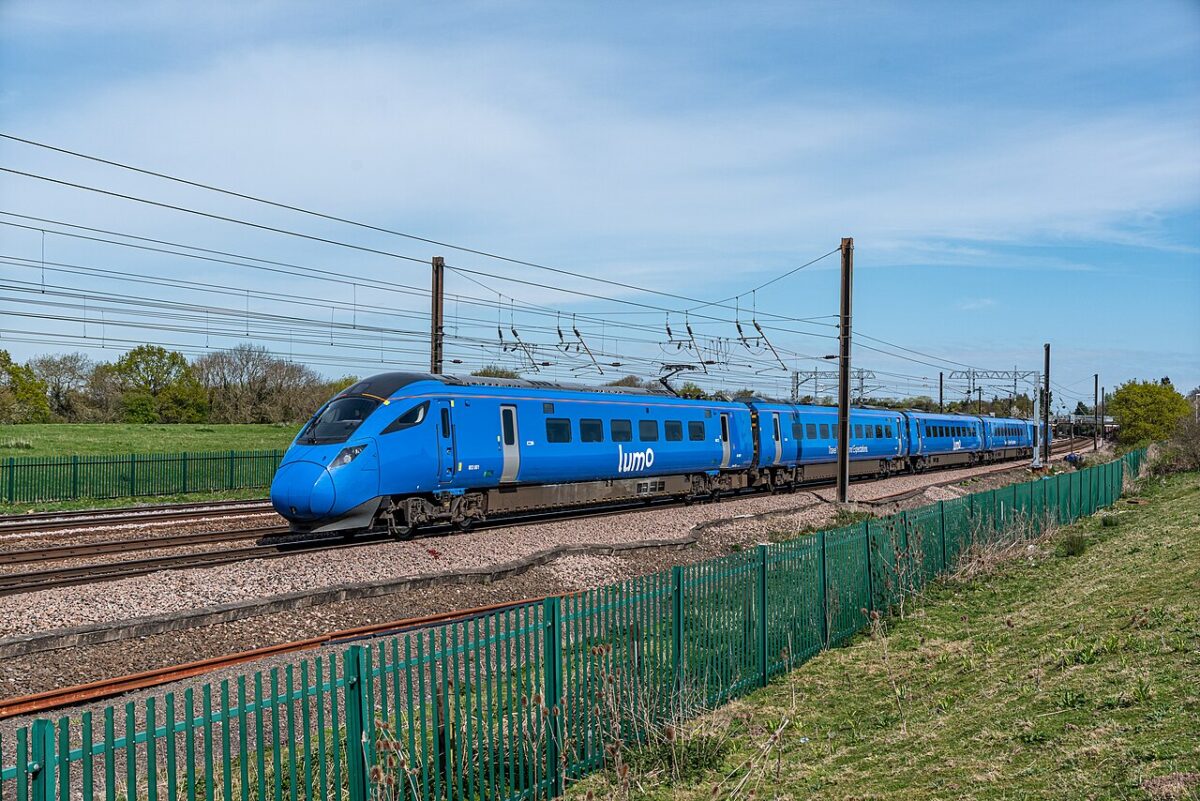
Over the last thirty years, several open-access services have run successfully on England’s East Coast Main Line, operated by companies such as Grand Central (now part of Arriva / Deutsche Bahn) and Lumo (FirstGroup’s open-access brand).
Carmarthen – London open-access service
Open-access services have previously operated in Wales. The Wrecsam, Shropshire and Marylebone Railway, owned by Deutsche Bahn, began running in 2008 with Welsh Government financial support. However, the economic downturn of that period made it unprofitable, and the service was discontinued three years later.
Preparations are now in the final stages for the long-awaited open-access service between Carmarthen and London. Shortly before Christmas 2024, the operator, Lumo, ordered new Hitachi trains, similar to those used by GWR, with funding from Angel Trains, a rolling stock company. Trains will be five-car sets with standard-class seating only, with time needed for train delivery, route testing and driver training before December 2027.
Five trains will run each day in each direction, calling at Carmarthen, Llanelli, Gowerton (for Swansea), Cardiff, Newport, Severn Tunnel Junction, Bristol Parkway and London Paddington. Carmarthen to London journey times could be as short as 2h 45m (3h 40m currently) through bypassing Swansea on an avoiding line and if maximum line speeds can be achieved between London Paddington and Bristol Parkway. Tickets will not be interchangeable between Lumo and GWR or Transport for Wales (TfW) services.
The ORR has approved the service, having determined that there are competition benefits and no significant abstraction of passengers from existing operators (though there are conflicting views on this). If demand is as high as Lumo hopes, however, it may prove difficult to provide enough park-and-ride capacity at stations such as Carmarthen, Llanelli, Gowerton and Severn Tunnel Junction. Local authority support for such facilities could be needed.
UK Government’s view: for or against open access
The Labour government statement, Getting Britain moving, Labour’s plan to fix Britain’s railways, stated that ‘open-access services introduced by independent operators such as Lumo to use spare network capacity to supplement existing contract operators will remain where it adds value and capacity to the rail network’. ‘Open-access has a proven history in driving competition … makes the most of network capacity … and can help lower emissions through modal shift’. This will be achieved through the ORR approval process.
The UK Secretary of State for Transport, Heidi Alexander, was more circumspect in a letter to Declan Collier, ORR chair.
She agreed that open access can offer passengers more choice and provide services in new markets (new routes) while making efficient use of the network. She said these benefits had to be weighed against the impact on taxpayers and the loss of revenue from the soon-to-be state-owned passenger railway. So, as ever, we have HM Treasury / DfT ‘bean counters’ concerned about possible increased revenue support.
Her letter set out how commercially provided ‘open-access train services sit alongside better value for passengers and taxpayers with public ownership and a single directing mind’.
Surely not a single directing mind. The Welsh Government determines TfW Rail service levels and the Cardiff Valleys infrastructure. Are Messrs Burnham and Kinnock not only refusing to transfer track responsibility and funding to the Welsh Government, but also intending to take back control of rail service direction? Even former Labour First Ministers Drakeford and Jones back Rhun ap Iorwerth’s demand to transfer infrastructure.
Access charges for non-Great British Railways operators
One valid concern for the Transport Secretary and Network Rail is that open-access operators pay marginal-cost-based charges to Network Rail for using its tracks. This does not at present cover the long-term costs of track maintenance and renewal or the central support costs. This charge is at present determined by the ORR but will, in future, be determined by Great British Railways (GBR).
The Railways Bill currently going through the Westminster Parliament will require GBR to create an ‘Access and Use Policy’ (AUP). As GBR will not exist until that Bill is passed, the DfT has asked Network Rail to create an AUP.
One telling comment in a Network Rail paper last year was that GBR should be required [by statute?] to determine access for open-access and other operators for ‘the overall benefit rather than prioritising its own services or financial position’. If GBR does that, both open-access operators and TfW Rail will suffer. TfW Rail services will be subject to such decisions by GBR which will also have services on the north and south Wales main lines and to Manchester and, more recently, Bristol, where there are competing GBR operations.
Open access has generally succeeded, benefiting passengers and increasing rail demand. However, there have been conflicting consultants’ reports on the impact on East Coast Main Line services with some citing increases in all flows and others a reduction in demand for the franchised operator’s services.
From a biased Llanelli resident’s point of view, any increase in the level of train service is a benefit, so long as that is what is achieved.
Support our Nation today
For the price of a cup of coffee a month you can help us create an independent, not-for-profit, national news service for the people of Wales, by the people of Wales.
Get more trusted Welsh news
Choose Nation.Cymru as a preferred source in Google News to see more of our journalism.