


Change –a surprising thing I learnt from Afon Hafren and why it matters
Sarah Chave
One of the things which most surprised me on a recent journey I made with Afon Hafren (River Severn) from her source to the sea is how much rivers teach us about change.
In my mind, and maybe yours too, I accepted that the water in rivers is constantly changing – as the Ancient Greek philosopher Heraclitus reminds us ‘you can never step in the same river twice’.
A river’s route and banks, however, seemed to represent a constant, calming presence in a fast-paced world. Yet these too are constantly evolving, albeit on a very different timescale to the flowing water within them.
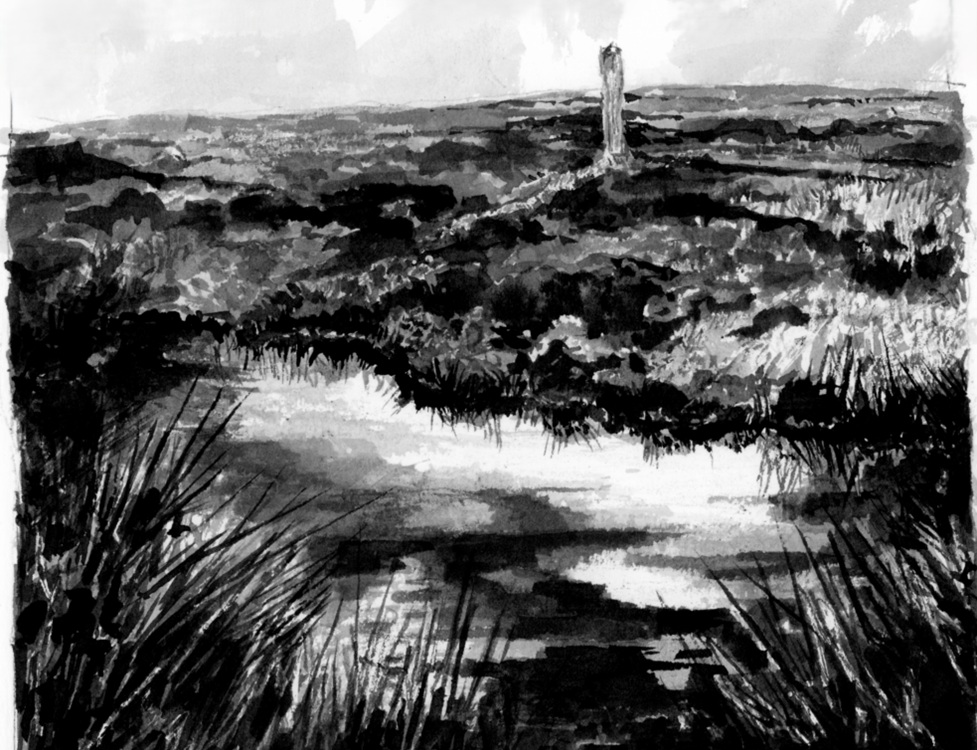
Afon Hafren starts her journey, alongside her sister rivers Gwy (Wye) and Ystwyth, as rainwater falling onto boggy ground and pools on the high Pumlumon plateau in the Cambrian mountains about 20 miles inland from Aberystwyth in mid Wales.
She tumbles as a mountain stream towards Llanidloes where, boosted by water from the Clywedog Reservoir, she takes on the wider, meandering flow more associated with rivers.
As she leaves Llanidloes she heads north-eastwards, passing through Newtown and Welshpool.
Deeside
Her original route, it is believed, would have then taken her to join the sea on Deeside, south of Liverpool. But 10,000 years ago, in the last Ice Age, her route was blocked near today’s town of Shrewsbury. She was forced to find a new route through the Ironbridge gorge and begin her long journey south, eventually rejoining her sister Gwy between Chepstow and Bristol before they flow into the sea together.
Aust Cliff where this coming together of the two rivers can be enjoyed, has become one of my favourite places. The open horizon, the changing cloud patterns, the silvery expanses of water, the ever-changing tidal push and pull ground me, give me a sense of my own (small) size in the world.
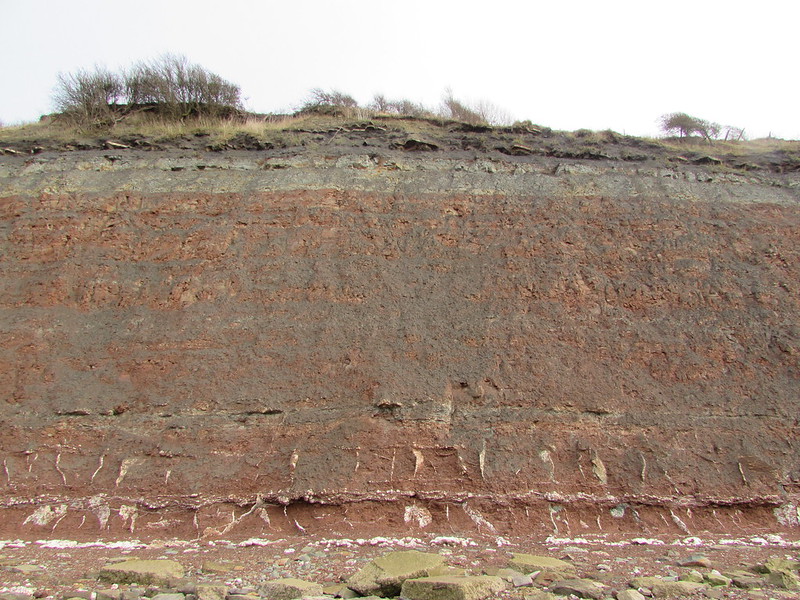
Aust also teaches about deep time. The foreshore here is scattered with rocks containing many fossils, fallen from the cliffs above. These cliffs are unusual in that they show clear stripes of different types of rocks consisting of a white layer near the base, a wide layer of red sandy rock and a top layer of more recent clay soil.
It blew my mind when I first read that the red layer was once part of a sandy desert near the Equator.
This had formed when a sea had dried out leaving behind shells and other maritime remains which then became fossilised. The white layer is formed from minerals once present in this dried-out sea.
How could rock in a cliff near Bristol and Chepstow have once been on the Equator? It seems that the world and landforms aren’t as stable as we might imagine and going back millennia, the land masses with which we are now so familiar have moved, through changes brought about by the earth’s tectonic plates.
Just as in our own lives, less dramatic changes have happened and are happening to Hafren and her course too.
Gloucester
It is believed that the Romans built their fort Glevum (current day Gloucester) on Hafren’s banks but changes caused by her meanders and flooding mean that her main course now runs west of the city. Only a smaller, secondary channel now touches her Western flank. The village of Lydney, in South Gloucestershire, was once beside Hafren but is now a mile from her banks.
Flooding is increasingly occurring all along her course and new areas are being added to existing flood plains to accommodate these. By 2075 it is predicted that areas such as the village of Deerhurst in Gloucestershire, might be permanently under water.
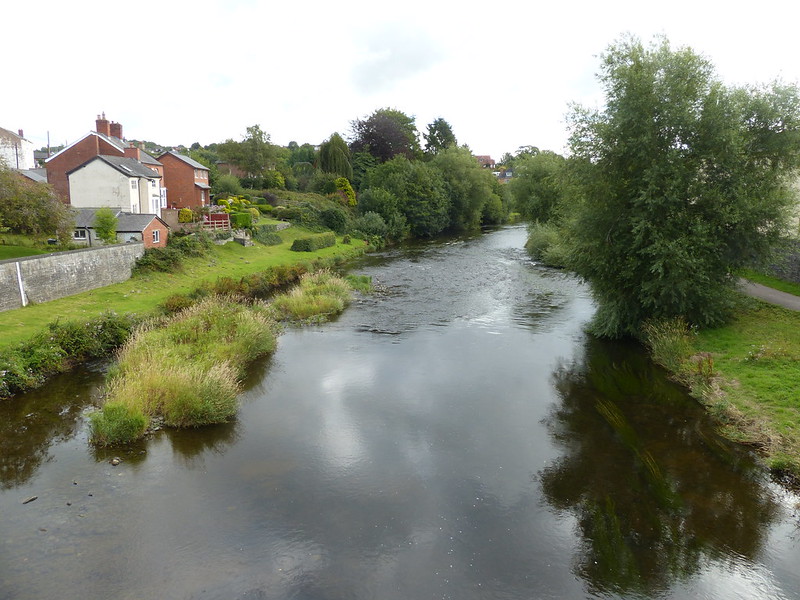
Towns such as Newtown in Powys are changing their approach to flood management, moving away from a containment policy to one of accommodation of Hafren’s evolving flowing and flooding.
All of these factors have challenged my existing idea of permanence in the world. There is a need to be aware of and open to change. These changes do not have to be wholly new.
It is often helpful to draw on, but not be constrained by, ideas from the past and from other traditions currently practised in different places in the world. Svetlana Boym’s thinking on restorative and reflective nostalgia is helpful here. Recognising the fluidity between the two ‘types’, Boym highlights how restorative nostalgia often arises in times of crisis.
It is characterised by a desire at an individual- and/or a society-wide level to reinstate ‘a truth’ based on a return to origins and a firm idea of how things once were. In reflective nostalgia, however, there is no single notion of truth or desire to reinstate a ‘true past’. Instead, reflective nostalgia ‘dwells on the ambivalences of longing and belonging’. It cherishes fragments of memory whilst at the same time examining them critically, questioningly and with compassion. Future actions can be informed, but not constrained, by notions and methods of the past.
Reflection
All along Hafren’s route people are engaging in reflection and using this to work for positive changes in this time of ecological crisis. Citizens are engaging in various activities such as collecting scientific data. They are also supporting campaigns such as the one conducted by River Action who were successful in getting the planning permission granted for the construction of poultry farming sheds to house 200,00 hens in Hafren’s water catchment in Shropshire overturned.
Left unopposed, these would have caused significant pollution to Hafren. Volunteers are undertaking activities to safeguard and restore habitats for native species such as pine martens in various sites in Powys, Worcestershire and Gloucestershire. A project to restore upriver navigation by fish, including the endangered twaite shad, have been completed at Diglis Island in Worcester and at other locations on Hafren’s route. Changes towards more regenerative approaches to farming are being introduced in many places.
In Powys, farmers such as Gai at Porth farm near Caersws and those on the newly started 37-acre agroecology site at Sarn, near Newtown, are experimenting with fruit and vegetable growing. In Shropshire, the Bradford Estate is trialling regenerative principles.
These include reduced tillage winter cover crops and animal dung to boost soil health and biodiversity restoration on 3,500 acres of their land. In many locations, lessons are being learnt from traditional Lammas principles, such as those used on the hams (riverside meadows) at Upton-on-Severn in Worcestershire.
Despair
In the face of major ecological challenges, it is easy to feel despair, or what the philosopher Spinoza calls potestas – a sense that power lies in the hands of others and one cannot do anything about it. But these examples show us that we all have what Spinoza calls potentia – the power to effect change. Hafren reminds us that change has already happened and always will happen.
How that change manifests itself will be influenced by our actions and inactions. People on Hafren’s banks are showing that we can and need to be part of changes towards more sustainable ways to live together on this our shared planet.
Hafren: The Wisdom of the River Severn by Sarah Siân Chave with illustrations by her sister, Rachel Collis, is published by Calon (£16.99) and available in all good bookshops.
Support our Nation today
For the price of a cup of coffee a month you can help us create an independent, not-for-profit, national news service for the people of Wales, by the people of Wales.



The ‘traditional Lammas principles’ is culturally English and translates from Anglo-Saxon as ‘Loaf -Day’, the pre-reformation mass. Celebrated with first bread bake of the end of summer harvest. Imported into Wales by recent new-age settlers on benefits. In Wales, not dependent on grain harvests, there was Gŵyl Awst of Celtic church. Celebrations of summer fruits. The claim that Lammas principles in England involved no tillage of the soil is false. A misunderstanding of the process of livestock grazing on the stubble of a grain field. A mere delay, prior to winter ploughing.