


Church in Shropshire preserves Welsh englyn stone from 1661
Nation Cymru staff
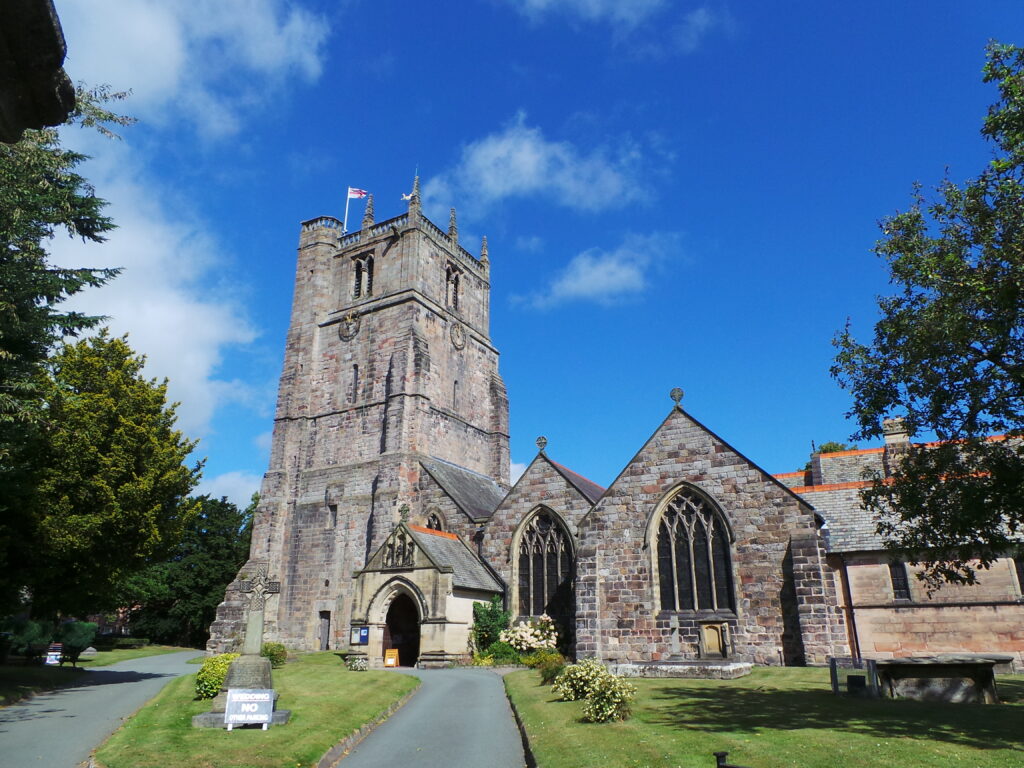
A gravestone bearing what is thought to be one of the oldest known examples of a Welsh englyn has survived thanks to a Victorian restoration project at a church in Shropshire.
Oswestry (Croesoswallt in Welsh) is an ancient market town in Shropshire, England, close to the Welsh border.
The town is five miles (8.0 km) from the Welsh border and has a mixed English and Welsh heritage. The town changed hands between the English and the Welsh a number of times during the Middle Ages and still retains some Welsh-language street and place names.
In 1972, ITV even broadcast a television report asking residents if they thought the town should be English or Welsh, with mixed responses.
Writing about the stone in St Oswald’s Parish Church in Oswestry & Border Counties Advertiser this week, Gavin Grosvener shared how the stone was lifted from the nave floor and placed on a wall for safekeeping during restoration work carried out by architect George Edmund Street in the late 19th century.
He shared: “At the time, much of the church floor was paved with old gravestones marking burials beneath. Many had become heavily worn after generations of foot traffic” before 22 were thankfully saved and placed on the walls, including the stone bearing the englyn.
He added: “The inscription, dated 1661, is written in strict englyn form, a traditional Welsh poetic style. It is believed to be one of the oldest known examples of its type and is regarded as a rare survival of Welsh literary culture.”
The inscription translates as: “If any man should ask, I give certain knowledge where Salbri’s heir was buried. Here is his impression, a cold, sharp cry. He is the one placed under me.”
Englyn (plural englynion) is a traditional Welsh short poem form, consisting of a stanza of either three or four lines. The metre involves the counting of syllables, and rigid patterns of rhyme and half rhyme. Many lines contain a repeating pattern of consonants and accent known as cynghanedd.
An englyn can be used as a poem in its own right, for example as an epitaph, or used in a series as part of a longer poem. Sometimes different types of englyn are mixed in the same poem.
The three-line englyn was common in early Welsh poetry, but about the 12th century it went out of fashion, to be replaced completely by four-line varieties.
The most common type of englyn is the four-line englyn unodl union, which is usually referred to simply as an englyn.
For those interested in seeing the stone, follow the Oswestry Bell Ringing Facebook page or watch for announcements on the church website when the tower is next opened to the public.
Support our Nation today
For the price of a cup of coffee a month you can help us create an independent, not-for-profit, national news service for the people of Wales, by the people of Wales.
Get more trusted Welsh news
Choose Nation.Cymru as a preferred source in Google News to see more of our journalism.



It’s good to know that this English church has preserved this 17th-century Englyn gravestone rather than hiding it away. What some don’t realise is that Oswestry, Shropshire itself, was once Welsh territory, as it was within the post-Roman settlement of Pengwern and part of the ancient Kingdom of Powys.
Could happen again. If Burnham’s devolution takes hold eventually Shropshire will have to decide if it wants to be absorbed into Greater Birmingham or if it might prefer to look west and rekindle old alliances.
Yes, West is best.
Note that the descriptions of the history of the form, and the definitions given of an englyn and englynion are not entirely correct. The metrics are incorrectly presented (e.g., a standard englyn will have cynghanedd in every single line, not ‘many lines’, as suggested here), and the three-line ‘englyn milwr’ did not disappear entirely after the 12th century (though the four-line ‘unodl union’ did certainly surpass it in popularity). Also, this is obviously not “one of the oldest known examples of a Welsh englyn” given that it is 17th-century and the article itself (correctly) notes that the englyn form has… Read more »
Tybed ai mab hynaf Catrin o Ferain oedd yr aer hwn? Yr un a’i ddienyddwyd am gymryd rhan yng nghynllwyn Babington i ladd y freninhes Elisabeth 1af?