


Could the UK actually split? Experts explain the legal route for pro‑independence leaders
Richard Brant, Senior Lecturer in Law, The University of Law, Nikos Skoutaris, Professor of European Constitutional law, University of East Anglia
As the Scottish National Party gathered in Aberdeen for the its annual conference, UK Prime Minister Andy Burnham had also travelled north of the border.
SNP conferences are of course a platform for the party to coalesce around its core aim of Scottish independence.
But at Labour’s conference in September, Burnham told colleagues the union is “worth saving” and “worth fighting for” and he was determined not to be “the last prime minister of the United Kingdom”.
This was a riposte to SNP leader and Scottish First Minister John Swinney, who had predicted exactly that weeks earlier.
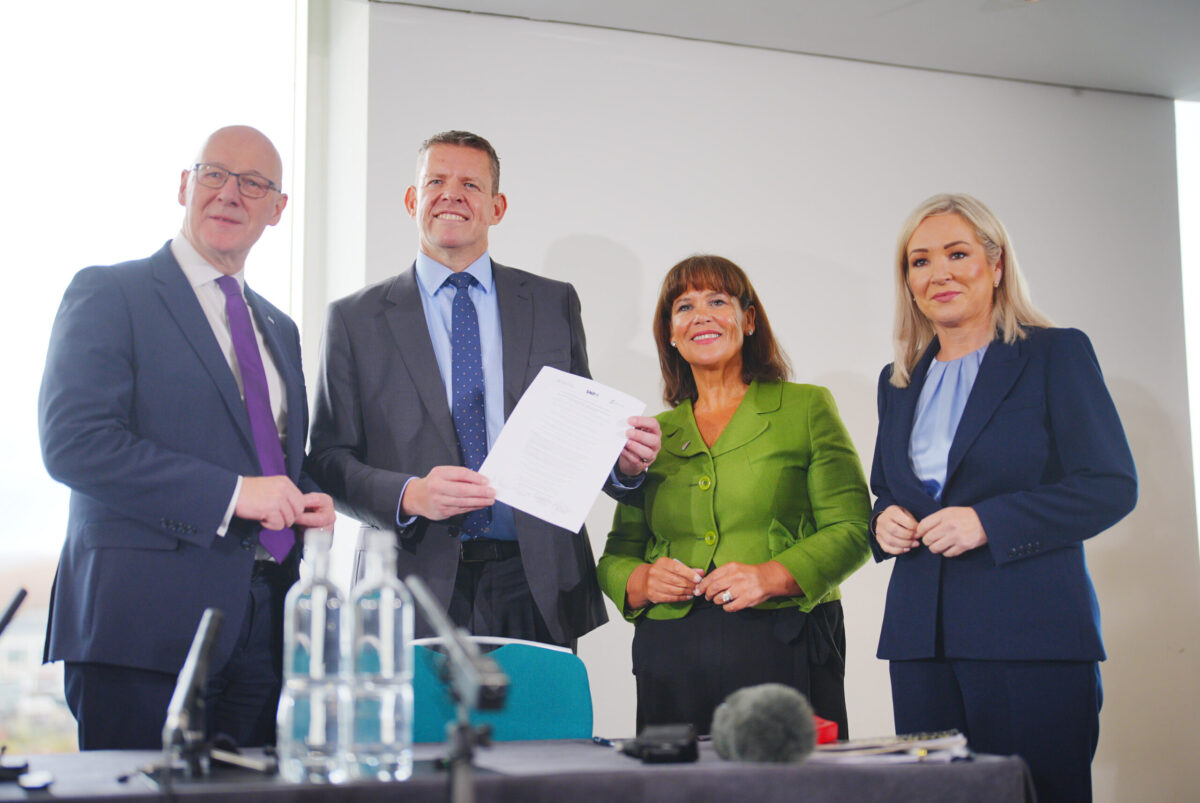
Also in September, Swinney and his fellow pro-independence leaders in Wales and Northern Ireland met for a summit where they asserted their right to decide their own futures.
At the talks in Cardiff, the leaders signed two agreements – neither of which changes the law. What they do expose, however, is that the three nations stand in very different legal positions – and that two of them have no route forward at all.
The party leaders (Swinney of the SNP, Rhun ap Iorwerth of Plaid Cymru, and Sinn Féin’s vice president, Michelle O’Neill, and president, Mary Lou McDonald) signed what’s known as a memorandum of understanding.
Officially, the meeting was not a summit of first ministers, rather of party leaders. But this didn’t stop unionists in Northern Ireland criticising O’Neill for taking part while serving as first minister of an executive she leads jointly with deputy first minister Emma Little-Pengelly of the Democratic Uunionist Party. Little-Pengelly is her equal in law.
Swinney and ap Iorwerth also signed a separate pact between their governments – the Cardiff Agreement. It describes the UK in its current form as “unjust and unsustainable” and commits both devolved governments to press for greater powers over their “constitutional future”. Swinney called it an “important moment”. But it is a political statement – in reality, it doesn’t affect either government’s statutory powers.
The two documents speak about self-determination in different registers. The memorandum is bold: it says the three nations have the right to self-determination and no Westminster government has the right to block democracy.
The governments’ agreement is more careful, referring only to the right of citizens to decide their constitutional future “through democratic means”. That difference matters. In international law, the right of peoples to self-determination does not normally give part of a state the right to break away on its own terms, save perhaps in cases of colonial rule or extreme oppression.
The UK Supreme Court said as much in its 2022 ruling, drawing on the Canadian Supreme Court’s decision on Quebec. The claim that Westminster has no right to block these nations’ choices is a political argument, not a statement of the law.
Three nations, three routes
As one of us (Nikos) has argued, only Northern Ireland has a treaty-backed route to exiting the UK. Under the Belfast/Good Friday Agreement and the Northern Ireland Act 1998, the Northern Ireland secretary must call a border poll if it appears likely that a majority would vote for a united Ireland.
Even then, the right belongs to “the people of the island of Ireland”. Reunification needs a majority in Northern Ireland and a separate majority in the Republic, a requirement mirrored in the Irish constitution. The two votes need not fall on the same day, but neither counts without the other.
Scotland’s route is blocked. The power to hold a referendum has to be transferred through a section 30 order, as was the case before the 2014 independence vote. Successive prime ministers have refused, and Burnham’s response to the Cardiff meeting was a statement saying that he “believes strongly in the union … rather than engaging in constitutional debates or further referendums”.
The Scottish government published a draft referendum bill in August, but it will only be introduced once that order is made. While Westminster refuses, the bill is written but unusable.
Wales has an equivalent mechanism – section 109 of the Government of Wales Act 2006. It has never been used to lift the reservation protecting the union of the nations of Wales and England. In September, the Senedd (Welsh parliament) backed a motion asserting Wales’s right to hold a referendum. But a motion settles nothing.
So in two of the three nations, repeated election victories for independence-supporting parties can be followed by an indefinite refusal to organise a referendum. There is no rule to say when that refusal must end.
The Cardiff agreements themselves sit close to a legal line. The Supreme Court has made clear that devolved legislatures cannot use their powers to put pressure on Westminster over the future of the union. Political agreements are not legislation, so they fall outside that test. And signing as party leaders rather than as first ministers adds a further layer of distance.
Legislation is another matter. The Scottish parliament’s 2013 referendum bill succeeded only because the power had already been transferred. That transfer came through a section 30 order in 2013, after the two governments, led by David Cameron and Alex Salmond, settled the terms in Edinburgh.
Cameron agreed because the SNP had won an outright majority at Holyrood (as the parliament is known), which made refusal hard to sustain. The transfer was time-limited: the order required the poll to be held no later than December 31 2014, after which the competence lapsed. The “once in a generation” referendum returned a vote against independence.
Judges
Judges at the Supreme Court held unanimously that the 2022 draft, without such a transfer, was outside Holyrood’s competence. The bill was never introduced: the Scottish government’s own senior law officer, the Lord Advocate, put the question to the court first. The problem was not how the bill was drafted but what it was about, and no redrafting could change that. The union between the nations of Scotland and England is reserved to Westminster.
The deeper problem is that the UK has no agreed rules for when a sustained democratic demand obliges the UK government to respond. Canada has developed a duty to negotiate, which would be triggered by a clear majority on a clear question. Until the UK finds its own answer, the question of whether the union is voluntary will keep being asked at the ballot box and refused in Whitehall.
Support our Nation today
For the price of a cup of coffee a month you can help us create an independent, not-for-profit, national news service for the people of Wales, by the people of Wales.
Get more trusted Welsh news
Choose Nation.Cymru as a preferred source in Google News to see more of our journalism.



How could Wales split from the United Kingdom? We have never been part of it. Educate yourself in Welsh history. I advise anyone with an ounce of common sense to research the 1535 Act of Union—which is a contradiction in terms, since it was never a marriage of equals but an act of rape by the English state, culminating in the stripping of our sovereignty, the dissolution of our native Welsh legal system, and the banning of our Wales and Britain’s native language. This question should be asked: is it a union worth saving? Not really, seeing as Wales was… Read more »
Yes yes yes….but at some point, you need to have a referendum at for legitimacy. And the SNP effectively killed any hope of that happening.
The question we should be asking, did they deliberately do it – I.e. was it a last throw of the dice, or was it just gross incompetence?
Either way, we are in the similar situation as Catalonia – Scotland can’t run its own independence referendum legally, and they won’t get permission to run one from Westminster
“permission”!!!!! Just do it!! Are we men or mice ffs? eff “permission”.
If you run a referendum without legal authority, you’ll end up in courts. A court can block it – with many instruments. For example, blocking money being spent on polling, making it a crime to use money for it. Which is why the Catalan president ended up in prison for 13 years
Piddlington established a precedent by holding a referendum without permission.
Catalan president set a precedent by going to prison. Tiny bit more relevant
Spanish constitution doesn’t apply here.
i’m not talking about Spanish constitutional law, I’m referring to criminal law. And yes, misuse of public funds is as much a crime in England and Welsh law as it is in spanish
So are all referenda a misuse of public money or just when you disagree with them?
It doesn’t matter if I agree with them, it’s a court’s decision. And If he’s found breaking the law then, he will be prosecuted.
What law?
In the Spanish case, it was the misuse of public funds. There’s obviously not a law saying you can’t have a referendum. But if you do it in full knowledge that you have no legal authority, then you can be prosecuted. And when it’s a multimillion pound project, that has severe political repercussions, prosecuting bodies won’t turn a blind eye.
What doublethink is this. If there’s no law saying you can’t have a referendum how can it be done without legal authority.
The Spanish constitution may not apply here, but international recognition certainly does. If a country or dependent territory declares independence unilaterally, then it is unlikely to receive widespread international recognition because of the precedent that would set. I support Welsh and Scottish independence, but the route has to be legal and democratic. The most realistic approach is to build public support and put political pressure on Westminster to agree a referendum, including by working with partners abroad, rather than pursuing a path that risks the result being ignored or unrecognised.
This thread is about organising a referendum not declaring independence. No-one from Piddington went to jail as the earlier poster implies should happen.
I think you are mixing up a symbolic protest with an illegally attempt to secede from a country.
The government will obviously not treat the two instances the same. This is ridiculous.
Stop gaslighting. A referendum is just an opinion poll. Those opposed to breaking up the UK should be pushing for sooner rather than later before the promises of Burnham come to naught and the “if this is the only way to improve things” minds join the “I want out whatever” hearts in support Leave.
I think you are missing my point. If Wales held a referendum without Westminster’s consent and then used the result of that referendum to pursue independence, then that would still amount to a unilateral route to independence. The key issue is not holding the vote, but whether the outcome would be recognised and implemented.
The real politik is in an illegal referendum, those opposed independence wouldn’t vote. It would turn it into a farce. This is what happened in spain
Agreed. For an independent Wales to have legitimacy, it has to achieve that through the mechanisms of law in place. For that to happen, proponents of independence need to build the case (particularly economically) and convince the electorate it is a viable alternative to the current situation.
Excellent comment.
In the meantime application should be made to the Supreme Court for parity with Scotland and NI under the Barnett formulated. Simple figures: with 55% of Scotland’s population, we gef 43% of their funding.
For that you’d need a written constitution which mandated fairness. Unfortunately there isn’t one which is why London gets away with exploiting the rest of the UK like a mini empire.
I disagree. When Johnson illegally Pro rogued Parliament, it was the Supreme Court that rectified the situation. No talk of written constituition.
Application should be made, if its rejected, well, face that then. Not to do it is plain pathet.
Barnett is only a convention. The UK Supreme Court has no legal authority to force the UK government to apply it equally, fairly, or at all. It or something better could be enshrined in law or a written constitution but today the Treasury is a law unto itself.
the SNP taking uk government to the Supreme Court in 2022 for the second referendum will be considered the moment that killed the independence movement. It’s never going to happen now.
this is the reason Argentina or the uk has never taken the dispute over the falklands to any form of international court. You need to be 100% sure you’ll win it. A second referendum will never be granted.
Are both academics Welsh or at least British? Something very discomforting about taking advice on independence (which would be very traumatic given our shared history) from people with no emotional or ancestral connection to Wales or the UK? Who are they?
The fight for independence can not stop due to there being no direct legal route to it happening. I doubt very much there was a legal route for India but Gandhi persisted. The Supreme Court says there should be no pressure from devolved governments for independence but what avenue is left? With enough pressure and peaceful protest stubborn Westminster will have to eventually submit – just as it had to in India.
Interestingly although the bar is high the international rules allow for remedial secession on economic grounds. There is significant evidence that London has been misusing its control of fiscal powers to enrich itself at the expense of the rest of the union. Examples of systematic economic marginalisation include intentionally underfunding a region’s infrastructure, for which there is ample evidence.
I really don’t think that the coming split is going to be just Wales and Scotland driven.
The UK government is the main entity pushing the UK apart. Apart from a few hangers on the old ways, the appetite just isn’t there for “British” anymore.
Who’d have thought they’d be the empire to destroy themselves while blaming others?